
Chef Jeong-sun
Albaechu-mul-kimchi (Baby Cabbage Water Kimchi)
Tender baby napa cabbage in a clear pear-garlic brine, lightly fermented until the broth turns clean and bright, the summer kimchi a beginner can make without a kimjang floor.
A cooking platform built around craft, culture, and the stories behind what we eat.
Created by
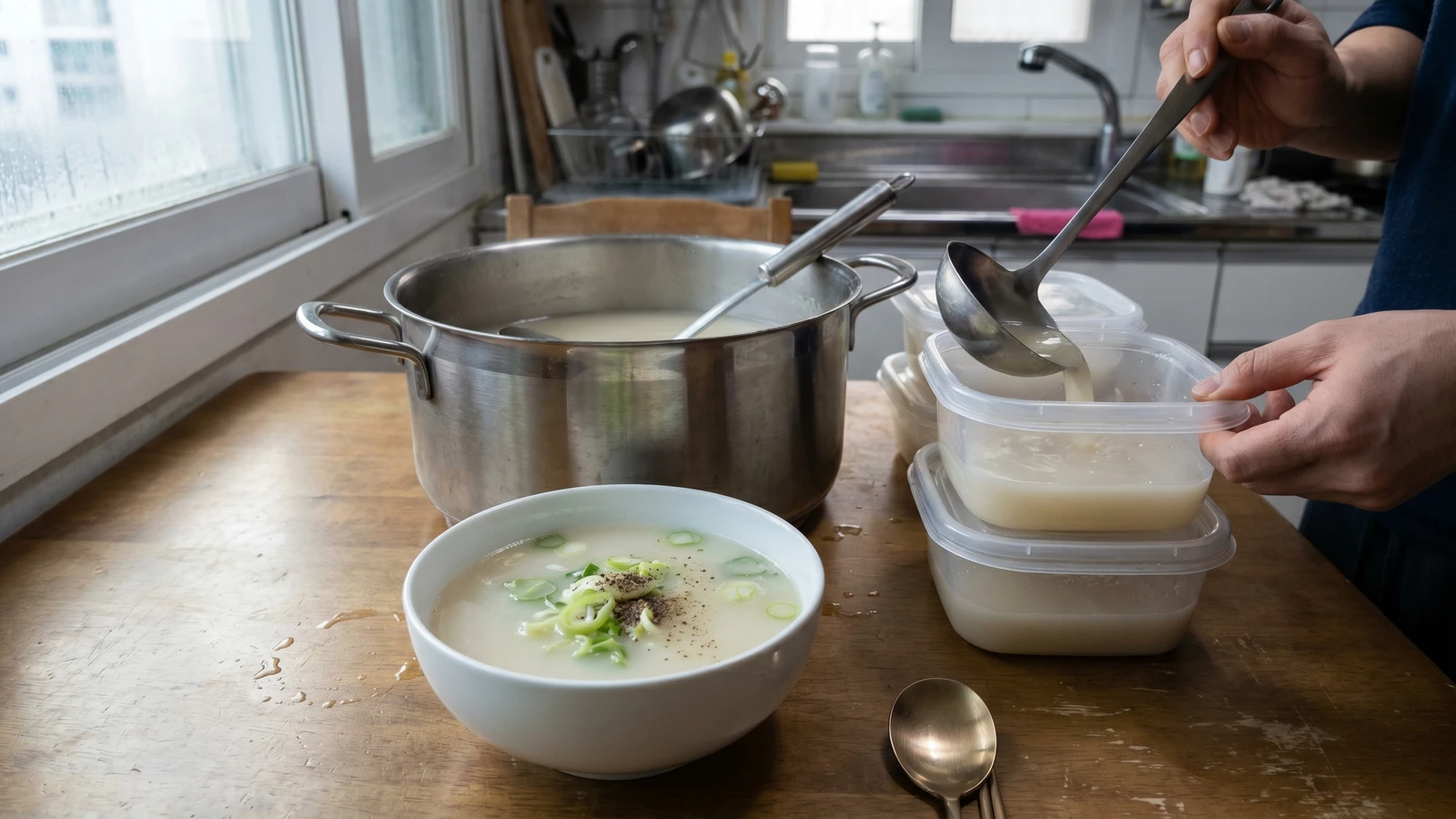
A milk-white Korean beef bone broth built from blanched leg and knuckle bones, simmered long enough to become the quiet base for seolleongtang, tteokguk, mandu-guk, and winter soups.
Sagol yuksu lives or dies before the real cooking begins. If you skip the soaking, blanching, and washing, you can boil the bones all day and still get a broth that tastes dirty. My teacher made us pour off the first gray water without discussion. Only then did the broth begin.
This is not a quick stock. It asks for a long day at home, or two shorter days if that is the schedule your life allows. 시대가 바뀌면 음식도 바뀌어야 해요. When times change, food must change too, so use a large stockpot, an electric pressure cooker for the first extraction, or chill it overnight between boils. But do not skip the first boil and rinse. That is the line.
Good sagol yuksu should be pale and opaque, with body on the spoon but no heavy seasoning. Salt belongs later, in the bowl of seolleongtang or tteokguk, because this broth has work to do under many dishes. Write the yield down. Memory is a borrowed bowl, and a freezer full of measured broth is how a Korean kitchen feeds people on the days nobody has time.
Sagol yuksu is the bone broth base behind seolleongtang, a Seoul soup closely associated with the neighborhood of Seonnongdan and with restaurants that popularized long-boiled ox bone soup in the twentieth century. The milk-white color comes from extended boiling that emulsifies fat and extracts collagen and minerals from leg and joint bones, a practical market and home method rather than a court dish. It also became a make-ahead household broth for tteokguk at Seollal, mandu-guk, and plain rice soups when a family needed depth without starting from raw bones each time.
Quantity
2.5 kg
cut crosswise if possible
Quantity
1 kg
Quantity
6 liters, plus more as needed
Quantity
7 liters
Quantity
4 liters, as needed
Quantity
1 large, about 450g
peeled and cut into 3 large chunks
Quantity
1 medium
halved
Quantity
6
thinly sliced, for serving if making soup
Quantity
to season at serving
Quantity
to season at serving
| Ingredient | Quantity |
|---|---|
| beef leg bones (sagol)cut crosswise if possible | 2.5 kg |
| beef knuckle or joint bones (dogani or mixed beef bones) | 1 kg |
| cold water for soaking | 6 liters, plus more as needed |
| cold water for the first long simmer | 7 liters |
| boiling water for replenishing | 4 liters, as needed |
| Korean radish or daikon (optional)peeled and cut into 3 large chunks | 1 large, about 450g |
| onion (optional)halved | 1 medium |
| scallions (optional)thinly sliced, for serving if making soup | 6 |
| fine sea salt (optional) | to season at serving |
| freshly ground black pepper (optional) | to season at serving |
Put the bones in your largest pot or a deep bowl and cover with at least 6 liters cold water. Soak 4 to 6 hours, changing the water every 1 to 2 hours, until the water stays much clearer. This pulls out blood that would cloud the broth in the wrong way and give it a stale taste.
Drain the soaked bones, return them to the pot, and cover with fresh cold water by 5 cm. Bring to a hard boil and boil 10 minutes. The water will turn gray and rough. Pour all of it away. That first water is not broth; it is cleaning.
Rinse each bone under running water, rubbing away clotted bits and dark residue with your fingers or a small brush. Wash the pot too. This is the step people rush, and then they wonder why the broth smells heavy. Clean bones and a clean pot give you a clean white yuksu.
Return the cleaned bones to the clean pot and add 7 liters cold water. Bring to a boil over high heat, then lower just enough to keep a steady, active boil. For sagol yuksu, too gentle a simmer gives a thin, clear stock; the movement in the pot helps turn the broth milk-white.
Boil uncovered for 3 hours, skimming foam and gray scum from the surface during the first hour. Add boiling water whenever the bones are close to peeking above the liquid. Use boiling water, not cold, so the pot keeps its rhythm.
Keep boiling 5 to 7 more hours, for 8 to 10 hours total, until the broth is opaque ivory and lightly sticky on your lips. If using radish and onion, add them only for the final 90 minutes, then remove them. They sweeten the broth, but if they cook all day they make it tired.
Lift out the bones and strain the broth through a fine strainer into clean containers. Do not season it now. This is a mother broth, and it may become seolleongtang, tteokguk, mandu-guk, or porridge. Salt it only when you know where it is going.
For a fuller batch, return the bones to the pot, add 5 liters fresh water, and boil 4 to 5 more hours. Strain and combine this second extraction with the first. Restaurants often do several extractions; at home, two is usually the honest balance between flavor and the gas bill.
Cool the broth quickly: set the containers in an ice bath, stir now and then, and refrigerate once the broth is no longer hot. Chill overnight, then lift off the solid fat cap if you want a cleaner broth. Refrigerate up to 4 days or freeze in 2-cup and 4-cup portions for up to 3 months.
1 serving (about 240g)
Culinary guides, cultural storytelling, and the editorial depth that makes cooking meaningful.
Discover Culinary ExplorerChef Jeong-sun
Tender baby napa cabbage in a clear pear-garlic brine, lightly fermented until the broth turns clean and bright, the summer kimchi a beginner can make without a kimjang floor.

Chef Jeong-sun
The kimchi from before chili, salted napa cabbage packed with radish, pear, jujube, and pine nuts in a clear brine that turns quietly tart in the jar.

Chef Jeong-sun
A pale summer cucumber kimchi, split and stuffed with radish and chives, then held in a cool pear brine so the cucumber stays clean, crunchy, and plainly itself.

Chef Jeong-sun
Flat spring bomdong cabbage, lightly brined and tucked into a clear pear-radish kimchi broth, made without chili and eaten young while the leaves still taste like spring.