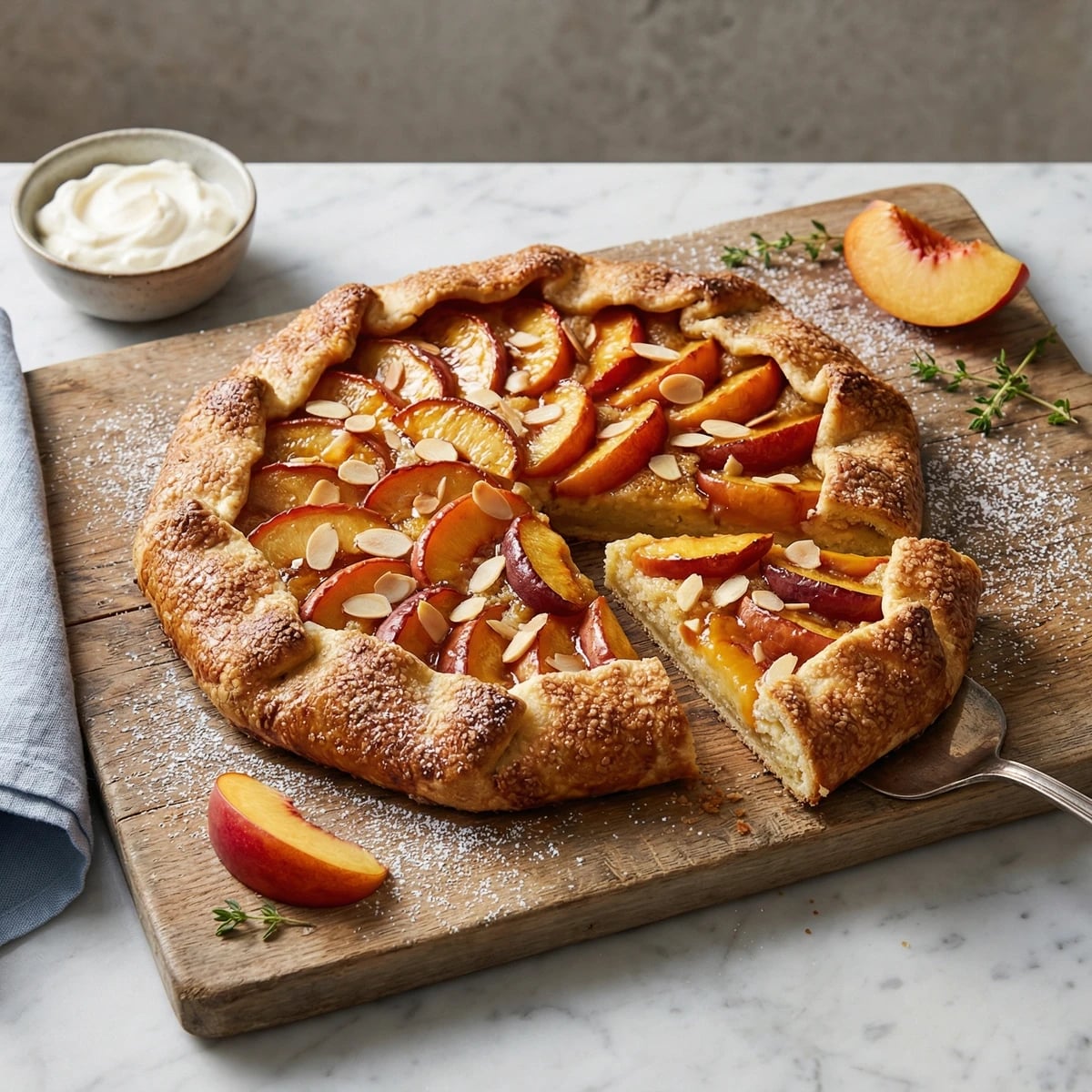
A forgiving free-form tart where golden butter pastry cradles ripe nectarines and silky almond cream, proving that imperfect edges and caramelized fruit make the most honest summer dessert.
Pastries & Cookies
French
Outdoor Dining
45 min
Active Time
50 min cook•2 hr 30 min total
Yield8 servings
The galette is the great equalizer of the pastry world. While its cousin the tart demands precision, straight sides, and the anxiety of unmolding, the galette asks only that you fold dough over fruit and slide it into a hot oven. Every crack and uneven edge becomes a feature, not a flaw. This is dessert for people who cook, not for people who fuss.
Frangipane changes everything. That layer of almond cream beneath the fruit serves three purposes: it creates a moisture barrier so your crust stays crisp, it adds richness that balances the bright acidity of summer nectarines, and it transforms what could be a simple fruit tart into something that makes guests ask for your recipe. The technique comes from French bistro kitchens, but it belongs on every American porch and picnic table from July through September.
Seek out nectarines at their peak. They should yield slightly to pressure and smell like summer itself. White nectarines bring floral sweetness; yellow varieties offer more acidity and hold their shape better during baking. Either works beautifully. What matters is ripeness. A mediocre nectarine baked in perfect pastry will never match a perfect nectarine in mediocre pastry. Start with the fruit.
The technique, the tradition, and the story behind every dish.
cold unsalted buttercut into 1/2-inch cubes, for pastry
10 tablespoons (140g)
ice water
4-6 tablespoons
blanched almond flourfor frangipane
1/2 cup (55g)
granulated sugarfor frangipane
1/4 cup (50g)
unsalted buttersoftened, for frangipane
4 tablespoons
large eggfor frangipane
1
pure almond extract
1/2 teaspoon
fine sea saltfor frangipane
1/4 teaspoon
all-purpose flourfor frangipane
1 tablespoon
ripe nectarines
4 medium (about 1 1/2 pounds)
granulated sugarfor fruit
2 tablespoons
egg yolkbeaten with 1 tablespoon heavy cream for egg wash
1
heavy creamfor egg wash
1 tablespoon
turbinado sugar
2 tablespoons
sliced almonds
2 tablespoons
apricot jamfor glaze
3 tablespoons
warm waterfor glaze
1 tablespoon
Equipment Needed
•Large baking sheet (rimmed, at least 13x18 inches)
•Parchment paper
•Rolling pin
•Pastry brush
•Offset spatula
•Wire cooling rack
Instructions
1
Make the pastry dough
Whisk flour, sugar, and salt together in a large bowl. Add the cold butter cubes and toss to coat each piece with flour. Using your fingertips or a pastry blender, work the butter into the flour until you have a mixture of pea-sized and flattened pieces. Some butter should remain visible. This unevenness creates the flaky layers you want. Drizzle 4 tablespoons ice water over the mixture and stir with a fork until the dough begins to clump. Squeeze a handful: if it holds together, you have enough water. If it crumbles, add more water one tablespoon at a time.
Cold butter is essential. If your kitchen runs warm, freeze the butter cubes for 10 minutes before starting.
2
Form and chill the dough
Turn the shaggy dough onto a lightly floured surface and gather it into a rough pile. Using the heel of your hand, smear the dough away from you in quick strokes to create long butter streaks. This French technique, called fraisage, builds flakiness without overworking the gluten. Gather the dough, shape it into a disk about one inch thick, wrap tightly in plastic, and refrigerate for at least one hour or overnight. The dough needs this rest to hydrate evenly and to firm the butter.
3
Prepare the frangipane
In a medium bowl, beat the softened butter and sugar together until light and fluffy, about 2 minutes with a wooden spoon or 1 minute with an electric mixer. Add the egg and beat until combined. The mixture may look slightly curdled; this is normal. Stir in the almond flour, almond extract, salt, and tablespoon of flour until smooth. The frangipane should be spreadable but hold its shape. Cover and refrigerate until ready to use.
Frangipane can be made up to 3 days ahead. Let it soften at room temperature for 15 minutes before spreading.
4
Slice the nectarines
Halve the nectarines through the stem end and twist to separate. Remove the pits. Cut each half into slices about 1/4-inch thick. Place the slices in a bowl and toss gently with the 2 tablespoons sugar. Let them macerate while you roll the dough. The sugar draws out moisture and intensifies the fruit flavor. You'll see the slices turn glossy and a small pool of juice collect at the bottom of the bowl.
5
Roll out the dough
Line a large baking sheet with parchment paper. On a lightly floured surface, roll the chilled dough into a rough circle about 14 inches across and 1/8-inch thick. Don't aim for perfection. Rotate the dough a quarter turn after each roll to prevent sticking, and add flour beneath as needed. The edges should look ragged and organic. Transfer the dough to the prepared baking sheet. If it tears slightly during the move, press it back together with your fingers. Refrigerate for 15 minutes to firm up.
6
Assemble the galette
Spread the frangipane evenly over the center of the dough, leaving a 2-inch border uncovered all around. Use an offset spatula or the back of a spoon. Arrange the nectarine slices over the frangipane in concentric circles, overlapping them slightly. Start from the outside and work toward the center. Leave any accumulated juices behind in the bowl; too much liquid will make the bottom soggy. Fold the exposed dough border up and over the edge of the fruit, pleating as you go. The pleats should overlap slightly to seal. Press gently to secure.
Work quickly during assembly. Warm dough makes sloppy folds. If the pastry softens, slide the whole sheet into the refrigerator for 10 minutes before continuing.
7
Apply egg wash and toppings
Brush the folded pastry border generously with the egg yolk and cream mixture. This creates the deep golden color and slight sheen that signals proper baking. Sprinkle the turbinado sugar over the egg-washed crust; the coarse crystals catch light and add crunch. Scatter the sliced almonds over the exposed frangipane and fruit. Refrigerate the assembled galette for 20 minutes while you preheat the oven. This final chill firms the butter and helps the pastry hold its shape during baking.
8
Bake until golden
Position a rack in the lower third of the oven and preheat to 400°F. Bake the galette for 45 to 50 minutes, rotating the sheet halfway through. The crust should turn deep golden brown, darker than you might expect. The frangipane will puff slightly around the fruit, and the nectarines will take on caramelized edges where they meet the heat. If the crust browns too quickly before the center sets, tent loosely with foil. The galette is done when the bottom crust sounds hollow if you lift an edge with a spatula and tap it.
9
Glaze and cool
While the galette is still warm, stir together the apricot jam and warm water until smooth. If the jam has large chunks, press it through a fine-mesh strainer. Brush this glaze over the fruit and any exposed frangipane. The glaze adds shine, seals in moisture, and brings a subtle sweetness that ties everything together. Let the galette cool on the baking sheet for at least 20 minutes before slicing. The frangipane needs time to set; cutting too soon leaves you with a molten mess rather than clean slices.
10
Serve
Slide the galette onto a cutting board or serving platter. Cut into wedges with a sharp knife. Serve warm or at room temperature. A galette like this needs no accompaniment, but a spoonful of cold crème fraîche or a small scoop of vanilla ice cream wouldn't be unwelcome. The contrast of cool cream against warm fruit and buttery crust is pure summer.
Chef Tips
•Select nectarines that yield to gentle pressure near the stem but aren't mushy. Slightly firm fruit holds its shape better during baking; overly ripe nectarines dissolve into jam. Smell the fruit: if it doesn't smell like anything, it won't taste like much either.
•This same pastry and technique work beautifully with peaches, plums, apricots, or a combination. Adjust sugar to the tartness of your fruit. Plums need a heavier hand; apricots less so.
•For deeper almond flavor, toast the sliced almonds in a dry skillet until golden before scattering them on the galette. Watch carefully; they burn quickly.
•Turbinado sugar, sold as Sugar in the Raw, provides the best crunch. Regular granulated sugar melts into the crust rather than staying crisp. Demerara works equally well.
•Store leftover galette loosely covered at room temperature for up to 2 days. The crust softens but remains delicious. Reheat slices on a sheet pan in a 350°F oven for 8 minutes to revive the texture.
Advance Preparation
•Pastry dough can be made up to 3 days ahead and refrigerated, or frozen for up to 1 month. Thaw overnight in the refrigerator before rolling.
•Frangipane keeps refrigerated for up to 3 days. Bring to spreadable consistency before using.
•The galette can be assembled, covered tightly, and refrigerated unbaked for up to 8 hours. Add 5 minutes to the baking time if starting from cold.
•Baked galette is best the day it's made but holds well at room temperature for up to 2 days.
Frequently Asked Questions
Nutrition Information
1 serving (about 205g)
Calories
431 calories
Total Fat
26 g
Saturated Fat
11 g
Trans Fat
0 g
Unsaturated Fat
16 g
Cholesterol
52 mg
Sodium
225 mg
Total Carbohydrates
43 g
Dietary Fiber
3 g
Sugars
27 g
Protein
6.5 g
Where cooking meets culture.
Culinary guides, cultural storytelling, and the editorial depth that makes cooking meaningful.