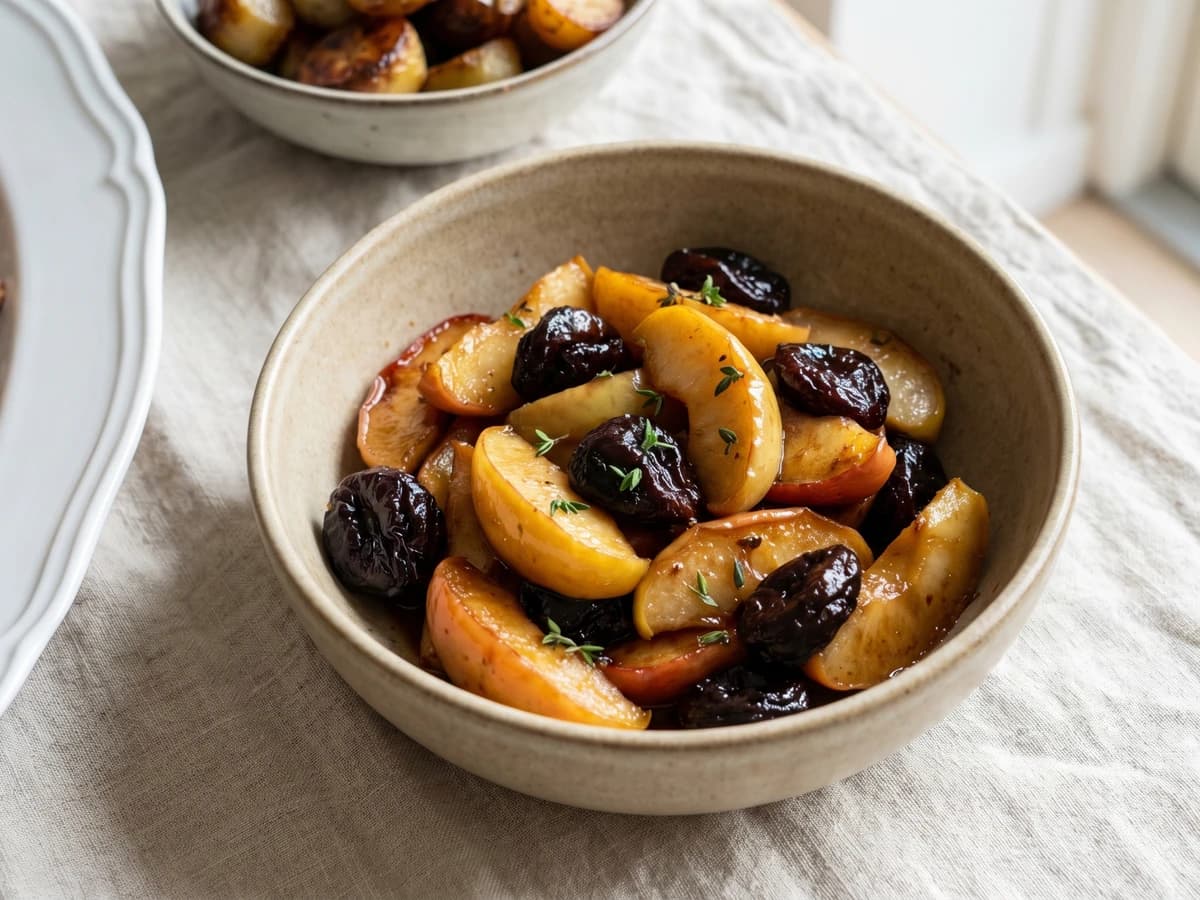
Danish rye bread stuffing with butter-softened apples, quartered prunes, and thyme, made for the Christmas goose and the dark, sweet richness that belongs to a Danish December table.
Side Dishes
Danish
Christmas
Holiday
Thanksgiving
25 min
Active Time
20 min cook•45 min total
YieldEnough to stuff one large duck or goose, or 6 side servings
December in Denmark starts in the kitchen. Not with the tree, not with the candles, but with the slow work of preparing things that take time. The brine for the flaesk. The red cabbage that simmers for hours. And the stuffing, rugbrodsfyld, which is where the leftover heel of last week's rugbrod meets this week's celebration.
This is not white bread stuffing. It's darker, denser, built on crumbled rye bread that has already done its job on the breakfast table and now gets a second life inside the Christmas goose. The rye gives the stuffing a mineral depth that white bread can't, a nuttiness that pairs with roasted fat the way only dark grain does. The apples bring tartness. The prunes bring sweetness and a dark, sticky richness. Together they absorb the juices of the roasting bird and turn into something that people remember from one December to the next.
I want you to pay attention to two things. First, crumble the rye by hand. The uneven pieces are what give the stuffing its texture, some crisp, some soft, every bite a little different. Second, don't pack the stuffing tight. It swells as it cooks, and it needs room to breathe. Give it that room and you'll pull the bird from the oven to find a stuffing that's dark and fragrant and loose enough to spoon, not slice. You'll know when it's right.
Stuffing a roasted bird with fruit and bread is a tradition that reaches back to medieval Danish kitchens, where dried prunes and apples were among the few fruits available through the winter months. The use of rugbrod as the stuffing base, rather than wheat bread, became common in households where rye bread was the daily staple and waste was unthinkable. By the 19th century, rugbrodsfyld med aebler og svesker had become inseparable from the juleaften goose in most Danish homes, particularly in Jutland, where the combination of dark rye, tart apples, and sweet prunes was seen as the natural counterpoint to the richness of a fat-rendered bird.
The technique, the tradition, and the story behind every dish.
dark rugbrodpreferably a day or two old, crumbled by hand
300g
unsalted butter
80g
onionfinely diced
1 large
firm, tart applespeeled, cored, cut into small dice
2
pitted prunes (svesker)quartered
150g
fresh thymestripped from the stems
1 tablespoon leaves
chicken or duck stock
150ml
fine sea salt
1 teaspoon
black pepper
freshly ground, to taste
apple cider vinegar
1 tablespoon
Equipment Needed
•Wide, heavy frying pan or skillet
•Large mixing bowl
•Baking dish, approximately 25cm by 18cm (if baking as a side)
Instructions
1
Crumble the rugbrod
Break the rugbrod into rough crumbs with your hands. You want uneven pieces, some the size of a hazelnut, some finer. The texture of the finished stuffing depends on this range. If you process it all to uniform crumbs you'll end up with something dense and paste-like, and that's not what you're after. Day-old rye is easier to crumble and absorbs the butter and stock more evenly than fresh. If yours is fresh, spread the crumbs on a baking sheet and let them dry in a low oven at 100C for fifteen minutes.
Don't use a food processor. Your hands know what the right texture looks like. Irregular crumbs give the stuffing its character: some pieces go crisp, some stay soft, and that contrast is the whole point.
2
Cook the onion in butter
Melt the butter in a wide, heavy pan over medium heat. Let it foam, then settle. When the foam calms and the butter begins to smell warm and nutty, add the diced onion and a pinch of salt. Stir it through the butter, lower the heat, and cook gently for eight to ten minutes. You want the onion completely soft and translucent, with just the faintest gold at the edges. The salt draws out the moisture and keeps the onion from browning too fast. If it starts to color before it's soft, add a splash of water and drop the heat.
The butter wants to go a shade past golden here, just enough that it smells of hazelnuts. That nutty depth is the foundation of the stuffing's flavor. Don't let it go dark brown.
3
Add the apples and prunes
Add the diced apple to the pan and stir through the buttery onion. Cook for two to three minutes until the edges of the apple soften slightly but the pieces still hold their shape. You want some bite left. The apple will continue to cook inside the bird, and if it's already soft now, it will dissolve to nothing. Then add the quartered prunes and the thyme leaves and stir everything together for another minute. The kitchen should smell like December.
4
Combine with the rugbrod
Take the pan off the heat. Add the rugbrod crumbs and toss them through the fruit and onion mixture with your hands or a large spoon. Pour the stock over the top in a slow, steady stream, tossing as you go, so the liquid is absorbed evenly. The crumbs should be moistened but not wet. You're looking for a stuffing that holds together loosely when you press a handful in your palm, but crumbles apart when you open your fingers. Add the apple cider vinegar and season with salt and black pepper. Taste it. The vinegar is there to cut through the richness of the butter and the sweetness of the prunes. If you can't quite taste it, that's right. If you can't taste it at all, add a few drops more.
If the mixture feels too dry, add a tablespoon of stock at a time. If it feels too wet, add a handful of extra rugbrod crumbs. You're the one who can feel it; trust your hands.
5
Use or bake the stuffing
If you're stuffing a duck or goose, let the mixture cool completely before spooning it loosely into the cavity. Don't pack it tight. The stuffing swells as it absorbs the juices from the roasting bird, and if it's compressed, it turns to a solid block instead of staying loose and layered. If you're serving it as a side dish, spread it in a buttered baking dish, dot the surface with a few small pieces of extra butter, and bake at 180C for twenty to twenty-five minutes until the top is crisp and the center is warmed through. The edges should be dark and crunchy. The middle should be soft and fragrant with fruit.
When roasted inside the bird, the stuffing catches the fat and juices as they render. That's the entire reason to stuff a goose: what happens to the filling is as important as what happens to the meat.
Chef Tips
•The rugbrod you use matters. A dense, dark rye with seeds and cracked grain gives the stuffing its character. Light rye or soft sandwich rye won't hold up. If you bake your own rugbrod, use the end pieces you've been saving in the freezer. They're perfect for this.
•Ingrid Marie apples are the classic Danish choice: firm, tart, and slightly floral. If you can't find them, Granny Smith works well. Avoid anything sweet or mealy. The apple needs to hold its shape and push back against the sweetness of the prunes.
•If you have duck or goose drippings from a previous roast, use a tablespoon in place of some of the butter when you cook the onion. It deepens the flavor and connects the stuffing to the bird before they've even met.
•This stuffing is cooked with love, not with force. Every step is gentle: soft heat, loose packing, patience. The bird and the oven do the final work.
Advance Preparation
•The stuffing can be made up to a day ahead. Cool completely, cover, and refrigerate. Bring it back to room temperature before stuffing the bird or baking as a side. Cold stuffing inside a cold bird slows the roasting and throws off the timing.
•If you crumble the rugbrod a day or two before, spread the crumbs on a tray and leave them uncovered at room temperature. They'll dry naturally and absorb the stock and juices more evenly.
Frequently Asked Questions
Nutrition Information
1 serving (about 160g)
Calories
300 calories
Total Fat
12 g
Saturated Fat
7 g
Trans Fat
0 g
Unsaturated Fat
4 g
Cholesterol
30 mg
Sodium
655 mg
Total Carbohydrates
45 g
Dietary Fiber
7 g
Sugars
16 g
Protein
5 g
Where cooking meets culture.
Culinary guides, cultural storytelling, and the editorial depth that makes cooking meaningful.