
Chef Lupita
Almendrados Conventuales Poblanos
Puebla's convent almond cookies, made from blanched almonds, sugar syrup, egg yolks, canela, and patient hands, the kind of sweet that belongs beside coffee in talavera, not in a plastic bakery box.
A cooking platform built around craft, culture, and the stories behind what we eat.
Created by
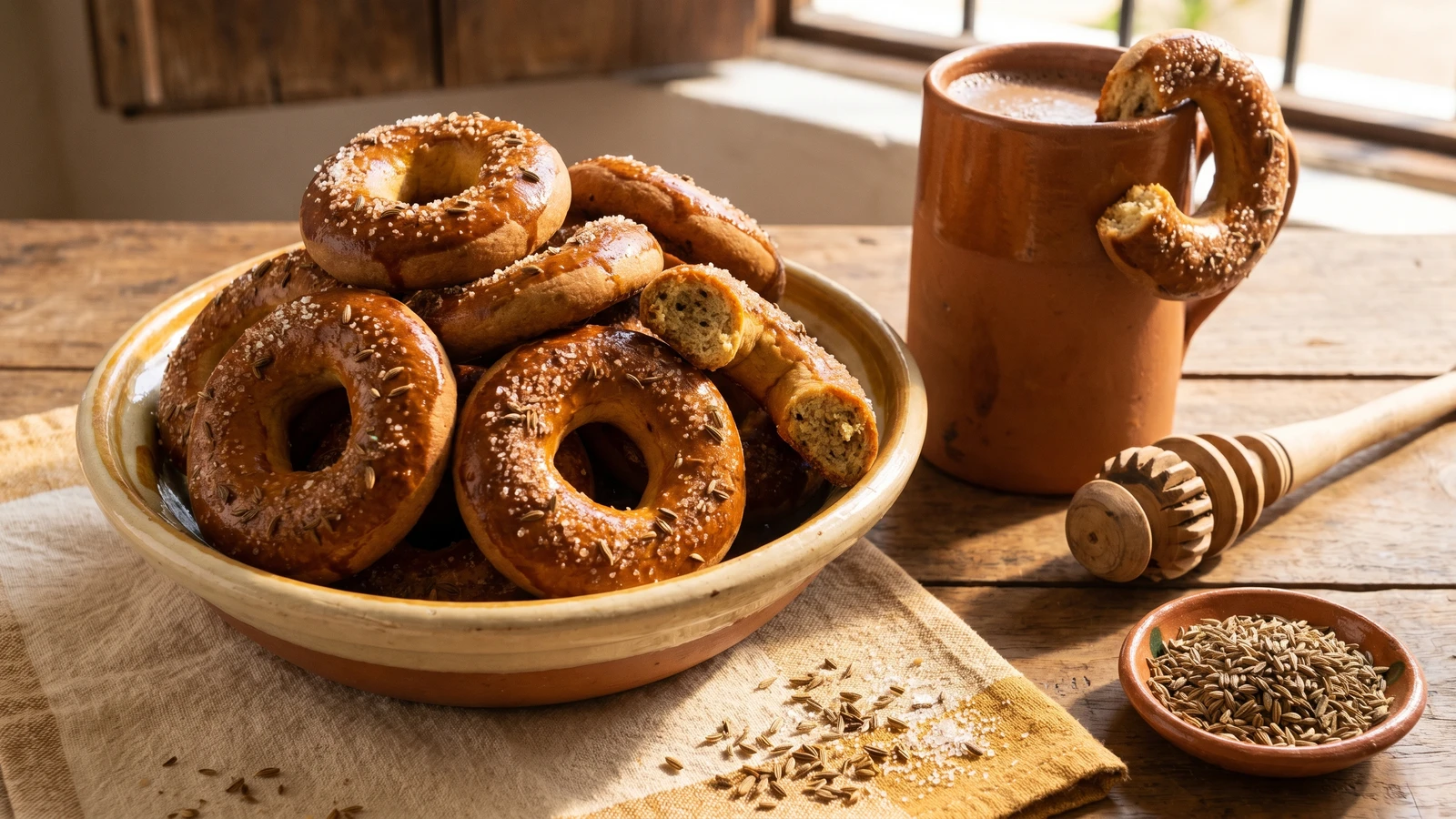
Yucatán's hard anise rings, kneaded with whole toasted anise seed and lard, baked dry on purpose so they can survive the long dip into a clay jarro of hot chocolate.
Rosquillas de anís belong to Yucatán. You find them in the panaderías of Mérida, Valladolid, and Izamal, stacked in baskets near the front counter, sold by the dozen wrapped in butcher paper. They are not a dessert in the way an American cookie is a dessert. They are an accompaniment, a partner to a clay jarro of hot chocolate in the morning or a cup of café de olla in the late afternoon.
The whole anise seed kneaded into the dough is what makes this a Yucatecan rosquilla and not a generic ring cookie. Not ground anise. Whole. You feel the seeds between your teeth, you taste them when they crack open against the hot chocolate. Yucatán has a long history of trade with the Caribbean and with the Levant by way of Spain, and anise arrived on those routes centuries ago and stayed. The peninsula folded it into its baking the way it folded in recado rojo into its meats and habanero into everything else.
These rosquillas are built to be hard. That is the design, not a flaw. A soft cookie dissolves into hot chocolate within seconds. A rosquilla yucateca survives the dunk, softens at the surface, and gives you a bite that is half crisp anise dough and half chocolate-soaked sweetness. The lard is what makes this possible. La manteca es el sabor and it is also what gives the dough its clean break. Do not substitute butter. The texture is wrong. Do not substitute vegetable shortening. The flavor is flat. Saber cocinar es saber vivir, and knowing which fat does what is part of that knowing.
Anise (Pimpinella anisum) is not native to the Americas. It arrived in Mexico through Spanish colonial trade in the 16th century and took root particularly in Yucatán's baking tradition, where the peninsula's geographic isolation from central Mexico, combined with its Caribbean and Gulf trade routes, produced a regional pastry repertoire distinct from the rest of the country. Rosquillas as a form trace to medieval Spanish ring breads and cookies, with the Yucatecan version adapting the technique to use locally rendered pork lard and the whole-seed anise method that defines the regional style. Yucatán's panadería tradition remains one of the most documented in Mexico, with pieces like the rosquilla, the mestiza, and the pan de manteca forming a daily bread vocabulary that has changed remarkably little since the 19th century.
Quantity
4 cups, plus more for dusting
Quantity
1 cup
Quantity
2 teaspoons
Quantity
1/2 teaspoon
Quantity
2 tablespoons
Quantity
3/4 cup
at room temperature
Quantity
2
Quantity
2
Quantity
1/2 cup
at room temperature
Quantity
1 teaspoon
Quantity
1 tablespoon
finely grated
Quantity
1 large egg beaten with 1 tablespoon milk
Quantity
2 tablespoons
Quantity
1 teaspoon
| Ingredient | Quantity |
|---|---|
| all-purpose flour | 4 cups, plus more for dusting |
| granulated sugar | 1 cup |
| baking powder | 2 teaspoons |
| fine sea salt | 1/2 teaspoon |
| whole anise seed | 2 tablespoons |
| manteca de cerdo (pork lard)at room temperature | 3/4 cup |
| large eggs | 2 |
| large egg yolks | 2 |
| whole milkat room temperature | 1/2 cup |
| vanilla extract | 1 teaspoon |
| orange zestfinely grated | 1 tablespoon |
| egg wash | 1 large egg beaten with 1 tablespoon milk |
| granulated sugar, for finishing | 2 tablespoons |
| whole anise seed, for finishing | 1 teaspoon |
Place the two tablespoons of whole anise seed in a dry skillet over medium-low heat. Toast for two to three minutes, shaking the pan, until the seeds smell sweet and licorice-warm and just a shade darker. Pull them off the heat immediately. Burned anise turns bitter and ruins the whole batch. Let them cool on a plate. The seeds go into the dough whole. Do not grind them. The whole seed is the point of a rosquilla yucateca. You feel them between your teeth when you bite, you taste them when they crack against the hot chocolate.
In a large bowl, whisk together the flour, sugar, baking powder, salt, and the toasted anise seed. Make sure the anise gets distributed throughout the flour, not clumped in one spot. The seeds are the signature. Every rosquilla should have them.
Add the room-temperature lard to the dry mixture. Work it in with your fingertips, pressing and rubbing until the flour looks like coarse damp sand. No big chunks of lard remaining. La manteca es el sabor and it is also the structure. Lard is what makes a rosquilla yucateca hard but not tough, with that clean snap when you break it. Butter will not give you the same texture. Vegetable shortening will not give you the same flavor. Use the lard.
Beat the whole eggs and egg yolks together with the milk, vanilla, and orange zest. Pour into the flour mixture. Mix with a wooden spoon until a shaggy dough forms, then turn it out onto a lightly floured counter and knead for three to four minutes. The dough should be firm, smooth, and just barely tacky. If it sticks to your hands, sprinkle a little more flour. If it cracks, a teaspoon more milk. You are looking for a dough that feels like cool clay, not like bread dough.
Wrap the dough in plastic and let it rest at room temperature for 20 minutes. This step is not optional. Resting lets the flour fully hydrate and the anise oils start to perfume the dough. No me vengas con atajos. Skip the rest and you fight the dough when you shape it.
Heat the oven to 350F. Line two heavy baking sheets with parchment. Yucatán's home cooks bake these in wood-fired ovens that hold steady heat for hours, and you want a steady moderate oven, not a hot one. Too hot and the outside hardens before the inside dries. The rosquilla needs to dry through, not just brown.
Pinch off pieces of dough about the size of a small lime, roughly one ounce each. Roll each piece between your palms into a rope about six inches long and as thick as your index finger. Bring the ends together and press to seal, forming a ring the size of a small saucer. Place on the lined baking sheets, leaving an inch between each ring. They do not spread much. The shape matters because the ring is built to dunk: you hold the bottom curve, you sink the top curve into the chocolate.
Brush each ring with the egg wash. Mix the finishing sugar with the teaspoon of whole anise seed and sprinkle lightly over the tops. The egg wash gives them that mahogany gloss the Yucatecan panaderías are known for. The extra anise on top makes the perfume hit you before the first bite.
Bake for 25 to 30 minutes, rotating the pans halfway through. The rosquillas are ready when they are deep golden on top, firm to the touch, and feel light when you lift one. If you tap one and it sounds hollow, it is done. If it still feels heavy or soft in the middle, give them another five minutes. They should be hard, not chewy. Hard is the point. A soft rosquilla turns to mush the second it touches hot chocolate.
Transfer the rosquillas to a wire rack and let them cool completely, at least one hour. They harden further as they cool. Do not store them warm. Warm storage traps moisture and softens them, and a soft rosquilla yucateca is a failed rosquilla yucateca. Once fully cool, they keep in an airtight tin for two to three weeks. Así se hace y punto.
1 serving (about 40g)
Culinary guides, cultural storytelling, and the editorial depth that makes cooking meaningful.
Discover Culinary ExplorerChef Lupita
Puebla's convent almond cookies, made from blanched almonds, sugar syrup, egg yolks, canela, and patient hands, the kind of sweet that belongs beside coffee in talavera, not in a plastic bakery box.

Chef Lupita
Ciudad de Mexico's panaderia banderillas are long sticks of hojaldre pressed with sugar, baked until amber, and finished with a hard glaze for coffee at the kitchen table.

Chef Lupita
Mérida's pale egg-yolk-and-vanilla kisses, tiny cookies built on eight yolks and a perfume of orange blossom, sandwiched with guava paste and dusted heavy with powdered sugar.

Chef Lupita
Hidalgo's bisquet de nata carries Pachuca's mining history into the breakfast table: a Cornish-style bread softened by Mexican nata, split warm and eaten with café de olla.