
Chef Klaus
Badische Dinnele
The Baden flatbread that keeps its bread body: sour cream, onion, and Speck on a yeast dough baked hard and hot until the edges blister.
A cooking platform built around craft, culture, and the stories behind what we eat.
Created by
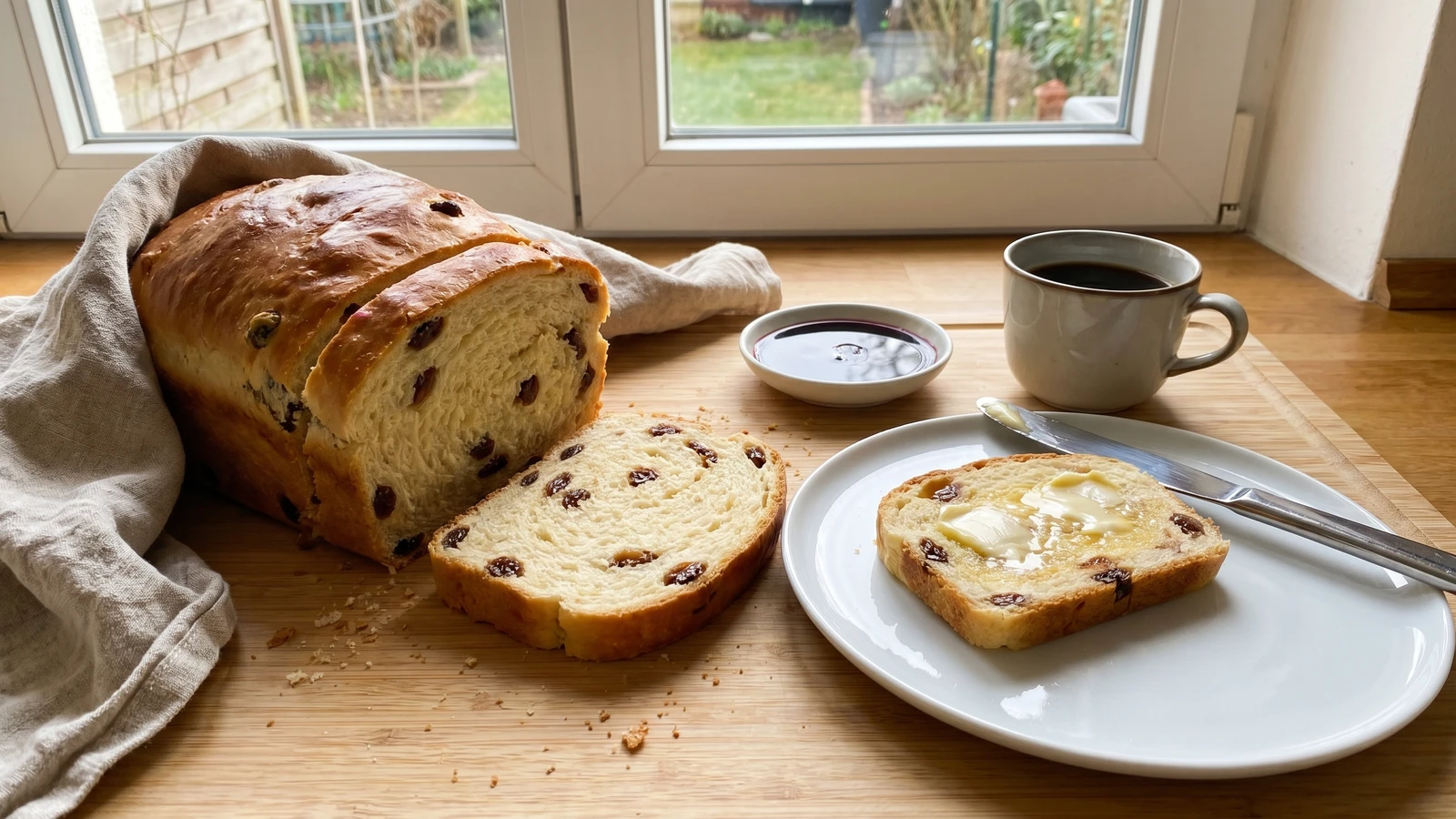
A raisin milk-loaf from the northern and western bread table: soft enough for breakfast, sturdy enough for Sunday coffee, and decided by one plain thing, soaking the raisins first.
Rosinenstuten belongs to the north and west, especially Westphalia, the Lower Rhine, and Lower Saxony, where Stuten means a soft white or milk loaf before it means anything fancy. It sits on the breakfast table, the Sunday coffee table, and sometimes at Easter, sliced thick, buttered, and eaten without ceremony. This is bread for the board, not a cake hiding in a loaf tin.
Im Norden anders, im Süden anders. In the north and west I want the loaf baked in a tin, pale-crumbed and sliceable, with raisins through the dough and a little sweetness, not a pastry. Farther south, the same family of dough often becomes Hefezopf, a braided yeast loaf, richer with egg and sometimes almonds. Both have their place. Today we're making Stuten.
The rule that decides it is simple: soak the raisins first. Dry raisins steal water from the dough while it bakes, so the crumb goes tight and the fruit turns leathery at the edge. Plump raisins give the water back slowly and stay soft in the slice. Add them after the dough is already smooth, because raisins worked in too early tear the gluten and leave you with a loaf that rises like it has lost interest.
Use good milk, real butter, and enough time for the dough to rise gently. Das braucht seine Zeit. A rushed enriched dough tastes of yeast and impatience, and nobody asked for that at breakfast.
Stuten is an old north and west German bread name for a fine white or milk loaf, common in Westphalia, Lower Saxony, and the Rhineland long before white wheat bread became everyday food. Raisins entered these breads through trade rather than local farming; by the nineteenth century, cheaper imported dried fruit made Rosinenstuten a household loaf for Sundays and feast days instead of only a baker's luxury. The regional split remains clear: north and west bake Stuten as a tin loaf, while southern German kitchens more often braid a related enriched dough as Hefezopf or Rosinenzopf.
Quantity
150g
Quantity
100ml
for soaking
Quantity
500g
plus more for dusting
Quantity
7g instant / 21g fresh
Quantity
60g
Quantity
250ml
lukewarm
Quantity
1
room temperature
Quantity
75g
softened
Quantity
8g
Quantity
1 tablespoon
for the tin
Quantity
1 tablespoon
for brushing
| Ingredient | Quantity |
|---|---|
| raisins | 150g |
| warm water or warm milkfor soaking | 100ml |
| strong white bread flourplus more for dusting | 500g |
| instant yeast or fresh yeast | 7g instant / 21g fresh |
| sugar | 60g |
| whole milklukewarm | 250ml |
| large eggroom temperature | 1 |
| unsalted buttersoftened | 75g |
| fine salt | 8g |
| neutral oil or melted butterfor the tin | 1 tablespoon |
| milkfor brushing | 1 tablespoon |
Put the raisins in a small bowl and cover them with the warm water or warm milk for 20 minutes. They should swell and soften, not swim forever. Drain them well and pat them dry, because soaked fruit belongs inside the dough, but loose soaking liquid makes streaks and heavy pockets.
Mix the flour, yeast, and sugar in a large bowl, then add the lukewarm milk and egg. The milk should feel warm to your finger, not hot, because heat wakes yeast but heat too high kills it before the loaf has begun. Work the mixture into a rough dough.
Knead for 5 minutes, then add the softened butter in pieces with the salt and knead another 8 to 10 minutes, until the dough is smooth, elastic, and slightly tacky. Butter goes in after the flour has taken up the milk, because fat coats flour and slows gluten if you dump it in too soon.
Spread the dough slightly, scatter over the drained raisins, and fold and knead just until they are evenly carried through. Don't punish the dough now. The gluten is already built, and the fruit only needs to be distributed; too much work crushes raisins and tears the dough.
Cover the bowl and leave the dough at room temperature until doubled, about 60 to 90 minutes. Enriched dough rises more slowly than lean bread because sugar, butter, and egg make the yeast work harder. Das braucht seine Zeit.
Grease a 23x13cm loaf tin. Tip the dough onto a lightly floured surface, press it gently into a rectangle, roll it up firmly from the short side, and pinch the seam closed. A tight roll gives the loaf a spine, so it rises upward in the tin instead of spreading flat.
Set the loaf seam-side down in the tin, cover it, and let it rise until it crowns just above the rim, about 45 to 60 minutes. Brush with milk and bake at 180C for 35 to 40 minutes, until deep golden on top and the loaf sounds hollow underneath. If the top browns too fast, cover it loosely with foil, because sugar colours before the crumb is fully baked.
Turn the loaf out and cool it on a rack for at least 1 hour before slicing. Cut hot Rosinenstuten and the soft crumb compresses under the knife; cooled bread slices cleanly and takes butter properly. Schön ist, was schmeckt.
1 serving (about 85g)
Culinary guides, cultural storytelling, and the editorial depth that makes cooking meaningful.
Discover Culinary ExplorerChef Klaus
The Baden flatbread that keeps its bread body: sour cream, onion, and Speck on a yeast dough baked hard and hot until the edges blister.

Chef Klaus
The farmhouse loaf that made sense of a weekly oven firing: rye for keeping, wheat for lift, sourdough for the crumb, and a dark crust that earns its crack.

Chef Klaus
The Bavarian pretzel lives by its lye bath: a pale dough goes in, a dark glossy Breze comes out, with thin arms, a proud belly, and salt that bites clean.

Chef Klaus
A Bavarian wheat-rye loaf for the Brotzeit board, mild from ripe sourdough, dark-crusted from a fierce first heat, and firm enough to carry cold cuts without sagging.