
Chef Lupita
Acambaritas de Acámbaro
Guanajuato's daily bread from Acámbaro, a small glazed roll built on pata, enriched with manteca de cerdo, and baked until the top shines lightly for merienda.
A cooking platform built around craft, culture, and the stories behind what we eat.
Created by
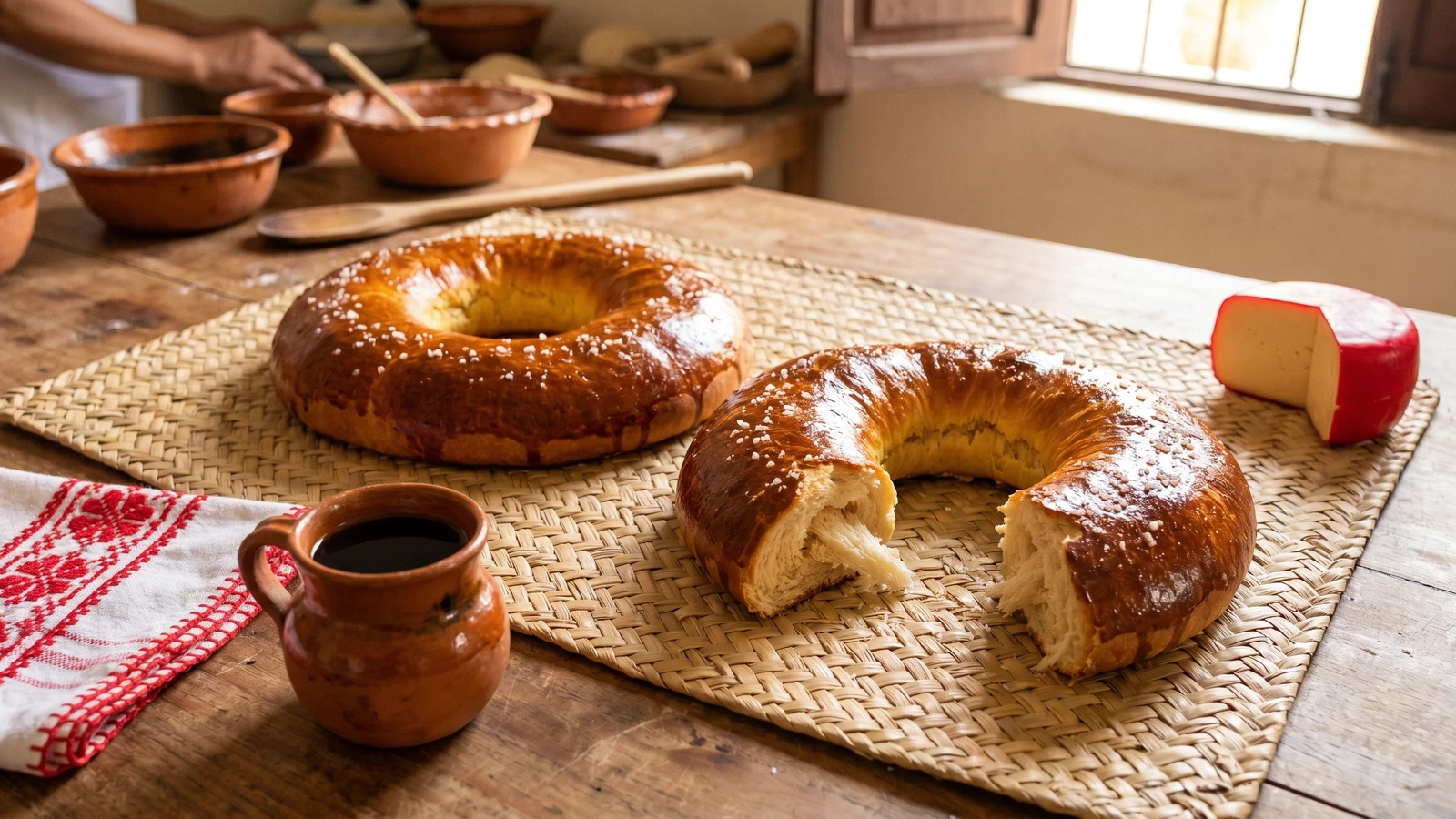
Yucatán's salted ring of yeasted dough, enriched with manteca and baked deep gold in the panaderías of Mérida. Torn open at the morning merienda with strong coffee and nothing else.
This is a pan from Yucatán. Specifically from Mérida, where the panaderías tradicionales bake the rosca salada before sunrise and the neighborhood walks over to buy it warm. It is not pan dulce. It is the opposite of pan dulce. The crust carries flaky salt and the crumb is enriched with manteca de cerdo, and that is the whole identity of the bread.
The Peninsula bakes its own way. The Yucatecan panadería tradition runs through francés, sevillanas, hojaldras, and the salty roscas that share the basket with them at the morning merienda. The fat is lard, not butter. The shape is a ring with a real hole in the middle, the kind you can hook three of them onto your arm walking home. The salt sits on top in flakes you can see. Don't substitute butter, don't skip the manteca, don't pretend Maldon belongs in a Yucatán panadería. La manteca es el sabor.
My mother's notebook has a page for rosca, copied from a panadero in Mérida my parents knew in the late seventies. The note in the margin says: la sal arriba, la manteca adentro. Salt on top, lard inside. That is the whole instruction. The rest is patience with the dough and respect for the humidity of the room. Cada estado, su propia cocina, and this one belongs to Yucatán.
The Yucatán panadería tradition reflects the Peninsula's long isolation from central Mexico, an isolation that lasted into the mid-20th century when the railroad and later the highway finally tied Mérida to the rest of the country. Local panaderos built their own catalog of breads drawn from Spanish, Lebanese, and Mayan kitchen traditions, with manteca de cerdo as the dominant fat long after butter took over in central Mexican baking. The rosca salada belongs to the daily merienda repertoire of Yucatecan households, eaten in the late morning or early evening with coffee or hot chocolate, a meal that has no real equivalent in central Mexican custom and that still anchors the rhythm of the Mérida day.
Quantity
500 grams (4 cups)
plus more for dusting
Quantity
10 grams (2 teaspoons)
Quantity
30 grams (2 tablespoons)
Quantity
7 grams (2 1/4 teaspoons)
Quantity
120 grams (1/2 cup)
at room temperature
Quantity
2
at room temperature
Quantity
240 milliliters (1 cup)
lukewarm
Quantity
1
for the egg wash
Quantity
1 tablespoon
Quantity
for finishing
| Ingredient | Quantity |
|---|---|
| all-purpose flourplus more for dusting | 500 grams (4 cups) |
| fine sea salt | 10 grams (2 teaspoons) |
| granulated sugar | 30 grams (2 tablespoons) |
| instant dry yeast | 7 grams (2 1/4 teaspoons) |
| manteca de cerdo (pork lard)at room temperature | 120 grams (1/2 cup) |
| large eggsat room temperature | 2 |
| whole milklukewarm | 240 milliliters (1 cup) |
| large egg yolkfor the egg wash | 1 |
| whole milk (for wash) | 1 tablespoon |
| flaky sea salt | for finishing |
Warm the milk until it feels like the inside of your wrist, no hotter. Hot milk kills yeast and gives you a brick. Stir the sugar and the yeast into the milk and leave it for ten minutes. You want a soft foam across the top. If nothing happens, your yeast is dead. Start over with new yeast. There is no fixing this later.
In a large bowl or the bowl of a stand mixer, combine the flour and the fine sea salt. Make a well in the center. Pour in the foamed milk, the two whole eggs, and the manteca de cerdo. Mix with a wooden spoon or the paddle attachment until a shaggy dough forms. The lard will look streaky at first. Keep going. It works itself in.
Switch to the dough hook and knead on medium for eight to ten minutes, or turn out onto a lightly floured counter and knead by hand for twelve. The dough should pull away from the bowl in a single mass and feel soft, springy, and slightly tacky. Not sticky. If it is sticky, add flour one tablespoon at a time. La manteca es el sabor and it is also what gives this dough its silky pull. Do not skimp.
Form the dough into a smooth ball, place it in a lightly greased bowl, and cover with a clean cotton servilleta. Let it rise in a warm spot until doubled, about an hour and a half. In a Yucatán kitchen this happens in an hour. In a cool kitchen up north, give it closer to two. The dough is ready when you press a fingertip in and the dent stays.
Punch the dough down gently. Divide it in half. Roll each half into a rope about 50 centimeters long, then bring the ends together and pinch them shut to form a ring. Place each rosca on a parchment-lined baking sheet. The hole in the middle should be wide, about the size of your fist, because the dough will close in as it rises. A rosca with no hole is a bun. Así no es.
Cover the shaped roscas with the same cotton cloth and let them rise again for forty-five minutes to one hour. They should look puffed but not slack. Press a fingertip gently into the side. The dent should fill in slowly, not bounce back fast. That tells you the gluten has relaxed and the bread will tear soft, not tight.
Heat the oven to 190 degrees Celsius (375 Fahrenheit). Beat the egg yolk with the tablespoon of milk. Brush the roscas all over with the wash, going slowly into the seams so nothing gets missed. Scatter flaky sea salt generously over the top. This is rosca salada. The salt on the crust is not garnish, it is the name of the bread.
Bake in the center of the oven for thirty to thirty-five minutes, rotating the pan halfway through. The roscas should be deep amber gold, not pale, and they should sound hollow when you tap the bottom. A pale rosca is an undercooked rosca and the crumb will be gummy. Trust the color.
Transfer the roscas to a wire rack and let them rest for at least twenty minutes before tearing. The crumb is still setting inside. In Mérida the roscas cool on a woven palm petate next to the panadería window while the morning customers wait. Tear, never cut. Serve with strong coffee or chocolate. Recetas probadas y garantizadas.
1 serving (about 87g)
Culinary guides, cultural storytelling, and the editorial depth that makes cooking meaningful.
Discover Culinary ExplorerChef Lupita
Guanajuato's daily bread from Acámbaro, a small glazed roll built on pata, enriched with manteca de cerdo, and baked until the top shines lightly for merienda.

Chef Lupita
Michoacan's Tinguindin aguacatas are flat, leaf-scored sweet breads made with harina de trigo, piloncillo, anise, and manteca de cerdo, shaped by hand for the wood oven.

Chef Lupita
From Ajijic on Lake Chapala, Pan Tachihual is a lightly sweet wedding loaf built with harina de trigo, harina de maiz, piloncillo, manteca, anise, and the old Guadalajara pata.

Chef Lupita
Comitán's pan de yema shaped into little pigs, birds, and rabbits, a Chiapas bakery bread rich with egg yolks, manteca de cerdo, and anís, baked golden on hoja de plátano.