Culinary Explorer

A cooking platform built around craft, culture, and the stories behind what we eat.
Discover Culinary Explorer
Rollo de Guayaba de Talpa

Rollo de Guayaba de Talpa

Created by

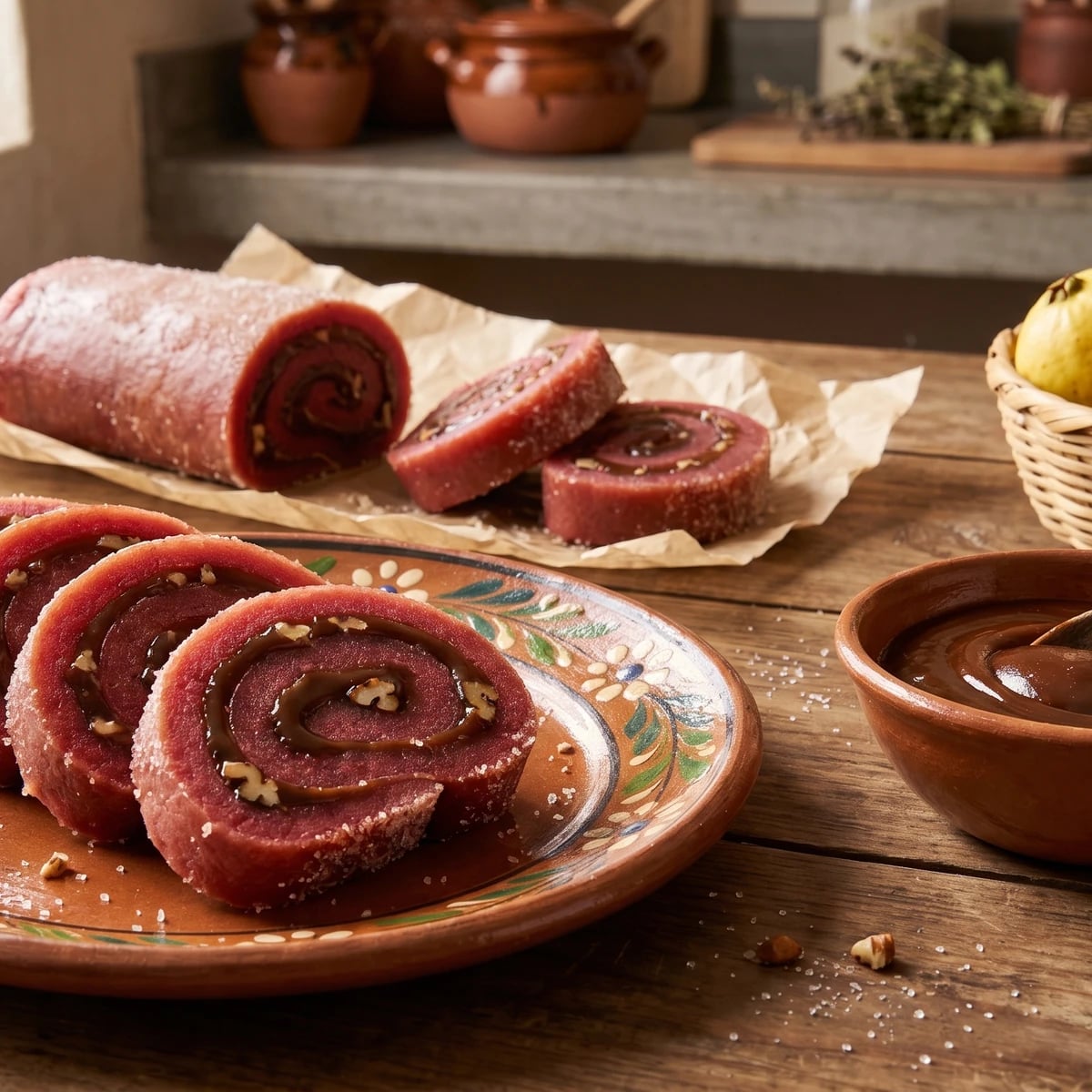
Jalisco's pilgrim candy from Talpa de Allende, a thin sheet of guava paste wrapped around cajeta and pecans, sugared outside and sliced thick for the road home.

Desserts
Mexican
Make Ahead
Comfort Food
45 min
Active Time
1 hr 25 min cook2 hr 10 min total
Yield2 rolls, about 24 slices

This comes from Talpa de Allende, Jalisco, in the sierra west of Guadalajara, where pilgrims arrive tired, dusty, and ready for something sweet to carry home. The rollo de guayaba is not a plated dessert. It is candy by the roll, sold in market stalls and sweet shops near the basilica, wrapped for the road like a small edible souvenir of the journey.

The guava is the point. In that part of Jalisco, guava grows well in the warm valleys, and the fruit's natural pectin lets it cook down into a firm ate without gelatin or tricks. The women who perfected this know the sound of the wooden spoon scraping the pot, the way the paste pulls from the copper or enamel, the moment it is flexible enough to roll but firm enough to hold cajeta. That judgment is the recipe.

Inside goes cajeta, thick and dark, and chopped pecans. Not chocolate. Not cream cheese. The sweetness has to taste like guava first, then goat milk caramel, then nut. Cada estado, su propia cocina. My mother did not make this one often, but in her notebook she wrote one line beside it: 'stir until your arm complains.' She was right. Saber cocinar es saber vivir.

Talpa de Allende became one of western Mexico's major pilgrimage towns after devotion to Nuestra Senora del Rosario de Talpa expanded in the 17th century, and local sweets developed around the movement of pilgrims through the town. Guava paste, or ate de guayaba, belongs to a wider colonial-era fruit preserving tradition that took native and introduced fruits and cooked them with cane sugar until they could travel without spoiling. The rolled version filled with cajeta and nuts is strongly associated with Talpa's sweet shops, where it is sold as a regional confection rather than a restaurant dessert.

The technique, the tradition, and the story behind every dish.

Discover Culinary Explorer

Ingredients

ripe guavas

Quantity

2 pounds

washed and trimmed

water

Quantity

4 cups, plus more as needed

granulated sugar

Quantity

2 1/2 cups, plus 1/2 cup

divided, for paste and coating

fresh lime juice

Quantity

2 tablespoons

fine sea salt

Quantity

1/4 teaspoon

thick cajeta

Quantity

1 cup

preferably goat milk cajeta from Jalisco or the Bajio

pecans

Quantity

3/4 cup

toasted and finely chopped

neutral oil

Quantity

as needed

for greasing the pan and spatula

Equipment Needed

  • Heavy wide pot or copper jam pan
  • Wooden spoon
  • Food mill or fine-mesh sieve
  • Rimmed half-sheet pan
  • Parchment paper
  • Offset spatula

Instructions

  1. 1

    Cook the guavas

    Put the guavas in a heavy pot with 4 cups water. Bring to a steady simmer and cook 25 to 30 minutes, until the skins split and the fruit collapses when pressed with a spoon. Guava has its own perfume, sharp and floral. If your kitchen does not smell like guava by now, the fruit was not ready.

  2. 2

    Strain the pulp

    Drain the guavas, saving 1/2 cup of the cooking liquid. Pass the fruit through a food mill or press it through a fine-mesh sieve to remove the seeds. Do not blend the seeds. They are hard and bitter when broken. You want smooth guava pulp, not grit. Measure 3 cups pulp for the paste.

  3. 3

    Build the paste

    Return 3 cups guava pulp to the clean pot. Add 2 1/2 cups sugar, lime juice, salt, and 1/4 cup reserved cooking liquid. Cook over medium-low heat, stirring with a wooden spoon, until the sugar dissolves and the mixture thickens. The lime is not for making it sour. It sharpens the guava and helps the paste set clean.

  4. 4

    Cook until firm

    Keep cooking 45 to 55 minutes, stirring more often as it thickens. The paste is ready when it pulls away from the sides of the pot and a spoon dragged through the center leaves a clean trail for two seconds before closing. Do not walk away. Sugar sticks, burns, and then you have wasted the guava. La cocina no es decoracion, es trabajo.

    If the paste spits, lower the heat and keep stirring. A wide pot cooks faster because more water evaporates. A narrow pot takes longer. The paste decides the clock.
  5. 5

    Spread the sheet

    Lightly oil a rimmed half-sheet pan or a large sheet of parchment on a work surface. Scrape the hot guava paste onto it and spread into a rectangle about 12 by 16 inches and 1/4 inch thick. Oil the spatula if it drags. Let it cool until warm and flexible, 25 to 35 minutes. If it cools completely, it can crack when rolled.

  6. 6

    Fill the roll

    Spread the cajeta in a thin layer over the guava sheet, leaving a 1-inch border on one long side. Scatter the toasted pecans evenly over the cajeta and press them lightly so they stay put. Use thick cajeta. Thin cajeta runs and makes a mess. No me vengas con atajos.

  7. 7

    Roll tightly

    Starting from the long side opposite the clean border, roll the guava sheet into a tight cylinder, using the parchment to help lift and guide it. Press the seam gently to seal. If the paste cracks, pinch it closed while it is still warm. This candy is forgiving only while warm. After that, it has opinions.

  8. 8

    Sugar and set

    Sprinkle the remaining 1/2 cup sugar on a tray. Roll the guava cylinder in the sugar until coated on all sides. Wrap snugly in parchment and let it set at room temperature for at least 4 hours, or overnight. Slice with a lightly oiled knife into 1/2-inch rounds. Recetas probadas y garantizadas.

Chef Tips

  • Use ripe yellow guavas with a strong smell. Hard green guavas will give you weak paste. If the market fruit is not ready, wait. Preguntale a las senoras del mercado.
  • Do not blend guava seeds. Strain them out. Broken guava seeds make the paste gritty and bitter, and nobody in Talpa would forgive that.
  • The cajeta must be thick enough to spread without running. If yours is loose, simmer it gently for a few minutes before using and let it cool.
  • Pecans are common in this roll, but some Talpa shops use walnuts. A substitution is a compromise, not an upgrade. Use what the region and the shop tradition call for when you can.

Advance Preparation

  • The guava paste can be cooked and spread one day ahead. Cover it loosely with parchment and keep it at room temperature until ready to fill and roll.
  • The finished roll keeps at room temperature for 5 days, tightly wrapped in parchment, or refrigerated for 2 weeks. Bring to room temperature before slicing so the cajeta softens.
  • This is a make-ahead candy. It slices cleaner after resting overnight.

Frequently Asked Questions

Nutrition Information

1 serving (about 55g)

Calories
190 calories
Total Fat
4 g
Saturated Fat
1 g
Trans Fat
0 g
Unsaturated Fat
3 g
Cholesterol
5 mg
Sodium
45 mg
Total Carbohydrates
38 g
Dietary Fiber
2 g
Sugars
35 g
Protein
2 g

Note: Chef personas and recipes are created with AI assistance. Cook with care: follow safe food-handling practices, check doneness with a thermometer when needed, and adapt for allergies and your kitchen.

Where cooking meets culture.

Culinary guides, cultural storytelling, and the editorial depth that makes cooking meaningful.

Discover Culinary Explorer

More from Occidente Desserts

Browse the full collection