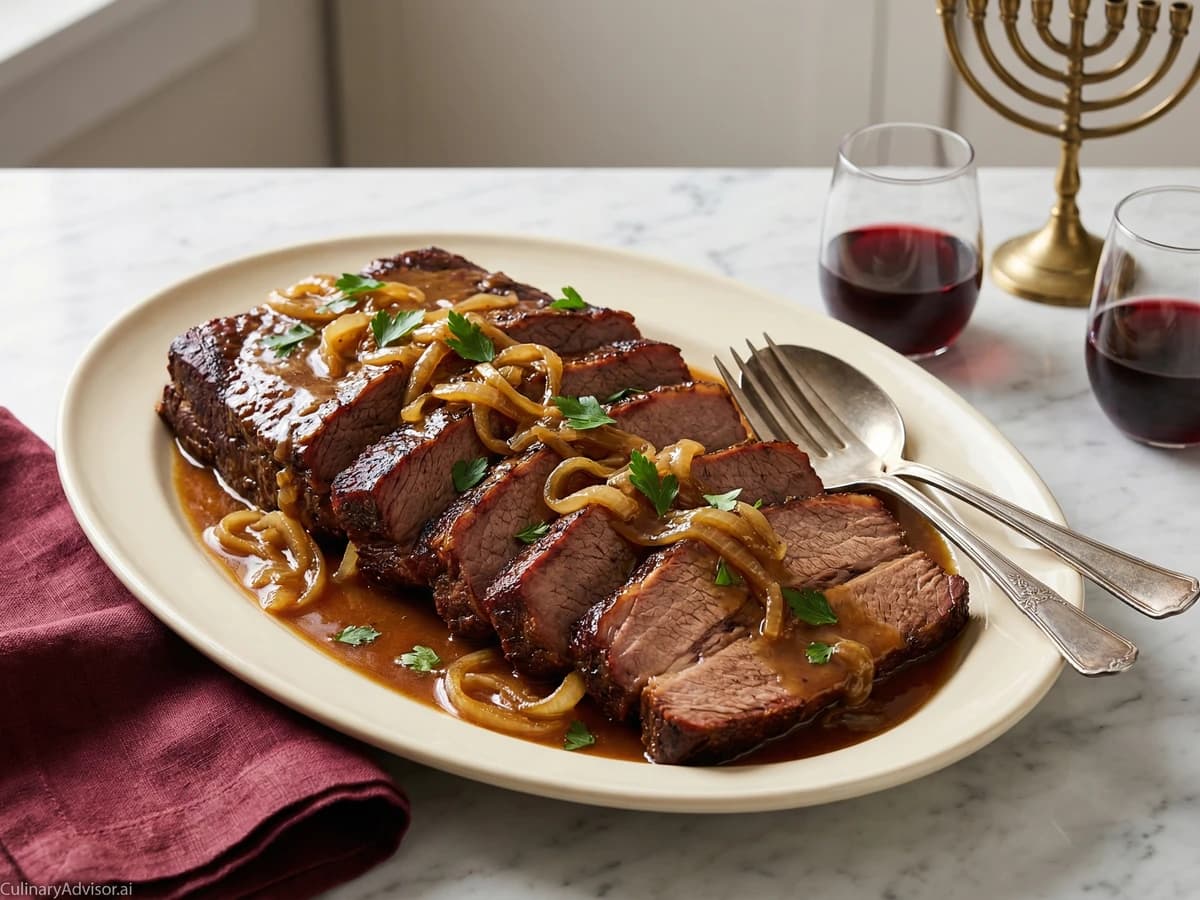
A whole bird roasted to burnished perfection, basted with golden schmaltz until the skin shatters and the meat stays impossibly juicy. This is the chicken your bubbe made, whether you had a bubbe or not.
Main Dishes
Jewish
Hanukkah
30 min
Active Time
1 hr 30 min cook•2 hr total
Yield4-6 servings
Before butter became the universal cooking fat, Jewish cooks in Eastern Europe understood something profound: a chicken contains everything you need to cook it beautifully. The fat rendered from the bird itself, that liquid gold called schmaltz, produces roast chicken of incomparable richness. The skin turns mahogany and crackles. The meat stays moist. Nothing else comes close.
This technique predates modern roasting methods by centuries. Ashkenazi Jewish households saved every scrap of chicken fat, rendering it slowly with onions until it became the foundation of their cuisine. Schmaltz fried the latkes, enriched the chopped liver, and basted the Shabbat chicken. When kashrut law forbade mixing meat with dairy, schmaltz became more than a cooking fat. It became a culinary identity.
I've roasted hundreds of chickens in my life, and I return to this method whenever I want to remind myself what the bird can truly become. The technique is forgiving. The results are not subtle. Your guests will notice the difference from the first bite, and they'll ask what you did differently. The answer is simple: you gave the chicken back to itself.
The technique, the tradition, and the story behind every dish.
Remove the chicken from its packaging and pat it completely dry inside and out with paper towels. This step matters more than any other. Wet skin steams instead of crisping. Wet skin stays pale and flabby. Take your time. Use more paper towels than you think necessary. The surface should feel almost tacky when you're done.
For the crispiest skin, unwrap the chicken a day ahead and let it air-dry uncovered in the refrigerator overnight. The cold air pulls moisture from the skin.
2
Season generously
Combine the kosher salt, black pepper, and paprika in a small bowl. Season the chicken cavity first, using about a third of the mixture. Now season the exterior, working the remaining seasoning over every surface of the bird. Don't neglect the back, the wings, the space between the thighs and breast. The salt needs to touch everywhere you want flavor.
3
Apply schmaltz under the skin
Gently loosen the skin over the breast and thighs by sliding your fingers underneath, being careful not to tear it. Take half the softened schmaltz and work it under the skin in an even layer, spreading it over the breast meat and as far down the thighs as you can reach. This fat will baste the meat from inside as it roasts, keeping the breast impossibly moist while the exterior crisps.
4
Rub the exterior
Coat the entire outside of the chicken with the remaining schmaltz. Use your hands. Work it into every crevice, every fold of wing, the crease where thigh meets body. The chicken should glisten. This exterior coating is what produces that deep mahogany color, that skin that shatters when you carve.
5
Stuff the cavity
Place the smashed garlic, lemon halves, thyme, and rosemary inside the chicken cavity. Don't pack it tight. The aromatics need room for air to circulate. These won't flavor the meat deeply, but they perfume the kitchen and infuse the pan juices. Tuck the wing tips behind the back to prevent burning.
6
Prepare the roasting pan
Scatter the quartered onions in the bottom of a roasting pan or large cast iron skillet. They'll catch the drippings and caramelize into something wonderful. Pour the chicken stock around them. This liquid prevents the drippings from scorching and gives you the foundation for a pan sauce. Set the chicken breast-side up on top of the onions.
A 12-inch cast iron skillet works beautifully here. The heavy bottom distributes heat evenly and the sides keep the juices contained for basting.
7
Roast at high heat
Place the chicken in a preheated 425°F oven. Roast for 30 minutes without opening the door. This initial blast of high heat starts rendering the fat and begins building the crust. You'll hear the schmaltz sizzling. That's exactly what you want.
8
Reduce heat and begin basting
Lower the oven temperature to 375°F. Using a large spoon or bulb baster, scoop the accumulated pan juices over the chicken. Baste the breast, the thighs, the drumsticks. Repeat this basting every 15 to 20 minutes for the remainder of cooking. Each application builds another layer of flavor and color on the skin.
9
Check for doneness
After about 1 hour and 15 minutes total roasting time, check the internal temperature. Insert an instant-read thermometer into the thickest part of the thigh without touching bone. You're looking for 165°F. The juicesshould run clear when pierced, and the leg should wiggle freely in its socket. If the skin is browning too quickly before the chicken is done, tent loosely with foil.
A properly roasted chicken will have skin the color of dark honey. If it's still pale after an hour, increase the heat to 400°F for the final 15 minutes.
10
Rest the chicken
Transfer the chicken to a cutting board and let it rest for 15 to 20 minutes. This is not optional. The juices need time to redistribute throughout the meat. If you carve too soon, those juices run out onto the board instead of staying in each slice. Tent loosely with foil if your kitchen is cold.
11
Make the pan sauce
While the chicken rests, set the roasting pan over medium heat on the stovetop. Mash the softened onions into the pan juices with a wooden spoon. If the liquid has reduced too much, add another splash of chicken stock. Scrape up any browned bits from the bottom. Taste and adjust seasoning. Strain through a fine mesh sieve if you want a smooth sauce, or leave it rustic with the onion bits intact.
12
Carve and serve
Carve the chicken into serving pieces: separate the legs and thighs, slice the breast against the grain, remove the wings. Arrange on a warm platter. Spoon the pan sauce over and around the pieces. Serve immediately while the skin still crackles.
Chef Tips
•Making your own schmaltz is simple and worth the effort. Save chicken skin and fat trimmings in the freezer until you have about a pound. Render slowly in a saucepan with diced onion over very low heat for 2 to 3 hours until the fat is liquid gold and the skin bits are crispy gribenes. Strain and refrigerate for up to 3 months.
•For a large Hanukkah gathering, roast two chickens side by side. They'll take slightly longer, about 1 hour and 30 minutes total, but the technique remains identical. Better to have leftovers than not enough.
•If you keep kosher, this entire dish works beautifully within traditional guidelines. No dairy touches the bird. The schmaltz is pure rendered chicken fat. It's the way generations cooked before convenience convinced us to forget.
•Save the carcass after carving. It makes extraordinary chicken stock. Cover with water, add an onion and some celery, simmer for 4 hours. The schmaltz-roasted bones produce stock with remarkable body.
•Traditional accompaniments include roasted root vegetables, latkes (fried in schmaltz, naturally), and braised cabbage. The pan juices work as a sauce for all of them.
Advance Preparation
•Schmaltz can be rendered and refrigerated up to 3 months ahead, or frozen for 6 months. Bring to room temperature before using so it spreads easily.
•The chicken can be seasoned, rubbed with schmaltz, and refrigerated uncovered for up to 24 hours before roasting. This essentially combines the dry-brine and air-dry steps, producing exceptionally crispy skin.
•If roasting for a holiday dinner, the chicken can be fully cooked 2 hours ahead. Keep at room temperature loosely tented. Reheat in a 400°F oven for 10 minutes to re-crisp the skin just before serving.
•Pan sauce can be made while the chicken rests and held warm over very low heat for up to 30 minutes. Add a splash of stock if it thickens too much.
Frequently Asked Questions
Nutrition Information
1 serving (about 340g)
Calories
1065 calories
Total Fat
65 g
Saturated Fat
23 g
Trans Fat
0 g
Unsaturated Fat
38 g
Cholesterol
310 mg
Sodium
2350 mg
Total Carbohydrates
2 g
Dietary Fiber
0 g
Sugars
0 g
Protein
105 g
Where cooking meets culture.
Culinary guides, cultural storytelling, and the editorial depth that makes cooking meaningful.