Culinary Explorer

A cooking platform built around craft, culture, and the stories behind what we eat.
Discover Culinary Explorer
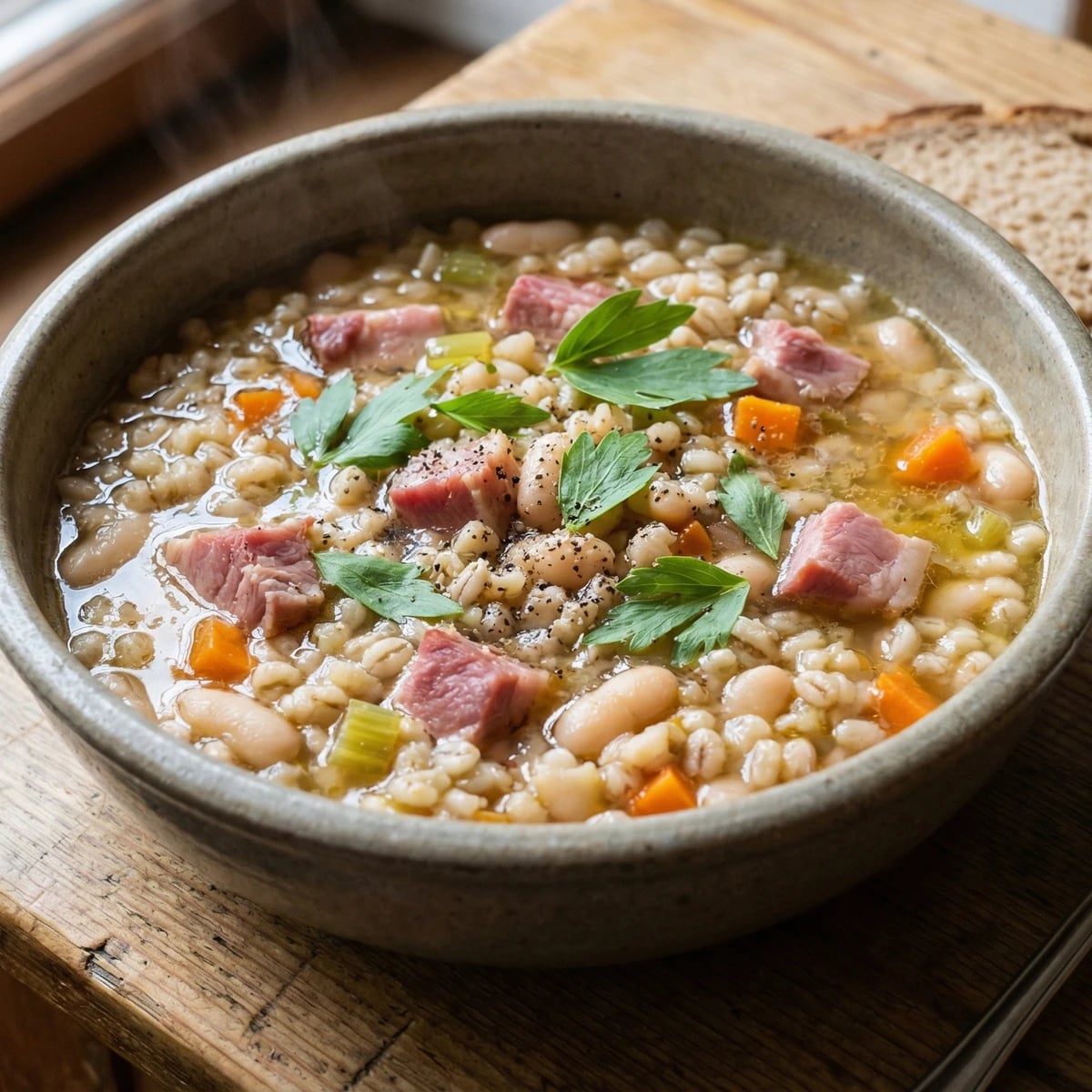
Ritschert (Carinthian Barley and Smoked Pork Stew)

Ritschert (Carinthian Barley and Smoked Pork Stew)

Created by

Carinthia's ancient barley and smoked pork stew, thick with white beans and root vegetables, the kind of one-pot cooking that fed Alpine farmers for centuries and still feeds my soul on a cold Salzburg evening.

Soups & Stews
Austrian
Comfort Food
Budget Friendly
20 min
Active Time
2 hr 30 min cook2 hr 50 min total
Yield6 servings

The first time I ate Ritschert was on one of those childhood trips to Austria with Gretel and my grandmother Eva. We'd driven south from Salzburg into Carinthia, past the Tauern mountains and down into the lake country where the air is different, softer somehow. At a Gasthaus somewhere near Villach, Gretel ordered for the table. She always ordered for the table. A deep bowl arrived, thick and pale brown, smoky from the pork, with grains of barley swollen so fat they were almost translucent. I don't remember the name of the Gasthaus. I remember the stew.

Ritschert is the oldest food I cook. Not the oldest recipe in my notebook, but the oldest kind of cooking: grain, beans, and smoked meat, simmered in one pot until everything becomes more than the sum of its parts. Carinthians have been making this since the Middle Ages, and probably longer than that. It's peasant food in the best sense. Cheap ingredients, slow time, big reward. The pearl barley does most of the work, swelling and releasing starch until the broth thickens into something you can nearly stand a spoon in. The Selchfleisch, that gorgeous Austrian smoked pork, gives the whole pot its backbone.

Gretel always said you can tell the character of a regional kitchen by its simplest dish. Ritschert is Carinthia's answer. No cream sauces, no pastry, no Konditorei flourishes. Just a heavy pot, a few honest ingredients, and enough patience to let them find each other. I put it on the menu at my restaurant every autumn, and it doesn't come off until spring. Some of my regulars would riot if it did.

Ritschert has been documented in Carinthian cooking since at least the 14th century, making it one of the oldest continuously prepared dishes in the Alpine region. The name likely derives from a Slavic root word connected to the region's historical Slovenian-speaking population in southern Carinthia, reflecting the cultural crossroads that shaped the province's food. Barley was the staple grain of the Alps long before wheat became affordable, and Selchfleisch (smoked pork) was how mountain farmers preserved meat through winter. The dish remains a point of regional pride: Carinthians will tell you, with some heat, that Ritschert belongs to them and not to Styria, despite Styrian claims to similar preparations.

The technique, the tradition, and the story behind every dish.

Discover Culinary Explorer

Ingredients

pearl barley (Rollgerste)

Quantity

250g

dried white beans (Bohnen)

Quantity

150g

soaked overnight

smoked pork (Selchfleisch)

Quantity

400g

in one piece

smoked pork ribs or small smoked ham hock

Quantity

150g

carrots

Quantity

2 medium

peeled and diced

parsnip

Quantity

1 medium

peeled and diced

celeriac

Quantity

1/4

peeled and diced

waxy potatoes

Quantity

2 medium

peeled and diced

onion

Quantity

1 large

finely diced

garlic

Quantity

2 cloves

minced

lard or unsalted butter

Quantity

2 tablespoons

bay leaves

Quantity

2

whole black peppercorns

Quantity

4

dried savory (Bohnenkraut)

Quantity

1 teaspoon

cider vinegar or white wine vinegar

Quantity

1 tablespoon

salt and freshly ground black pepper

Quantity

to taste

fresh lovage or flat-leaf parsley

Quantity

for serving

chopped

crusty dark bread

Quantity

for serving

Equipment Needed

  • Large heavy-bottomed pot or Dutch oven (6-liter minimum)
  • Medium frying pan for the soffritto
  • Wooden spoon
  • Ladle

Instructions

  1. 1

    Soak the beans and barley

    The night before you cook, put your dried white beans in a bowl and cover them with cold water by at least eight centimeters. They'll double in size. In a separate bowl, soak the pearl barley the same way. Soaking is not a shortcut you can skip. The beans need it to cook evenly, and the barley absorbs water overnight so it swells into that thick, creamy mass that gives Ritschert its body. Drain and rinse both in the morning.

    If you forgot to soak the beans overnight, cover them with boiling water and let them sit for two hours. It's not as good, but it works. The barley is more forgiving and can manage with a one-hour soak in warm water.
  2. 2

    Build the broth base

    Place the whole piece of Selchfleisch and the smoked ribs or ham hock in your largest pot. Cover with about two and a half liters of cold water. Add the bay leaves and peppercorns. Bring to a gentle simmer over medium heat. The smoke from the pork is going to season every drop of this liquid, so you want a slow extraction, not a rolling boil. Skim any foam that rises. Let it simmer for about forty-five minutes until the meat is starting to become tender but isn't falling apart yet.

  3. 3

    Add barley and beans

    Add the drained pearl barley and white beans to the pot with the pork. The barley will begin to release starch almost immediately, and that's exactly what you want. It's the barley that thickens Ritschert into a stew rather than a soup. Stir once to settle everything, then let the pot return to a lazy simmer. Cook for another forty-five minutes, stirring occasionally so nothing sticks to the bottom. The liquid level will drop. That's fine. The stew is supposed to get thick.

    Resist the urge to add more water every time the level drops. Ritschert is a thick stew, not a broth. You want the barley starch to concentrate and bind everything together. Only add a splash of hot water if the bottom starts catching before the beans are done.
  4. 4

    Prepare the soffritto

    While the barley and beans simmer, melt the lard or butter in a separate pan over medium heat. Add the diced onion and cook slowly until it turns golden, about eight minutes. Lard is traditional here, and it gives a rounder, deeper flavor than butter does. Add the garlic and cook for one minute more until fragrant. Stir in the dried savory (Bohnenkraut). This herb is called the bean herb in German for a reason. It was born for this dish. Set the pan aside.

  5. 5

    Add root vegetables

    After the barley and beans have had their forty-five minutes, add the diced carrots, parsnip, celeriac, and potatoes to the pot. Scrape in the onion mixture from the pan. Stir everything together gently. The potatoes will break down slightly at the edges and add even more body. Continue simmering for another thirty to forty minutes, until the beans are completely tender and the barley has swelled into soft, plump grains. The stew should be thick enough that a wooden spoon stands up in it for a moment before tipping.

  6. 6

    Shred the pork and finish

    Lift the Selchfleisch and smoked ribs out of the pot and set them on a board. Pull the meat from any bones, discard the skin and bones, and shred or dice the pork into rough bite-sized pieces. Return the meat to the pot. Remove the bay leaves. Add the vinegar and stir it through. This is not optional. The splash of acid lifts the whole stew out of heaviness and into balance. Taste for salt. The smoked pork may have given you enough, but the barley absorbs a lot of seasoning, so you'll likely need more than you expect. Add freshly ground black pepper.

  7. 7

    Rest and serve

    Take the pot off the heat and let it sit with the lid on for ten minutes. Ritschert, like most bean and grain stews, gets better as it rests. The barley continues to absorb, the flavors settle, and the whole thing becomes more cohesive. Ladle it into deep bowls, scatter chopped lovage or parsley over the top, and serve with thick slices of crusty dark bread. This is a meal that asks nothing of you except a spoon and an appetite. Mahlzeit!

    Ritschert is one of those rare dishes that tastes even better the next day. The barley absorbs more liquid overnight, so add a splash of water or stock when you reheat and stir it back to life.

Chef Tips

  • Find good Selchfleisch if you possibly can. In Austria, any butcher will have it. Outside Austria, look for a proper smoked pork shoulder or loin at a German, Polish, or Hungarian butcher. Supermarket bacon is not a substitute. You need a whole piece of dry-smoked pork that will hold up to two hours of simmering and still have texture.
  • Bohnenkraut (savory) is the herb that makes this dish taste like itself. It has an earthy, slightly peppery quality that rounds out the beans and barley. If you can't find dried savory, a few sprigs of fresh thyme will do the job, but it won't be quite the same.
  • Don't dice the vegetables too small. You want pieces that hold their shape after forty minutes of simmering, not mush. About one-centimeter cubes are right. The potatoes will break down a little at the edges, which helps the texture, but the carrots and parsnip should still have some bite.
  • The vinegar at the end is the secret that most people outside Carinthia don't know about. A tablespoon of good cider vinegar or white wine vinegar cuts through the richness of the smoked pork and the starchiness of the barley. Without it, the stew is flat. With it, every flavor sharpens.

Advance Preparation

  • Beans must be soaked overnight. The barley benefits from overnight soaking as well, though it can manage with a shorter soak if needed.
  • Ritschert improves dramatically overnight. Make the full pot a day ahead, refrigerate it, and reheat gently with a splash of water or stock. The flavors deepen and the texture becomes even more cohesive.
  • The stew keeps well in the fridge for up to four days. It also freezes beautifully for up to three months. Thaw overnight and reheat slowly.

Frequently Asked Questions

Nutrition Information

1 serving (about 500g)

Calories
535 calories
Total Fat
15 g
Saturated Fat
5 g
Trans Fat
0 g
Unsaturated Fat
9 g
Cholesterol
65 mg
Sodium
1250 mg
Total Carbohydrates
70 g
Dietary Fiber
15 g
Sugars
6 g
Protein
33 g

Note: Chef personas and recipes are created with AI assistance. Cook with care: follow safe food-handling practices, check doneness with a thermometer when needed, and adapt for allergies and your kitchen.

Where cooking meets culture.

Culinary guides, cultural storytelling, and the editorial depth that makes cooking meaningful.

Discover Culinary Explorer

More from Austrian Stews & Gulasch

Browse the full collection