
Chef Elsa
Bröselnudeln
Broad egg noodles tossed in golden butter-toasted breadcrumbs until every strand is coated and crackling. Four ingredients, fifteen minutes, and a dish that has kept Austrian families fed and happy for centuries.
A cooking platform built around craft, culture, and the stories behind what we eat.
Created by
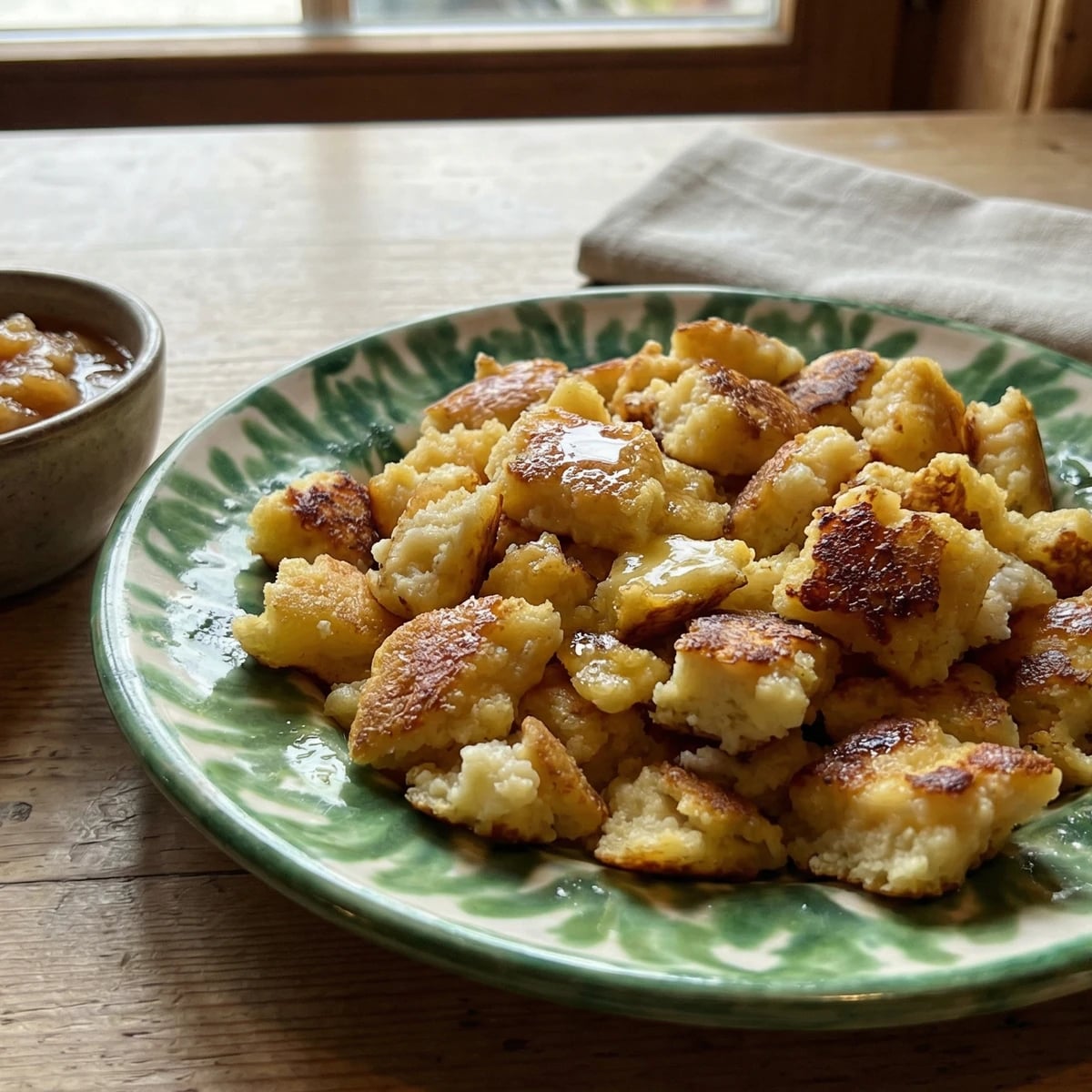
Vorarlberg's golden fried porridge of corn and wheat semolina, crumbled in butter until craggy and crisp, served with cold Apfelmus and all the quiet satisfaction of the Bregenzerwald.
Vorarlberg is Austria's smallest and westernmost province, pressed up against Switzerland and Lake Constance, and it has a kitchen that sounds nothing like Vienna. The people there speak Alemannic dialect that even other Austrians struggle with, and they eat Riebel for breakfast the way the rest of the country eats Semmel. Gretel always said that if you want to understand Austria, you can't stop in Vienna. You have to keep going until the mountains change shape and the food changes with them.
Riebel is as plain as cooking gets. Corn semolina and wheat semolina, cooked into a thick porridge, cooled until it sets, then broken apart and fried in butter until the edges turn golden and craggy. That's the whole recipe. The genius is in the texture: crispy, almost shattering pieces on the outside, soft and grainy inside, all of it soaked in butter. You eat it with cold Apfelmus and the contrast between the warm, buttery crumble and the cool, tart apple is the kind of thing that makes you close your eyes.
I first ate proper Riebel at a farmhouse Gasthaus near Schwarzenberg, on one of those childhood trips with Gretel and Eva. It came to the table in a cast-iron pan, still crackling, with a bowl of homemade apple sauce and a small pitcher of warm milk. I remember thinking it looked like nothing. Then I tasted it. This is good Austrian home cooking at its most honest: two cheap ingredients, butter, patience, and something that tastes like it has no right to be as good as it is.
Corn arrived in Vorarlberg in the 17th century through trade routes from northern Italy and the Swiss Rhine Valley, and the region adopted it more enthusiastically than anywhere else in Austria. Riebel, also called Türkenriebel (from Türken, the old Austrian word for corn), became the daily staple of farming families in the Bregenzerwald and around Lake Constance. The dish was so central to the regional identity that Vorarlbergers were nicknamed 'Riebelmuas-Esser' (Riebel porridge eaters) by their fellow Austrians. Today it holds protected regional status and remains a breakfast tradition in Vorarlberg homes and Gasthäuser.
Quantity
150g
medium grind
Quantity
150g
medium grind
Quantity
600ml
Quantity
200ml
Quantity
1 teaspoon
Quantity
1 tablespoon
Quantity
60g
for frying
Quantity
for serving
Quantity
for serving
| Ingredient | Quantity |
|---|---|
| Maisgrieß (corn semolina)medium grind | 150g |
| Weizengrieß (wheat semolina)medium grind | 150g |
| whole milk | 600ml |
| water | 200ml |
| salt | 1 teaspoon |
| granulated sugar | 1 tablespoon |
| unsalted butterfor frying | 60g |
| Apfelmus (apple sauce) | for serving |
| warm milk or strong coffee (optional) | for serving |
Combine the milk, water, salt, and sugar in a heavy-bottomed saucepan and bring it to a gentle simmer over medium heat. Don't let it boil hard. You want it just trembling at the edges. The mix of milk and water gives the porridge richness without making it too heavy to fry properly later.
Stir the Maisgrieß and Weizengrieß into the simmering liquid in a slow, steady stream, whisking constantly. This is where lumps happen if you rush it. Keep whisking until the mixture thickens into a smooth, heavy porridge that pulls away from the sides of the pan, about five to seven minutes. It should be stiff enough that a spoon stands up in it. Reduce the heat to low, cover tightly, and let it cook for another ten minutes. The grains need this time to swell and soften fully.
Scrape the cooked porridge onto a plate or shallow dish and spread it to about two centimeters thick. Let it cool until it firms up, at least fifteen minutes. You can do this overnight if you're making Riebel for breakfast. Once cool, the porridge holds together in a solid mass. That's exactly what you want. You're going to break it apart.
Melt the butter in a wide, heavy pan over medium heat. When it foams and the foam begins to settle, break the set porridge into rough chunks with your hands or a spoon and scatter them into the pan. Now leave them alone. This is the hardest part for most people. Let the pieces sit in the hot butter without moving them for two to three minutes until a golden crust forms on the bottom. Then turn them, break them smaller with a spatula, and let them crust again. Repeat this: crust, turn, break. You're building layers of crispy golden edges around soft, grainy centers. The whole process takes about ten to twelve minutes.
Heap the golden Riebel onto warm plates. Serve with a generous bowl of cold Apfelmus on the side and, if you like, a cup of warm milk or strong coffee to pour over. In the Bregenzerwald, some families pour the milk right into the plate. Others keep everything separate. Both are correct. There is no wrong way to eat Riebel as long as the Apfelmus is there. Mahlzeit!
1 serving (about 250g)
Culinary guides, cultural storytelling, and the editorial depth that makes cooking meaningful.
Discover Culinary Explorer
Chef Elsa
Broad egg noodles tossed in golden butter-toasted breadcrumbs until every strand is coated and crackling. Four ingredients, fifteen minutes, and a dish that has kept Austrian families fed and happy for centuries.

Chef Elsa
Vienna's weeknight answer to everything: soft flour Nockerl fried golden in butter, scrambled through with eggs and buried under fresh chives. A sharp green salad on the side because the Viennese know that richness needs a counterpoint.

Chef Elsa
Soft Austrian potato dumplings in browned butter with warm, caraway-scented sauerkraut. A meatless Gasthaus meal that's been filling up Alpine kitchens for centuries.

Chef Elsa
Tyrolean meatless bread dumplings stuffed with handfuls of fresh herbs and soft onions, poached until they float, and served in broth or with brown butter and a sharp green salad.