
Chef Klaus
Allgäuer Krautkrapfen
The Allgäu pan dish that makes a meal from noodle dough, winter kraut, onion, and fat: brown the cut sides first, then cook gently so the rolls hold.
A cooking platform built around craft, culture, and the stories behind what we eat.
Created by
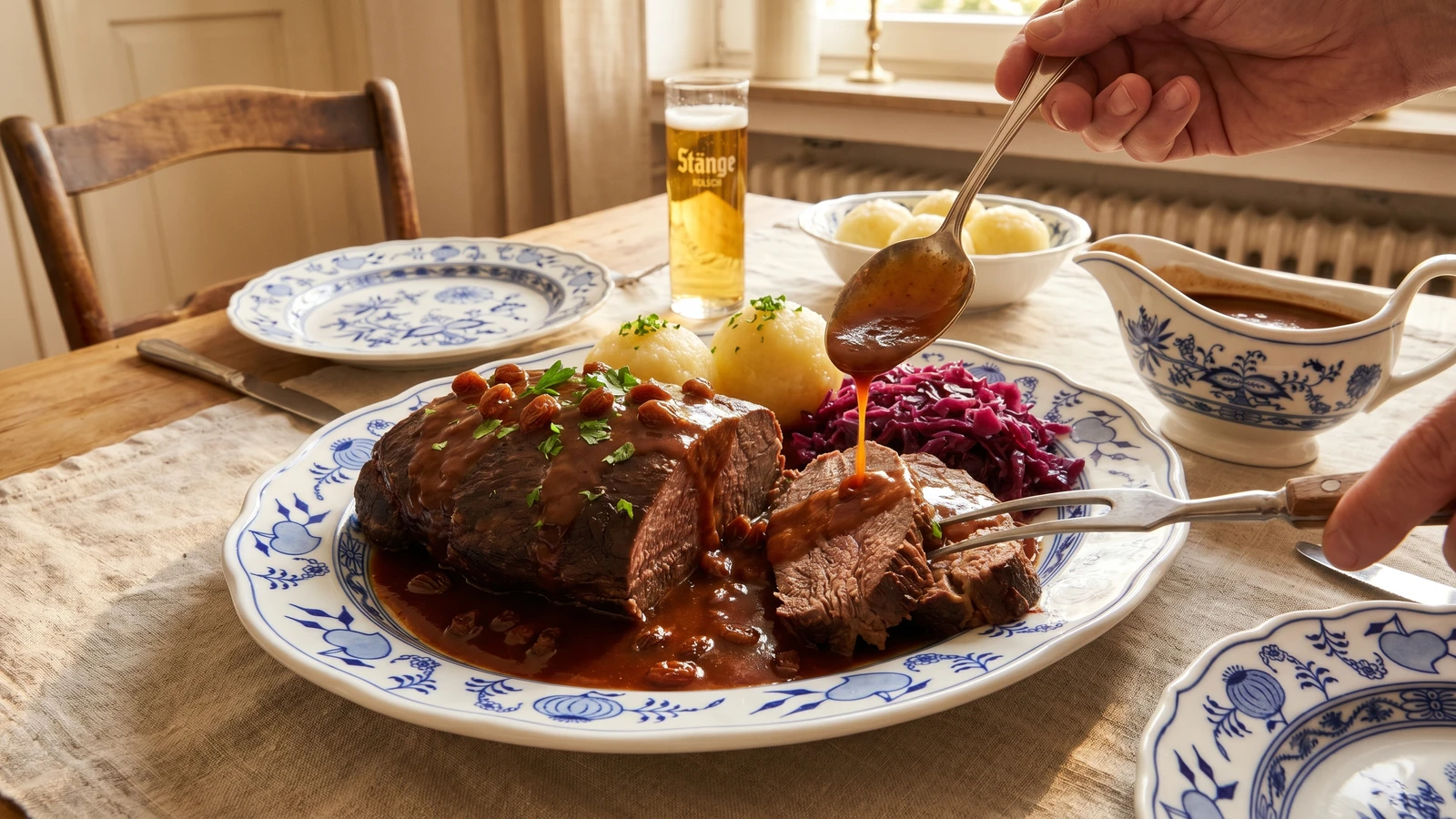
The Rhineland's sour roast earns its tenderness before the oven, with beef resting four days in wine and vinegar and a dark sauce thickened by Lebkuchen, not flour.
Rheinischer Sauerbraten is the Rhineland's Sunday braise, made for a celebration because the calendar starts four days before the table is set. I cook it from beef shoulder now, though the old Rhenish pot often used horse, and the point is the same: a hard-working cut goes into wine, vinegar, onion, roots, juniper, and cloves until the acid and spice have reached the middle.
Every region argues about it. The Rhineland sweetens the sauce with raisins and thickens it with Lebkuchen, spiced gingerbread, or Aachener Printen; Franconia keeps the roast sharper, and Swabia often makes the sauce plainer. Im Norden anders, im Süden anders. German food has no single national version, only kitchens with their own rules.
The rule here is simple: the marinade must be cold before the beef goes in. Boil the wine and vinegar to wake the spices, then let it cool completely. Pour it warm and you start cooking the outside of the meat, and the middle never takes the flavour properly. Erst verstehen, dann kochen.
After that, keep the heat low and the sauce honest. Nicht aus dem Glas. The braising liquid, bone stock, raisins, and crumbled Printen make the sauce; flour and jarred Bratensoße can stay where they are. Taste it at the end, sweet against sour, salt only after it has reduced. Das braucht seine Zeit.
The older Rhenish form was often Pferdesauerbraten, horse-meat Sauerbraten, because a hard-working animal gave tough meat that needed acid, spice, and time before it could become Sunday food. Aachen's Printen trade was reshaped during Napoleon's Continental System from 1806 to 1814, when imported cane sugar was scarce and local bakers leaned on beet syrup; those dark spiced Printen became a natural thickener for the Rhenish sauce. The regional split remains clear: the Rhineland runs sweet-sour with raisins and gingerbread, while Franconian and Swabian versions stay sharper and plainer.
Quantity
1.5kg
in one piece
Quantity
750ml
Quantity
250ml
Quantity
250ml
Quantity
2
sliced
Quantity
2
chopped
Quantity
100g
chopped
Quantity
1
rinsed well and sliced
Quantity
2
Quantity
8
lightly crushed
Quantity
6
Quantity
6
Quantity
1 tablespoon
Quantity
3 tablespoons
Quantity
300ml
preferably from bones or a good butcher, as needed
Quantity
60g
Quantity
60g
no chocolate glaze, crumbled
Quantity
1 tablespoon
Quantity
to taste
Quantity
1 tablespoon
only if needed to sharpen the sauce
Quantity
small handful
chopped
Quantity
for serving
Quantity
for serving
| Ingredient | Quantity |
|---|---|
| beef shoulder, chuck, or topsidein one piece | 1.5kg |
| dry red wine | 750ml |
| red wine vinegar | 250ml |
| water | 250ml |
| yellow onionssliced | 2 |
| carrotschopped | 2 |
| celeriacchopped | 100g |
| small leekrinsed well and sliced | 1 |
| bay leaves | 2 |
| juniper berrieslightly crushed | 8 |
| whole cloves | 6 |
| allspice berries | 6 |
| black peppercorns | 1 tablespoon |
| lard or Butterschmalz, German clarified butter | 3 tablespoons |
| unsalted beef stockpreferably from bones or a good butcher, as needed | 300ml |
| raisins | 60g |
| Aachener Printen or plain Lebkuchenno chocolate glaze, crumbled | 60g |
| Rübenkraut, dark beet syrup (optional) | 1 tablespoon |
| fine salt and freshly ground black pepper | to taste |
| red wine vinegar (optional)only if needed to sharpen the sauce | 1 tablespoon |
| flat-leaf parsley (optional)chopped | small handful |
| Kartoffelklöße, potato dumplings (optional) | for serving |
| Rotkohl, braised red cabbage (optional) | for serving |
Put the wine, vinegar, water, onions, carrots, celeriac, leek, bay leaves, juniper, cloves, allspice, and peppercorns into a pot and bring it to a boil for 3 minutes. Boiling wakes the spices and takes the raw edge off the vinegar, so the marinade tastes seasoned instead of harsh. Take it off the heat and cool it completely before it touches the beef.
Lay the beef in a snug non-reactive dish and pour the cold marinade over it with all the vegetables and spices. Cover it and refrigerate for 4 days, turning the meat once each day so every side takes the acid evenly. Das braucht seine Zeit. The cooking tenderises the meat later, but these four days are where the flavour moves inward.
Lift the beef from the marinade and pat it very dry with kitchen paper. Strain the marinade, keeping the liquid and the vegetables separately. A wet roast will go grey in the pot instead of browning, and browning is where the sauce gets its dark backbone. Weggeworfen wird nichts: the marinade vegetables go into the braise, not down the drain.
Heat the lard or Butterschmalz in a heavy lidded braiser and brown the beef hard on all sides, 10 to 12 minutes in total. Give it room and patience, because a deep crust makes the sauce taste roasted instead of boiled. Lift the meat out, add the drained vegetables, and cook them for 5 minutes so their sour edge softens and their sweetness comes forward.
Return the beef to the pot and add the strained marinade plus enough beef stock to come halfway up the meat. Bring it just to a simmer, cover the pot, then put it in a 150C oven for 2 1/2 to 3 hours, turning the meat once. Runter mit der Temperatur. A hard boil tightens the fibres and dries the outside before the middle has yielded; a low braise lets the shoulder loosen without falling to rags.
When a fork turns easily in the meat, lift the roast onto a board, cover it loosely, and let it rest for 20 minutes. Resting lets the juices settle, so the slices hold instead of leaking all over the board. Strain the braising liquid into a clean pot and press the vegetables lightly, then stop; pressing hard forces cloudiness into the sauce.
Bring the strained liquid to a gentle simmer and stir in the raisins and crumbled Printen or Lebkuchen. Let it dissolve slowly for 10 to 15 minutes, stirring often, until the sauce is glossy and lightly thickened. Don't reach for flour. The gingerbread gives thickness, colour, sweetness, and spice in one move, which is why this is Rhenish Sauerbraten and not just pot roast with vinegar.
Taste the sauce before the meat goes back in. Add Rübenkraut if it needs round sweetness, a spoon of vinegar if it has gone flat, and salt only at the end because the sauce has reduced. Würzen, Fett, Salz zum Schluss. Slice the beef across the grain, warm the slices gently in the sauce, and serve with Kartoffelklöße, potato dumplings, and Rotkohl, braised red cabbage. Schön ist, was schmeckt.
1 serving (about 520g)
Culinary guides, cultural storytelling, and the editorial depth that makes cooking meaningful.
Discover Culinary ExplorerChef Klaus
The Allgäu pan dish that makes a meal from noodle dough, winter kraut, onion, and fat: brown the cut sides first, then cook gently so the rolls hold.

Chef Klaus
Swabian egg pasta turned toward the apple cellar: fresh Spätzle tossed with browned butter, tart apples, cinnamon, and enough restraint to stay supper, not cake.

Chef Klaus
Hesse's pork goulash belongs to Apfelwein country: shoulder, onions, and tart cider cooked low until the cheap cut turns soft and the sauce lands sweet-sour, not sour-sweet.

Chef Klaus
The old sweet supper that saves yesterday's loaf: stale bread drinks eggy milk, the pan stays moderate, and butter browns the outside only after the centre has set.