
Chef Lupita
Almendrados Conventuales Poblanos
Puebla's convent almond cookies, made from blanched almonds, sugar syrup, egg yolks, canela, and patient hands, the kind of sweet that belongs beside coffee in talavera, not in a plastic bakery box.
A cooking platform built around craft, culture, and the stories behind what we eat.
Created by
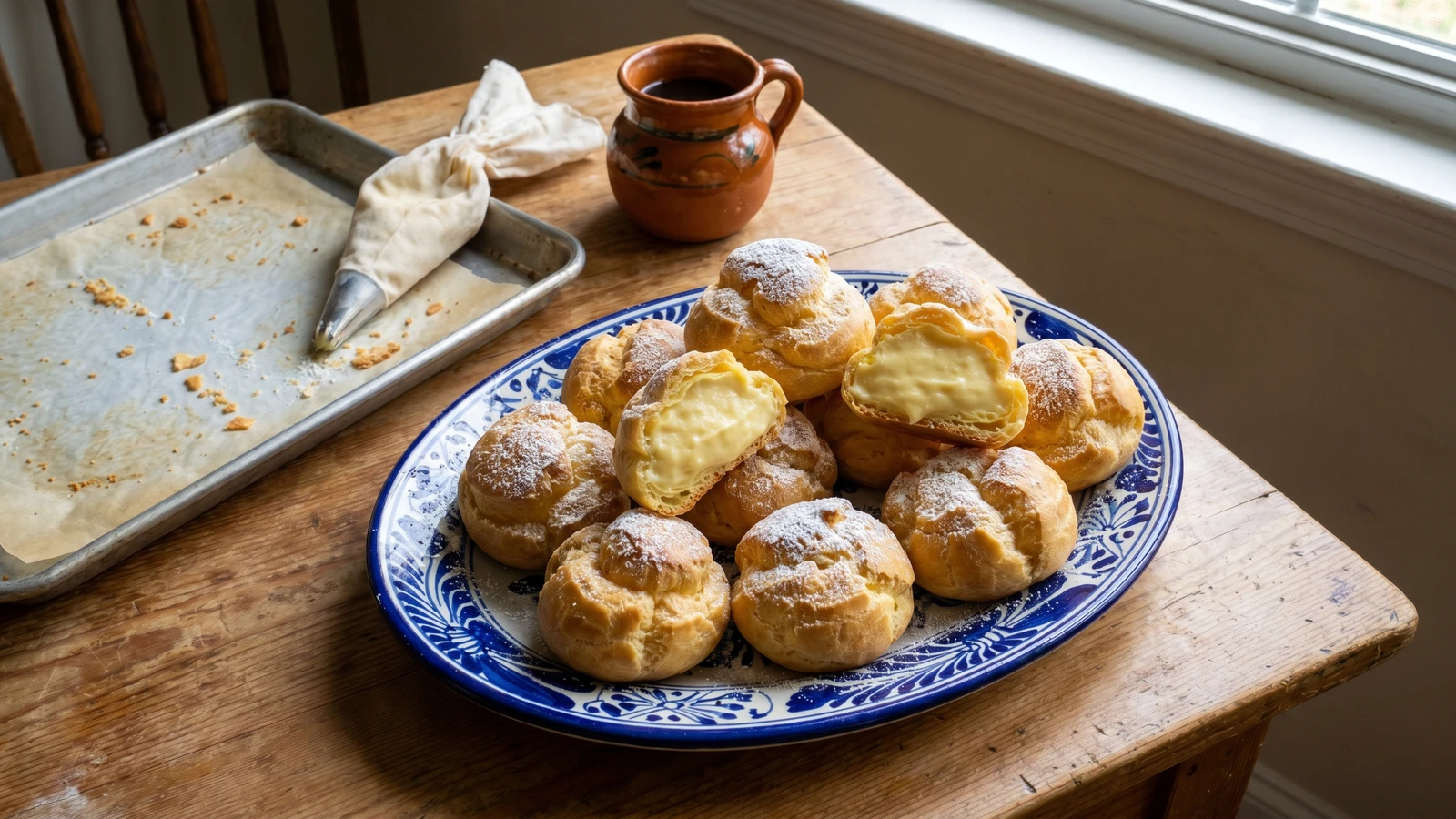
Puebla's bakery repollos are crisp choux shells with cabbage-like folds, split only after cooling and filled with thick vanilla crema pastelera made to hold its shape.
Puebla, the Angelopolis and its old center, is where I place this version of repollos rellenos de crema: a panaderia sweet that sits between convent discipline and the French pastry habits that Mexico absorbed, corrected, and made its own. You see them in bakery cases, golden and wrinkled, not smooth like a restaurant profiterole. They look like little cabbages. That is the point.
The ingredient that makes them Mexican is not chile. Sit with that. Not every Mexican dish needs chile to prove where it belongs. Here the markers are wheat flour, milk, canela, and real Mexican vanilla, the kind that carries the memory of Papantla even when it reaches a Puebla bakery by way of the mercado. The technique is choux, yes, but the filling is panaderia logic: thick crema pastelera that holds when the shell is split, dusted with azucar glass, carried home in a cardboard box tied with string.
A panadera from near the mercado El Carmen once corrected my repollos before I even filled them. Too pale, she said. If the shell is blonde, it is still wet inside. She was right. You bake these until the outside is firm and the folds are golden. Then you wait. Cold crema, cold shell. My mother had the same warning in her notebook, written underlined twice. Saber cocinar es saber vivir.
Pate a choux developed in French pastry and its name comes from the French word 'chou,' meaning cabbage, because the baked mounds wrinkle like small cabbages. In Mexico, wheat bread entered after the Spanish conquest, while urban panaderia absorbed convent sweetmaking and, during the Porfiriato from 1876 to 1911, more French-style pastry technique. Repollos rellenos de crema are part of that central Mexican bakery inheritance: European structure, Mexican merienda table, and vanilla crema pastelera made for a bakery case, not a white-plate dessert.
Quantity
2 cups
Quantity
1/2 cup
divided
Quantity
1 small
Quantity
4
Quantity
1/4 cup
Quantity
1/4 teaspoon
Quantity
2 tablespoons
Quantity
2 teaspoons
Quantity
1 cup
Quantity
1/2 cup
Quantity
8 tablespoons
cut into cubes
Quantity
1 tablespoon
Quantity
1/2 teaspoon
Quantity
1 cup
sifted
Quantity
4
room temperature
Quantity
1
beaten, for adjusting the dough only if needed
Quantity
1/2 cup
for dusting
| Ingredient | Quantity |
|---|---|
| whole milk, for crema pastelera | 2 cups |
| granulated sugar, for crema pasteleradivided | 1/2 cup |
| Mexican canela stick | 1 small |
| large egg yolks | 4 |
| cornstarch | 1/4 cup |
| fine sea salt, for crema pastelera | 1/4 teaspoon |
| unsalted butter, for crema pastelera | 2 tablespoons |
| real Mexican vanilla extract | 2 teaspoons |
| water | 1 cup |
| whole milk, for choux | 1/2 cup |
| unsalted butter, for chouxcut into cubes | 8 tablespoons |
| granulated sugar, for choux | 1 tablespoon |
| fine sea salt, for choux | 1/2 teaspoon |
| all-purpose floursifted | 1 cup |
| large eggsroom temperature | 4 |
| large egg (optional)beaten, for adjusting the dough only if needed | 1 |
| powdered sugar (azucar glass) (optional)for dusting | 1/2 cup |
For the crema pastelera, combine the 2 cups milk, half the sugar, the canela stick, and salt in a heavy saucepan. Warm over medium heat until tiny bubbles gather at the edge. Do not boil it hard. You want the milk hot enough to carry the canela, not scorched on the bottom like a careless fonda pot.
In a bowl, whisk the egg yolks, remaining sugar, and cornstarch until pale and thick. Whisk in a little hot milk to temper the yolks, then whisk everything back into the saucepan. Cook over medium heat, whisking constantly, until the crema thickens and gives a few heavy bubbles. Keep cooking for 1 full minute so the cornstarch loses its raw taste.
Remove the canela stick. Whisk in the butter and Mexican vanilla until smooth. Strain the crema into a shallow dish, press plastic wrap directly against the surface, and refrigerate until cold and firm, at least 1 hour. Warm crema collapses the shells and should not sit on the counter. La cocina no es decoracion, es trabajo.
Heat the oven to 425F. Line two sheet pans with parchment. In a medium saucepan, combine the water, 1/2 cup milk, cubed butter, sugar, and salt. Bring to a full simmer over medium heat. When the butter has melted, add the sifted flour all at once. All at once means all at once. No me vengas con atajos.
Stir hard with a wooden spoon until the dough gathers into one smooth mass and leaves a thin film on the bottom of the pan, 2 to 3 minutes. The sound changes from soft stirring to a dry scrape. That drying matters. Too much moisture gives you flat repollos instead of hollow shells.
Transfer the hot dough to a mixing bowl and let it cool for 5 minutes. Beat in the 4 eggs one at a time, mixing fully after each addition. The dough should turn glossy and fall from the spoon in a thick V shape. If it is still stiff, add the beaten extra egg 1 tablespoon at a time. Eggs are measured by texture here, not by pride.
Spoon the dough into a piping bag fitted with a 1/2-inch round tip. Pipe 18 mounds, about 2 inches wide, leaving room between them. Smooth only the sharp points with a damp fingertip. Do not polish them flat. Those little ridges are why they are called repollos, like tiny cabbages.
Bake at 425F for 10 minutes, then reduce the oven to 375F and bake 20 to 25 minutes more, until the shells are deep golden, dry-looking, and firm when lifted. Do not open the oven early. Pale choux is not done choux. The color is the clock.
Turn off the oven. Pierce the side of each shell with a small knife, then return them to the turned-off oven with the door cracked for 10 minutes. Cool completely on a rack. Do not fill them warm. My mother wrote this kind of warning in her notebook because people never want to wait.
Whisk the chilled crema pastelera until smooth and pipeable. Split each shell across the middle with a serrated knife and fill generously with crema. Set the tops back on, dust with powdered sugar, and serve the same day with cafe de olla or hot chocolate. Recetas probadas y garantizadas.
1 serving (about 70g)
Culinary guides, cultural storytelling, and the editorial depth that makes cooking meaningful.
Discover Culinary ExplorerChef Lupita
Puebla's convent almond cookies, made from blanched almonds, sugar syrup, egg yolks, canela, and patient hands, the kind of sweet that belongs beside coffee in talavera, not in a plastic bakery box.

Chef Lupita
Ciudad de Mexico's panaderia banderillas are long sticks of hojaldre pressed with sugar, baked until amber, and finished with a hard glaze for coffee at the kitchen table.

Chef Lupita
Mérida's pale egg-yolk-and-vanilla kisses, tiny cookies built on eight yolks and a perfume of orange blossom, sandwiched with guava paste and dusted heavy with powdered sugar.

Chef Lupita
Hidalgo's bisquet de nata carries Pachuca's mining history into the breakfast table: a Cornish-style bread softened by Mexican nata, split warm and eaten with café de olla.