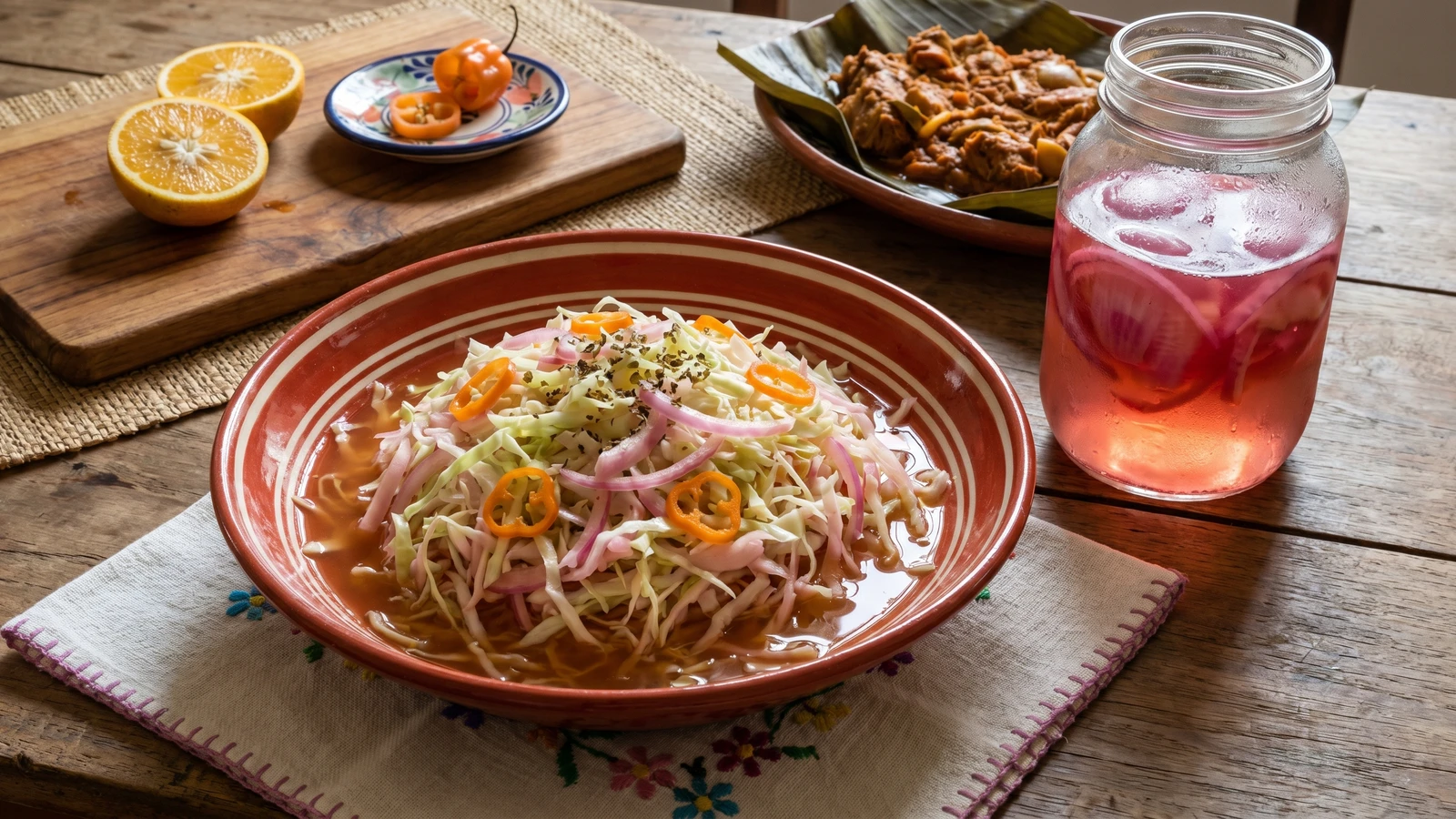
Yucatán's pickled cabbage, finely shredded repollo blanched and steeped in naranja agria with toasted Maya oregano, red onion, and habanero. The bright partner that cochinita pibil cannot do without.
Salads
Mexican
Make Ahead
Comfort Food
Budget Friendly
20 min
Active Time
5 min cook•2 hr 25 min total
YieldAbout 4 cups, serving 8 to 10
This is from Yucatán. Not from a generic Mexican kitchen, not from a slaw recipe rewritten with lime. From the peninsula, where the cooking lives by its own rules and answers to its own pantry. The repollo curtido on a Mérida table is not a side dish you can swap out. It is the acid, the heat, and the perfume that finishes the cochinita, the poc chuc, the panucho. Without it, the meat sits heavy.
The ingredient that defines this dish is naranja agria, the sour orange the Spanish brought to the peninsula in the 16th century and that the Maya cooks absorbed into their pantry until it became as native as achiote. You cannot pickle Yucatecan cabbage with white vinegar alone. Vinegar gives you sharpness; naranja agria gives you sharpness with a perfumed bitterness behind it that no other citrus carries. If you cannot find it, mix lime with a little sweet orange and accept that you are making a compromise. The Yucatecan oregano is the second non-negotiable. The leaf is broader, the oil is different, and a señora from Tizimín would correct you on the spot if you used the wrong oregano in her kitchen.
Yucatecan salads are not lettuce-and-dressing affairs. They are built on cabbage, jícama, radish, sour orange, and habanero. The peninsula has its own logic. Cada estado, su propia cocina, and Yucatán is the state that argues this point loudest. Treat this pickle with the respect it deserves. It is not garnish. It is the dish working alongside another dish. Saber cocinar es saber vivir.
Naranja agria (Citrus aurantium) arrived in the Yucatán Peninsula with Spanish colonizers in the early 16th century and was rapidly adopted by Maya cooks, who substituted it for the indigenous souring agents they had used in pre-conquest cuisine. The pickled cabbage and onion preparations that accompany cochinita pibil, poc chuc, and salbutes evolved as Maya-Spanish hybrids during the colonial period, combining Old World pickling vinegar logic with the peninsula's new citrus and the indigenous habanero, a chile that botanists trace to the Amazon basin but whose modern cultivation has been so concentrated in Yucatán that the state holds a Denominación de Origen for it as of 2010. Yucatecan oregano (Lippia graveolens, regionally distinct from northern Mexican varieties) and the local cooking lineage explain why a peninsula pickle tastes nothing like a central-Mexican pickle, even when the cabbage and onion are the same.
The technique, the tradition, and the story behind every dish.
naranja agria juice (or 2/3 cup lime juice with 1/3 cup orange juice)
Quantity
1 cup
freshly squeezed
white vinegar
Quantity
1/2 cup
cold water
Quantity
1/2 cup
chile habanero
Quantity
2
stemmed and sliced into thin rings, seeds left in
chile xkatik (optional)
Quantity
1
stemmed and sliced into thin rings
garlic cloves
Quantity
4
lightly smashed
Yucatecan oregano
Quantity
1 tablespoon
lightly toasted on a comal
whole black peppercorns
Quantity
10
whole allspice berries
Quantity
4
bay leaves
Quantity
2
kosher salt
Quantity
1 tablespoon
sugar
Quantity
1 teaspoon
Ingredient
Quantity
green cabbagecored and finely shredded
1 small head (about 1 1/2 pounds)
red onionsliced into thin half-moons
1 medium
naranja agria juice (or 2/3 cup lime juice with 1/3 cup orange juice)freshly squeezed
1 cup
white vinegar
1/2 cup
cold water
1/2 cup
chile habanerostemmed and sliced into thin rings, seeds left in
2
chile xkatik (optional)stemmed and sliced into thin rings
1
garlic cloveslightly smashed
4
Yucatecan oreganolightly toasted on a comal
1 tablespoon
whole black peppercorns
10
whole allspice berries
4
bay leaves
2
kosher salt
1 tablespoon
sugar
1 teaspoon
Equipment Needed
•Sharp chef's knife or mandoline for shredding
•Large pot for blanching
•Colander
•Cast iron comal or small dry skillet for toasting oregano
•Large non-reactive bowl (glass or ceramic, not aluminum)
•Glass jar with a tight lid for storage
Instructions
1
Shred the cabbage
Cut the cabbage in quarters through the core. Cut out the core. Lay each quarter flat and slice across the grain as thinly as you can manage, into long thin ribbons. Thin matters here. Thick shreds stay raw in the brine and the pickle bites back. You want strands that bend, not chunks that crunch like a coleslaw. The señoras in the Mérida markets shred it almost translucent.
A mandoline gets you there fastest, but a sharp chef's knife and patience works. Do not put cabbage in a food processor. It bruises the leaves and you end up with wet pulp.
2
Blanch the cabbage
Bring a large pot of well-salted water to a rolling boil. Drop the shredded cabbage in. Count to thirty. Drain immediately in a colander and run cold water over it until it stops steaming. Press out the excess water with your hands, firmly, in batches. This is not boiled cabbage. Thirty seconds takes the raw squeak out of the leaf and lets the naranja agria penetrate. Longer than that and you have cooked it. The cabbage should still snap between your teeth.
3
Toast the oregano
Heat a dry comal over medium-low. Place the Yucatecan oregano in your palm, smell it once. Scatter it on the comal and shake it for 20 to 30 seconds, just until it darkens a shade and the kitchen smells green and slightly resinous. Tip it into a small bowl. Yucatecan oregano is not Mexican oregano from the north and it is not Mediterranean oregano. The leaf is bigger, the oil is different, the flavor leans toward citrus and pine. If you cannot find it, use Mexican oregano. Mediterranean oregano is the wrong plant for this dish.
Toasting is the difference between oregano that smells like a spice jar and oregano that smells like a Yucatecan kitchen. Twenty seconds. Do not walk away.
4
Build the brine
In a non-reactive bowl, combine the naranja agria juice, vinegar, cold water, smashed garlic, peppercorns, allspice, bay leaves, toasted oregano, salt, and sugar. Stir until the salt and sugar dissolve. Taste it. It should be sharp, faintly sweet at the back, and aromatic. Naranja agria is doing the work that vinegar does in other pickles. If you substituted lime and sweet orange, the brine will taste a little flatter, that is the compromise. Naranja agria has a perfumed bitterness you cannot fake. If you live somewhere with Cuban or Yucatecan grocers, find it. It matters.
5
Combine and steep
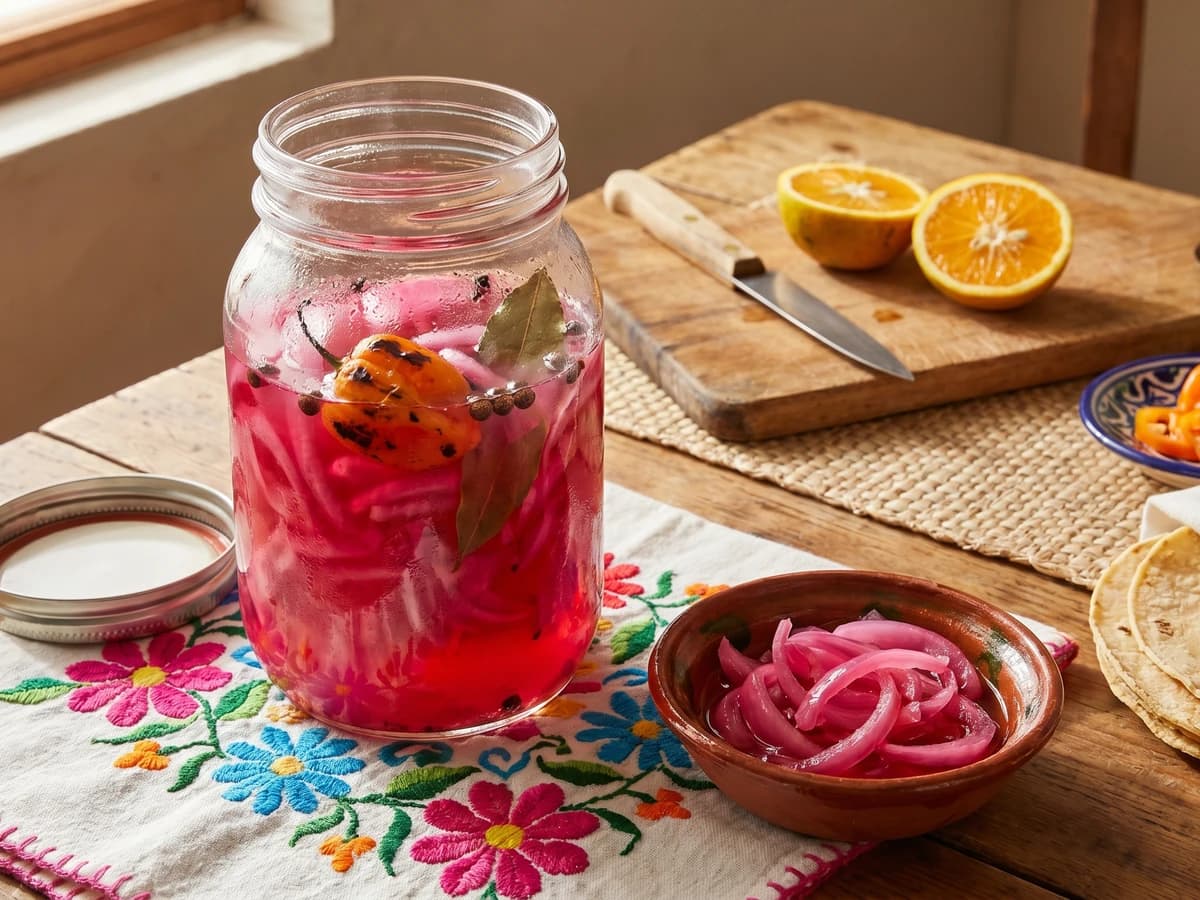
Add the drained cabbage, sliced red onion, habanero rings, and xkatik (if using) to the brine. Stir with clean hands, lifting from the bottom so every strand gets coated. The onion will start to turn pink within minutes. That is the naranja agria pulling the color out, the same chemistry that gives cebollas moradas their famous rose color. Cover and refrigerate for at least two hours. Overnight is better. The flavor sharpens as it sits and the cabbage takes on a faint translucence at the edges.
Leave the habanero seeds in if you want the proper Yucatecan heat. Take them out if you are feeding people who have never met a habanero. Either way, slice the chile with the knife you reserve for chiles. Habanero oil on a tomato is not a happy surprise.
6
Serve and store
Transfer to a clean glass jar with a tight lid. The repollo curtido is ready after two hours and at its best between day one and day four. Serve it cold or at room temperature, alongside cochinita pibil, salbutes, panuchos, poc chuc, or papadzules. A spoonful goes on top of the meat. The acid cuts the richness, the habanero opens the palate, the oregano sets the whole thing in Yucatán. Así se hace y punto.
Chef Tips
•Find naranja agria if you can. Latin grocers with a Cuban or Yucatecan clientele carry it fresh in winter and bottled the rest of the year. The Goya bottled naranja agria is acceptable in a pinch. A blend of lime and sweet orange is the next compromise, in that order.
•Yucatecan oregano is sold as 'oregano yucateco' or 'oregano de Yucatan' in good Mexican spice shops. Mexican oregano from Oaxaca or Chihuahua is the next best option. Mediterranean oregano is not a substitute. It is a different plant with a different oil and it will make your pickle taste like an Italian sandwich.
•If you have access to chile xkatik, the pale yellow Yucatecan chile, slice a few rings in with the habanero. It adds a vegetal warmth without more heat. If not, the habanero alone is correct.
•This pickle keeps in the refrigerator for up to two weeks but it is at its peak between day one and day four. After that the cabbage softens past where you want it and the habanero starts to dominate.
Advance Preparation
•Make this at least two hours before serving. Overnight is better. The flavor sharpens and the cabbage takes on the brine fully.
•Stored in a clean glass jar in the refrigerator, the repollo curtido holds for up to two weeks, though it is at its best in the first four days.
•The brine itself can be mixed one day ahead and refrigerated. Combine with the blanched cabbage and onion the morning of serving.
Frequently Asked Questions
Nutrition Information
1 serving (about 120g)
Calories
35 calories
Total Fat
0 g
Saturated Fat
0 g
Trans Fat
0 g
Unsaturated Fat
0 g
Cholesterol
0 mg
Sodium
450 mg
Total Carbohydrates
9 g
Dietary Fiber
2 g
Sugars
4 g
Protein
1 g
Where cooking meets culture.
Culinary guides, cultural storytelling, and the editorial depth that makes cooking meaningful.