
Chef Lupita
Aguascalientes Beef Tongue Pozole (Pozole de Lengua)
Aguascalientes' Bajio pozole de lengua, built with cacahuazintle hominy, tender beef tongue, chile ancho and guajillo, with xoconostle brightness and table garnishes.
A cooking platform built around craft, culture, and the stories behind what we eat.
Created by
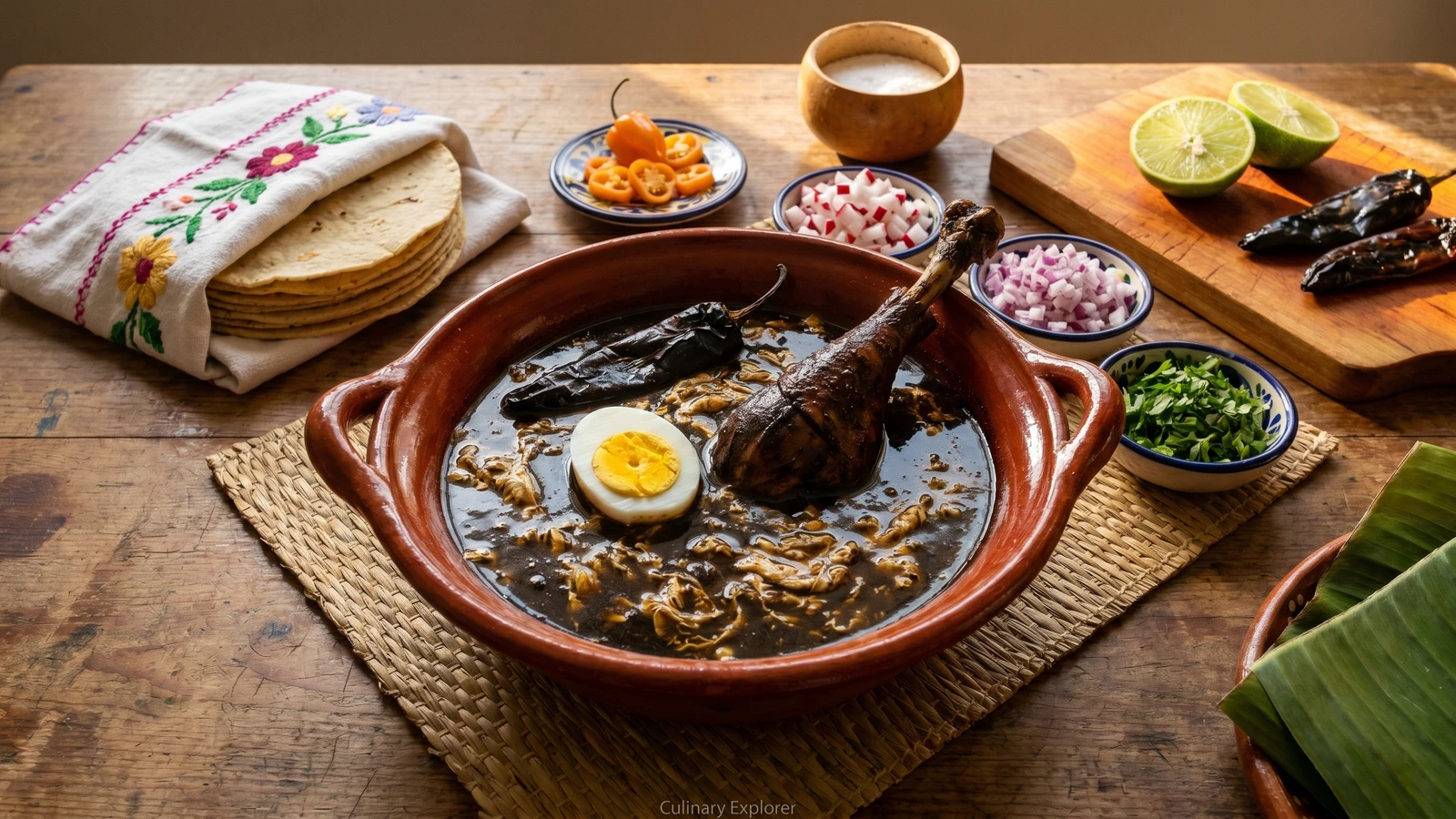
Yucatán's black turkey stew built on chiles burned to charcoal, finished with a pork-and-egg but wrapped in banana leaf. The dish that owns weddings, funerals, and the most serious tables in Mérida.
Relleno negro is from Yucatán. Not from Mexico generally, from Yucatán specifically, and within Yucatán it belongs to the towns around Mérida and Valladolid where the Maya kitchens have kept it alive for centuries. It is the dish that appears at weddings, baptisms, funerals, and Día de Muertos. When a family wants to say something important with food, this is what they cook.
The color is the first thing. It is not brown. It is not dark red. It is black, the black of wet ink, and it comes from chiles burned past the point where any other Mexican cuisine would stop. Ancho, guajillo, de arbol, plus the seeds, all charred on a comal until the kitchen has to be evacuated. That carbon is the recado negro, also called chilmole, and it is the soul of the dish. The señoras in the Mérida markets sell it by the kilo in black bricks and every cook has her preferred vendor. If you can buy a good one, buy it. If you cannot, burn your own and accept that you will smell like smoke for two days.
The but inside the stew is a pork-and-beef meatball wrapping a whole hard-boiled egg, poached in banana leaf, sliced open at the table. The yellow yolk against the black sauce is the image every Yucateco recognizes. Without it, this is just a dark turkey soup. With it, it is relleno negro. Sin huevo, no es relleno negro.
My mother did not cook this. She was jalisciense and she would have called it a project, in the tone she reserved for dishes that took three days. I learned it from a señora named Doña Elvia in a courtyard kitchen outside Valladolid where she was preparing it for her granddaughter's wedding. She had been burning the chiles since dawn. She told me, hands black to the elbow, that her grandmother taught her, and her grandmother before that, and that when a Yucatecan girl marries, the kitchen of her family must show up in the pot. Cada estado, su propia cocina. This is what Yucatán brings to the table.
Relleno negro is one of the clearest surviving examples of Maya culinary tradition adapted through colonial contact. The technique of charring chiles to produce a black paste is documented in the cuisine of the Yucatec Maya long before Spanish arrival, when wild fowl and venison were the meats of choice; turkey, pork, and beef entered the dish after the conquest, with turkey eventually becoming the prestige protein for ceremonial occasions. The dish belongs to a broader Yucatecan category called the 'eight recados,' a system of spice pastes (negro, rojo, blanco, para escabeche, para bistec, and others) that organizes the regional cuisine in a way that has no parallel in central or northern Mexico. The word 'but' for the egg-stuffed meatball is Yucatec Maya, not Spanish, and survives only in this dish and a handful of other peninsular recipes, a linguistic fossil of a kitchen that has cooked continuously for over a thousand years.
Quantity
1 (10 to 12 pounds)
cut into 8 pieces, or substitute 6 pounds turkey legs and thighs
Quantity
2 pounds
Quantity
1 pound
Quantity
8
peeled
Quantity
4
Quantity
20
stemmed and seeded, seeds reserved
Quantity
10
stemmed and seeded, seeds reserved
Quantity
8
stemmed
Quantity
1, plus 6 extra cloves
Quantity
2 medium
one halved, one finely chopped
Quantity
4 tablespoons, plus more to taste
Quantity
2 tablespoons
Quantity
1 cup
or 2/3 cup orange juice mixed with 1/3 cup lime juice
Quantity
1/4 cup
Quantity
2 large
passed over an open flame until pliable
Quantity
3
whole, or substitute güero/banana chiles
Quantity
2
whole and uncut
Quantity
1 large bunch
Quantity
1 small bunch
Quantity
2 tablespoons
Quantity
1 tablespoon
Quantity
1 tablespoon
orégano yucateco if available
Quantity
6
Quantity
2 sticks
Quantity
2 tablespoons
dissolved in 1/2 cup warm water
Quantity
to taste
Quantity
for serving
Quantity
1 bunch
finely diced, for serving
Quantity
1
finely diced, for serving
Quantity
1 small bunch
chopped, for serving
Quantity
for serving
Quantity
for serving
| Ingredient | Quantity |
|---|---|
| whole turkeycut into 8 pieces, or substitute 6 pounds turkey legs and thighs | 1 (10 to 12 pounds) |
| ground pork (not lean) | 2 pounds |
| ground beef | 1 pound |
| hard-boiled eggspeeled | 8 |
| raw eggs | 4 |
| dried chile anchostemmed and seeded, seeds reserved | 20 |
| dried chile guajillostemmed and seeded, seeds reserved | 10 |
| dried chile de arbolstemmed | 8 |
| head of garlic | 1, plus 6 extra cloves |
| white onionsone halved, one finely chopped | 2 medium |
| recado negro paste (chilmole) | 4 tablespoons, plus more to taste |
| recado rojo (achiote paste) | 2 tablespoons |
| naranja agria juiceor 2/3 cup orange juice mixed with 1/3 cup lime juice | 1 cup |
| manteca de cerdo (pork lard) | 1/4 cup |
| fresh banana leavespassed over an open flame until pliable | 2 large |
| fresh chile xkatikwhole, or substitute güero/banana chiles | 3 |
| fresh chile habanerowhole and uncut | 2 |
| fresh epazote | 1 large bunch |
| fresh hierbabuena (Mexican mint) | 1 small bunch |
| whole black peppercorns | 2 tablespoons |
| whole cumin seed | 1 tablespoon |
| dried Mexican oreganoorégano yucateco if available | 1 tablespoon |
| whole cloves | 6 |
| Mexican cinnamon (canela) | 2 sticks |
| masa harinadissolved in 1/2 cup warm water | 2 tablespoons |
| kosher salt | to taste |
| hand-pressed corn tortillas (optional) | for serving |
| radishes (optional)finely diced, for serving | 1 bunch |
| small red onion (optional)finely diced, for serving | 1 |
| cilantro (optional)chopped, for serving | 1 small bunch |
| naranja agria halves (optional) | for serving |
| sliced fresh habanero (optional) | for serving |
This is where relleno negro begins, and this is where most cooks outside Yucatán turn back. Take the chile ancho, chile guajillo, chile de arbol, and the reserved seeds out to a comal set over an open flame. Burn them. Not toast. Burn. Leave them on the fire until they are pitch black, smoking, and the kitchen is uninhabitable. The cooks in Yucatán traditionally do this outdoors over a wood fire because the smoke is punishing. Open every window. The black color of the dish comes from this step. Underburn and you have a brown stew. Burn properly and you have relleno negro.
Soak the burned chiles in cold water for 15 minutes. The water will turn black. Drain them and squeeze out the bitter liquid. Toast the peppercorns, cumin, cloves, and cinnamon on a clean comal until fragrant, then grind them with the oregano in a spice grinder. Combine the drained chiles, the ground spices, the head of garlic (cloves peeled), and 2 tablespoons of the recado rojo in a blender with 1 cup of water. Blend to a thick black paste. This is recado negro. La pasta es el alma del plato.
Rub the turkey pieces with salt and the naranja agria juice. Let them sit for 20 minutes. Place the turkey in a large stockpot with the halved onion, 6 extra garlic cloves, half the epazote, and enough water to cover by two inches. Bring to a gentle simmer. Skim the foam. Cook partially covered for one hour. The turkey should be tender but not falling apart yet. Reserve 8 cups of the broth and set the turkey aside.
But is the meatball that goes inside the stew, a Yucatecan word, pronounced 'boot.' In a large bowl, combine the ground pork, ground beef, the finely chopped onion, the hierbabuena (chopped), 2 of the raw eggs, 1 tablespoon of the prepared recado negro paste, and 1 teaspoon of salt. Mix with your hands until uniform. Divide into 8 equal portions. Take one portion, flatten it in your palm, place a hard-boiled egg in the center, and close the meat around the egg like a tomb. The egg should be completely sealed inside. Repeat with the remaining portions. You will have 8 large meatballs, each hiding an egg at its heart. This is the relleno that gives the dish its name.
Pass the banana leaves over an open flame for a few seconds on each side until they turn from matte to glossy green and become pliable. Cut into 8 squares large enough to wrap each meatball. Place a but in the center of each square, fold the leaf around it like a package, and tie with kitchen twine or a strip of banana leaf. Lower the wrapped bus into a separate pot of gently simmering salted water. Poach for 25 minutes. The banana leaf gives the meat an earthy, green flavor that no other wrapper can replicate. Corn husks are wrong here. This is Yucatán, not central Mexico.
Melt the manteca in a large heavy pot or cazuela over medium heat. Add the recado negro paste. It will spit and hiss. Fry the paste for 8 to 10 minutes, stirring constantly, until it darkens further and the lard begins to separate at the edges. La manteca es el sabor. Pour in the 8 cups of reserved turkey broth slowly, whisking to dissolve the paste. Add the whole xkatik chiles, the whole habaneros (uncut, do not break them or the sauce becomes inedible), and the rest of the epazote. Bring to a gentle simmer.
Add the cooked turkey pieces and the poached bus (still in their banana leaves or unwrapped, however you serve it; the señoras in Valladolid leave them wrapped until the table). Simmer for 45 minutes on low heat. The sauce should be the color of wet obsidian. Stir in the masa harina slurry to thicken. Cook for 10 more minutes until the sauce coats the back of a spoon. Taste for salt. Add more recado negro if the color is not deep enough.
Beat the remaining 2 raw eggs in a bowl. Just before serving, stir them slowly into the simmering sauce off the direct heat. The eggs will set in delicate strands through the black broth, the way Yucatecan cooks have done it for generations. This is called huevo cocido en hilos. It is not optional. It is part of the texture of the dish.
Ladle the black sauce into wide bowls. Place a piece of turkey and a but (sliced in half to show the egg) in each bowl. Spoon extra sauce on top. Set the radish, red onion, cilantro, sliced habanero, and naranja agria halves in small dishes around the table. Serve with warm corn tortillas. The diner builds their plate. Recetas probadas y garantizadas.
1 serving (about 480g)
Culinary guides, cultural storytelling, and the editorial depth that makes cooking meaningful.
Discover Culinary ExplorerChef Lupita
Aguascalientes' Bajio pozole de lengua, built with cacahuazintle hominy, tender beef tongue, chile ancho and guajillo, with xoconostle brightness and table garnishes.

Chef Lupita
Veracruz's Gulf coast rice from Alvarado, built with seafood stock, tomato, chile chipotle, epazote, shrimp, fish, jaiba, and pulpo, served loose and brothy in a clay cazuela.

Chef Lupita
Costa Chica's wet salt-beef stew, built from chile costeño, guajillo, tomato, manteca, yuca, plantain, and masa dumplings, the ranching pot of Cuajinicuilapa and Pinotepa.

Chef Lupita
Michoacán's P'urhépecha atápakua is a masa-thickened sauce and stew at once, built with pork, chile guajillo, and hierbabuena added only at the end.