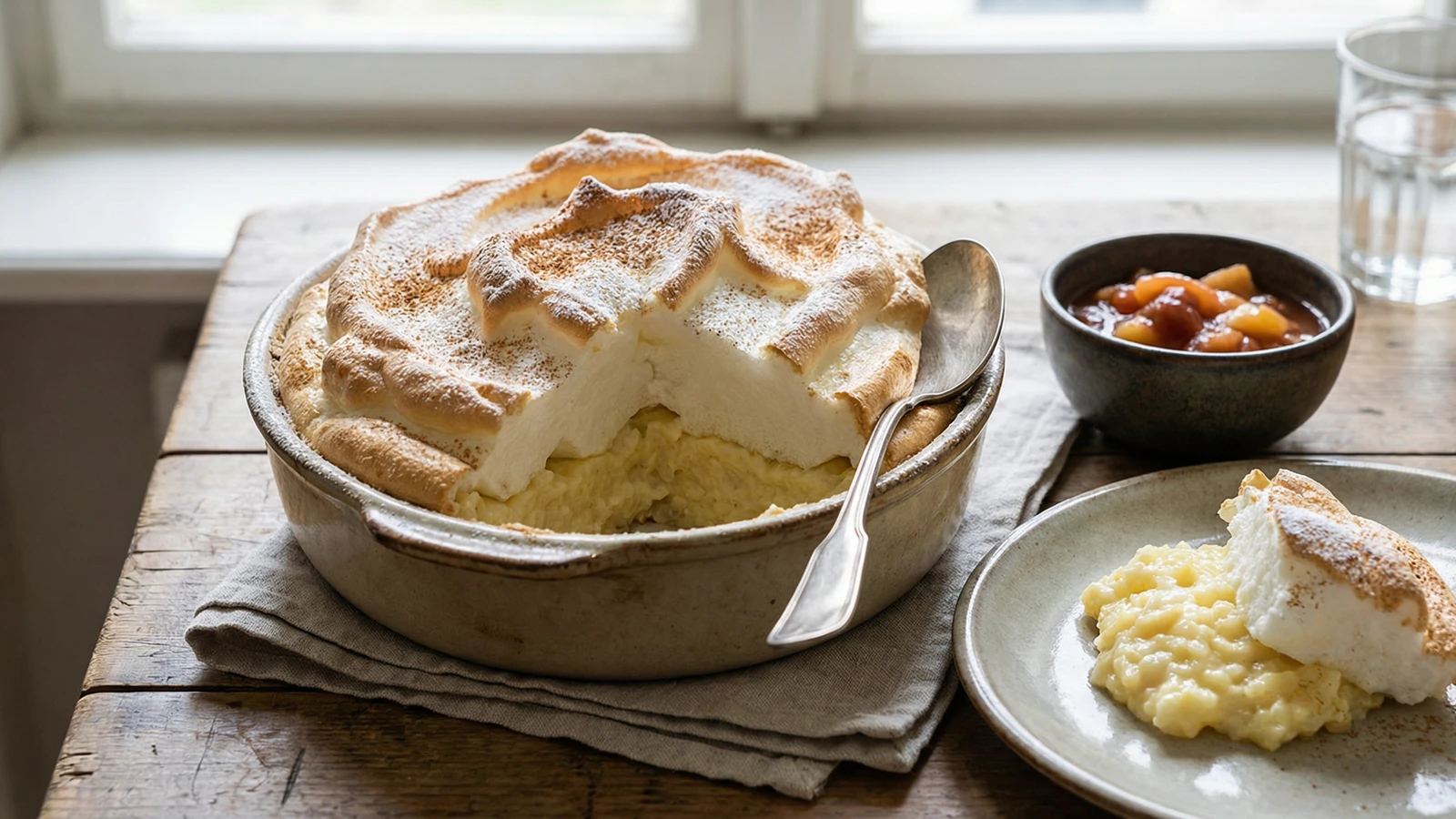
Velvety milk rice baked under a billowing golden meringue crown, dusted with cinnamon and powdered sugar, and carried to the table in its dish because this is the kind of gentle Austrian cooking that feeds a whole family from one warm pot.
Desserts
Austrian
Comfort Food
Make Ahead
20 min
Active Time
55 min cook•1 hr 15 min total
Yield6 servings
Gretel always said that Mehlspeisen are the heart of Austrian cooking. Reisauflauf proved her right every time. In my grandmother Eva's kitchen in Kent, this was a Thursday evening dish, the kind of gentle, sweet cooking that turned a quiet weeknight into something worth sitting down for. Rice simmered in milk until it went creamy and thick. Egg yolks stirred through while it was still warm. Then the whole thing crowned with a tall, billowing meringue that puffed golden in the oven. We ate it with stewed fruit, and nobody called it dessert. It was the meal.
That's something people outside Austria often miss about Mehlspeisen. These sweet dishes aren't an afterthought tacked onto the end of dinner. They are dinner. A proper Reisauflauf feeds a family. The rice base is rich with butter and Vanillezucker and egg yolks, substantial enough to satisfy, but the whipped whites folded through keep it surprisingly light, almost souffle-like under that burnished meringue crown. You dust cinnamon across the peaks just before you carry it to the table, and that warm spice smell is the signal that gets everyone into their chairs.
The technique here is forgiving. Cook the rice gently in milk, don't rush it. Whip the whites until they hold firm, glossy peaks. Fold half into the rice for lightness, pile the rest on top for drama. The oven does the rest. If you can simmer rice and separate an egg, you can make this tonight. It's good Austrian home cooking at its most comforting, and I think you'll find yourself making it again before the week is out.
Reisauflauf belongs to the vast Mehlspeisen tradition, the sweet flour-based and grain-based dishes that have been central to Austrian home cooking since at least the 18th century. In Austrian households, particularly in the countryside, a sweet Auflauf made from rice, Topfen, or semolina was served as a complete evening meal, not as a course following a savory main. The practice of crowning baked puddings with whipped meringue became fashionable in Viennese bourgeois kitchens during the Biedermeier period of the early 19th century, when domestic comfort and elaborate home cooking defined middle-class identity.
The technique, the tradition, and the story behind every dish.
•Deep ovenproof dish, about 25cm (oval gratin dish or round ceramic)
•Hand mixer or stand mixer for whipping egg whites
•Large spatula for folding
Instructions
1
Simmer the rice in milk
Pour the milk into a heavy-bottomed saucepan. Add the rice, butter, sugar for the rice, Vanillezucker, lemon zest, and a pinch of salt. Bring it to a gentle simmer over medium-low heat, then turn the flame down as low as it will go. Stir every few minutes. The rice needs about twenty-five minutes to absorb the milk and turn soft and creamy. You're looking for a thick, porridge-like consistency. If it looks too dry before the rice is tender, add a splash more milk. Don't rush this. Low heat and patience give you a silky base. High heat gives you scorched milk and a ruined pan.
Use Rundkornreis, Austrian or Italian short-grain rice. The starchy round grains release just enough starch to make the pudding creamy without turning gluey. Long-grain rice won't do the same job.
2
Cool and enrich with yolks
Take the pot off the heat and let the rice cool for about ten minutes. You want it warm, not hot. If you stir egg yolks into boiling rice, you'll scramble them and there's no coming back from that. Once it's cooled enough that you can comfortably hold your hand against the side of the pot, stir in the four egg yolks one at a time, mixing each one through completely before adding the next. If you're using rum-soaked raisins, fold them in now. The base should be thick, golden, and smell like vanilla and lemon.
3
Prepare the baking dish
Preheat your oven to 180°C (350°F). Butter a deep ovenproof dish generously, about 25 centimeters across. An oval gratin dish or a deep round ceramic works well. Scatter fine breadcrumbs over the butter, tilting the dish so they coat the bottom and sides evenly. Tap out the excess. The breadcrumbs give you a thin, golden crust that keeps the pudding from sticking and adds a quiet crunch against the soft rice.
Breadcrumbs toasted in a little butter before coating the dish add even more flavor. A minute in a dry pan is all it takes.
4
Whip the meringue
In a spotlessly clean bowl, beat the four egg whites with a pinch of salt until they foam and turn opaque. Start adding the 60 grams of sugar gradually, a spoonful at a time, while continuing to whip. Keep going until the meringue holds stiff, glossy peaks. If you lift the whisk and the peak flops over, you're not there yet. If it stands straight up and shines like satin, stop. Overwhipped meringue goes grainy and dry, and it won't give you the crown you want.
5
Fold and fill
Take about half the meringue and fold it into the rice base. Use a large spatula and work gently in wide, sweeping motions, turning the bowl as you go. You're folding air into the rice, so every rough movement deflates it. Don't worry about a few white streaks. Better a few streaks than a flat pudding. Scrape the lightened rice mixture into the prepared baking dish and smooth the top.
6
Crown with meringue
Pile the remaining meringue on top of the rice in the dish. Use the back of a spoon to shape it into high, generous peaks and swirls. Don't flatten it, don't be tidy about it. You want height. The taller the crown, the more dramatic the contrast between the crisp golden peaks and the soft, cloud-like interior underneath. This is the moment people remember when the dish comes to the table.
7
Bake until golden
Slide the dish into the middle of the oven and bake for twenty-five to thirty minutes. The meringue should turn a deep, even gold on its peaks and feel firm to a light touch. The rice underneath will set and puff slightly. Don't open the oven door for the first twenty minutes. The meringue needs steady, undisturbed heat to set properly. If you keep peeking, it will crack and deflate on you.
Every oven is different. If your meringue is browning too fast, drop the temperature by ten degrees and give it a few more minutes. You want golden, not scorched.
8
Dust and serve
Pull the Reisauflauf from the oven and dust the meringue crown generously with powdered sugar, then a light shower of ground cinnamon. The powdered sugar should settle into the peaks and valleys like snow on the Salzburg rooftops in December. Bring it to the table in its dish while it's still warm. Spoon it out generously, making sure each portion gets some of the creamy rice base and some of the golden meringue crown. A spoonful of warm fruit compote alongside, Zwetschkenröster or stewed apricots, is traditional and very welcome. Mahlzeit!
Chef Tips
•Use real Vanillezucker, not vanilla extract. Austrian Mehlspeisen depend on vanilla sugar for their particular warm sweetness. You can make your own by burying a split vanilla pod in a jar of caster sugar for a week. Once you have it, you'll use it in everything.
•The lemon zest is doing more work than you think. It lifts the whole dish and keeps the richness of the milk and butter from feeling heavy. Use a fine grater and only take the yellow part. The white pith underneath is bitter and will ruin the gentle flavor you're building.
•If you have leftover rice from the night before, you can use it. Warm it gently with the milk, butter, sugar, and flavorings until it loosens and turns creamy again. It won't be quite as silky as rice cooked fresh in milk, but it's an honest shortcut Gretel would have approved of.
•Reisauflauf is also beautiful served with a warm Marillenröster in summer, stewed Wachau apricots with a little sugar and a squeeze of lemon. In winter, try it with Zwetschkenröster or a simple warm berry compote. The fruit is not decoration. It cuts through the richness and makes the whole dish sing.
Advance Preparation
•The rice base can be cooked and enriched with the egg yolks up to a day ahead. Cover and refrigerate. Bring it back to room temperature before folding in the meringue and baking.
•Fruit compote can be made three to four days ahead and stored in the fridge. Reheat gently before serving.
•The meringue must be made fresh and the dish baked immediately after assembly. There is no way around this. Meringue waits for no one.
Frequently Asked Questions
Nutrition Information
1 serving (about 190g)
Calories
420 calories
Total Fat
14 g
Saturated Fat
7 g
Trans Fat
0 g
Unsaturated Fat
6 g
Cholesterol
155 mg
Sodium
190 mg
Total Carbohydrates
63 g
Dietary Fiber
1 g
Sugars
33 g
Protein
11 g
Where cooking meets culture.
Culinary guides, cultural storytelling, and the editorial depth that makes cooking meaningful.