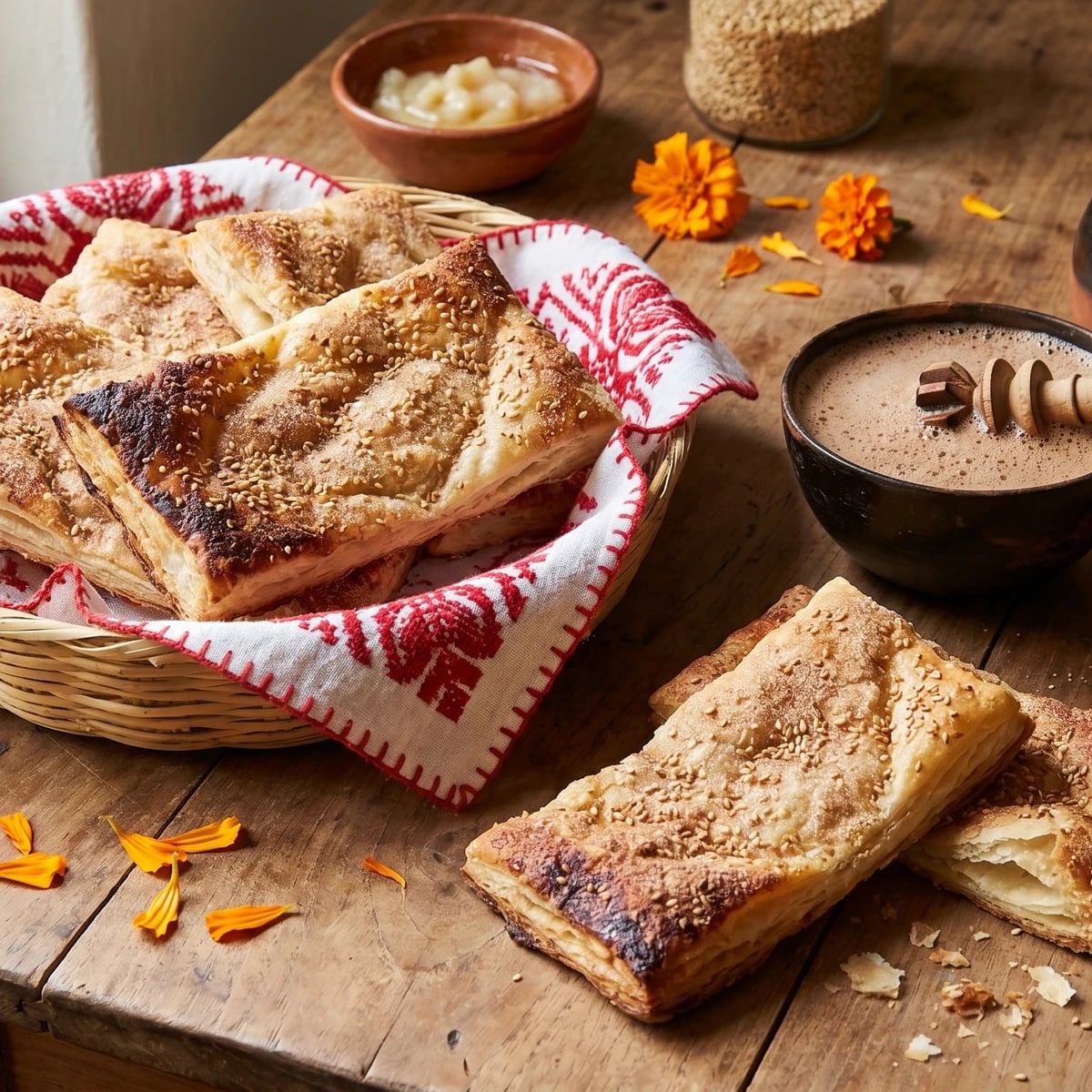
Oaxaca's flaky laminated sheet pastries, rolled paper-thin and baked crisp with ajonjolí and a dusting of canela sugar. The pastries the panaderas of the Valles Centrales pile onto altars for Día de Muertos, one for each soul coming home.
Breads
Mexican
Holiday
Special Occasion
Make Ahead
1 hr
Active Time
25 min cook•9 hr 25 min total
YieldAbout 18 pastries
This is from Oaxaca. From the panaderías of the Valles Centrales, from Tlacolula and Zaachila and Mitla, where lamination is done by hand at four in the morning and the lard is rendered in the back of the bakery from local pigs.
A regañada is a sheet of laminated dough, rolled until you can see through it, baked until it crackles, and dusted with canela sugar. It looks simple. It is not. The flake comes from the manteca de cerdo and the cold rest between turns. Use butter and you have made a French pastry. Use vegetable shortening and you have made nothing worth eating. The Oaxacan panadera will tell you the same thing: manteca, only manteca, and let the dough rest as long as it asks for. La manteca es el sabor.
On Día de Muertos, the regañadas go on the altar. One pastry for each soul expected home that night. Stacked next to the pan de yema, the chocolate de agua, the mezcal, the cempasúchil. They are not decoration. They are food for the dead, who arrive hungry from a long road. The crackle of the pastry under a thumb is part of the welcome. My mother was from Jalisco and she did not make regañadas, but I learned them from doña Eulalia in Mitla in 2009, who learned them from her mother, who learned them from hers. Doña Eulalia rolled hers so thin you could read the newspaper through them. She told me, sin prisa, mija, sin prisa. The dough does what the dough does and you wait for it. Saber cocinar es saber vivir.
This is not a Mexico City recipe. This is not pan de muerto. Cada estado, su propia cocina, and this one belongs to Oaxaca.
The regañada belongs to Oaxaca's panadería tradition, a fusion that took shape after the Spanish brought wheat, lamination techniques, and the convent baking traditions of Andalusia and Castile to the Valles Centrales in the 16th and 17th centuries. The name 'regañada,' from the verb regañar (to scold), is generally traced to the cracking, scolding sound the layers make when broken, though some Oaxacan bakers maintain the name comes from the scored lines that look like reproachful furrows. As part of Oaxaca's elaborate Día de Muertos altar tradition, recognized within UNESCO's 2008 inscription of Indigenous Festivity Dedicated to the Dead as Intangible Cultural Heritage, regañadas function alongside pan de yema and pan de muerto as one of three distinct breads with separate ritual roles, a regional precision that the homogenizing national imagination of Mexico City pan de muerto tends to obscure.
The technique, the tradition, and the story behind every dish.
manteca de cerdo (pork lard)at cool room temperature
200 grams
large egg yolks
2
whole large egg
1
cold watermore as needed
180 milliliters (3/4 cup)
mezcal or aguardiente
2 tablespoons
manteca de cerdo for laminatingvery cold
150 grams
large eggbeaten with 1 tablespoon water, for the wash
1
ajonjolí (sesame seeds)
2 tablespoons
granulated sugar for dusting
1/2 cup
ground canela (Mexican cinnamon)for dusting
1 teaspoon
Equipment Needed
•Long wooden rolling pin (palote)
•Bench scraper
•Two heavy baking sheets
•Parchment paper
•Pastry brush
•Wire cooling rack
•Tin or glass container with a tight lid for storage
Instructions
1
Build the base dough
In a wide bowl, whisk together the flour, salt, and the tablespoon of sugar. Add the 200 grams of room-temperature manteca and rub it into the flour with your fingertips until the mixture looks like coarse cornmeal. The fat coats the flour and that coating is what gives the regañada its flake. No me vengas con atajos. Do not use butter and do not use vegetable shortening. Manteca de cerdo. La manteca es el sabor.
If your manteca is too soft, the dough turns greasy. If it is rock-cold, it will not blend evenly. Cool room temperature, the texture of soft modeling clay, is what you want.
2
Add the wet ingredients
In a small bowl, whisk together the egg yolks, the whole egg, the cold water, and the mezcal. Pour into the flour mixture. Bring the dough together with a wooden spoon, then turn it out onto the counter and knead just until smooth, about three minutes. The dough should be firm but pliable, never sticky. Add a tablespoon more water only if the dough refuses to come together. Wrap in a clean cloth and rest for 30 minutes at room temperature. The rest relaxes the gluten and the lamination later will not fight you.
3
Laminate the dough
On a lightly floured surface, roll the rested dough into a rectangle about 40 by 25 centimeters and 5 millimeters thick. Spread one third of the cold laminating manteca evenly across the surface in small dabs, leaving a thin border. Fold the dough into thirds like a letter, business fold. Turn it 90 degrees, roll out again to the same rectangle, dab with another third of the cold manteca, and fold. Repeat one final time with the last third. Three turns, three lamintations. Wrap and refrigerate for at least four hours, ideally overnight. The cold rest is not optional. The fat needs to firm up between the layers or the regañadas will not flake.
If the kitchen is warm and the dough starts to feel greasy between turns, refrigerate for 20 minutes before continuing. Mexican panaderas in Oaxaca laminate at dawn for a reason. The cool morning air keeps the lard solid.
4
Roll paper-thin
Take the rested dough out of the refrigerator and let it sit for 10 minutes so it rolls without cracking. Divide into 18 equal pieces, about 50 grams each. Cover the pieces you are not working with so they do not dry out. On a lightly floured surface, roll each piece into a thin oval or rectangle, about 12 by 18 centimeters and just under 2 millimeters thick. You should be able to see the shadow of your hand through the dough when you hold it up. This thinness is the regañada. A thick regañada is no regañada. Asi se hace y punto.
5
Score and dock
Lay each rolled piece on a parchment-lined baking sheet, leaving a finger of space between them. Brush each with the egg wash. Scatter ajonjolí across the surface. With the tip of a sharp knife, score three or four shallow diagonal lines across the top, cutting through the egg wash but not all the way through the dough. The score lets the steam escape and gives the regañada its characteristic crackled top. Prick the surface several times with a fork so it does not balloon.
6
Bake until golden
Heat the oven to 200 degrees Celsius (400 degrees Fahrenheit). Bake the regañadas for 12 to 15 minutes, rotating the sheets halfway through, until the tops are deep golden brown and the layers have visibly separated along the edges. They should be crisp through, with no flexible spots. A regañada that bends is underbaked. The kitchen will smell like toasted lard and sesame, the way a panadería in Tlacolula smells before the sun is up.
7
Dust and cool
Mix the half cup of sugar with the canela in a small bowl. While the regañadas are still warm from the oven, dust the tops generously with the cinnamon sugar. The residual heat helps the sugar cling. Let them cool completely on a wire rack before stacking. Stored in a tin lined with cotton cloth, they keep crisp for up to two weeks. Recetas probadas y garantizadas.
Chef Tips
•Manteca de cerdo is non-negotiable. Find a Mexican carnicería and ask for fresh-rendered lard, the cream-colored kind, not the bleached hydrogenated bricks at the supermarket. If your local carnicería renders their own, that is what doña Eulalia uses and that is what you should use. A substitution to butter is a compromise that changes the dish into something else.
•The dough can be laminated and refrigerated overnight, or even up to two days. The longer cold rest only makes the lamination cleaner and the flake more defined. The Oaxacan panaderas mix the dough at night and laminate it before dawn for a reason.
•Roll thin. Then roll thinner. A regañada that looks like a cracker is wrong. It should be almost translucent, with the layers showing as faint stripes across the surface. If you can read the headline of a newspaper through it, you are close to right.
•The canela has to be Mexican canela, the soft cinnamon you can crush between your fingers. Cassia cinnamon from a supermarket jar is too aggressive and will overwhelm the toasted lard and ajonjolí.
Advance Preparation
•The laminated dough can be made up to two days ahead and refrigerated, well wrapped, before rolling and baking. The flake actually improves with the longer cold rest.
•Baked regañadas keep crisp for up to two weeks stored in a tin lined with a cotton cloth. Do not refrigerate them. The humidity will rob the flake.
•For Día de Muertos, the regañadas are typically baked two or three days before October 31 so they are ready when the altar is built. They are meant to last on the altar for the duration of the holiday.
Frequently Asked Questions
Nutrition Information
1 serving (about 73g)
Calories
320 calories
Total Fat
21 g
Saturated Fat
8 g
Trans Fat
0 g
Unsaturated Fat
12 g
Cholesterol
55 mg
Sodium
140 mg
Total Carbohydrates
28 g
Dietary Fiber
1 g
Sugars
6 g
Protein
4 g
Where cooking meets culture.
Culinary guides, cultural storytelling, and the editorial depth that makes cooking meaningful.