
Chef Lupita
Aceite de Chiltepin Bajacaliforniano
Baja California's wild chiltepin steeped in olive oil with garlic, orejon, and lime peel, until the oil turns ruby-amber and carries the slow, sneaky burn of the desert coast.
A cooking platform built around craft, culture, and the stories behind what we eat.

Created by
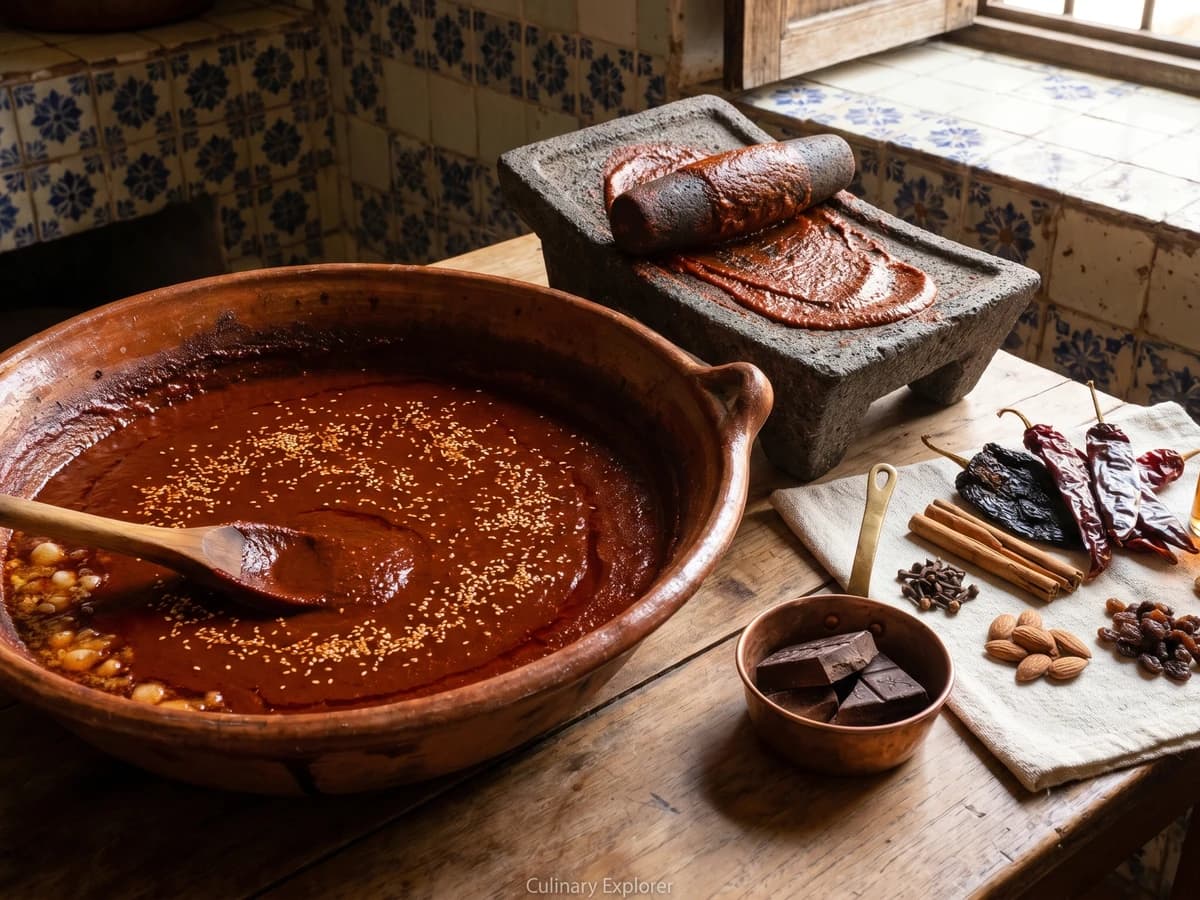
Puebla's conventual recado for celebration stews, a metate-ground paste of ancho chile, almonds, sesame, saffron, clove, cinnamon, peppercorn, and jerez that needs two days to settle.
Puebla, inside the old convent kitchens of the Centro Histórico, is where this recado belongs. Think of Santa Rosa's talavera-lined kitchen, Santa Mónica's long institutional tables, Santa Clara's discipline with sugar, spice, and chile. This is not a plate. This is the architecture underneath a festive estofado.
The chile here is ancho, not guajillo, not árbol, not whatever was left in the drawer. Ancho gives raisin-dark sweetness and a brick-red body that can carry saffron, cloves, black peppercorn, canela, almonds, sesame, raisins, and a little jerez. The conventual register is always a conversation between the milpa and the ships that came from Spain: chile and tomato on one side, almendra and canela on the other.
El metate es la regla. A blender can help a tired modern cook, but the paste should be worked until it is glossy, dense, and heavy enough to hold a spoon upright. Then it is fried in manteca, simmered slowly, cooled, and left for two days. No me vengas con atajos. A baroque recado tastes confused on the first day and disciplined on the third.
My mother didn't make this every year. It was too much work for an ordinary Sunday. But in her notebook she wrote beside a Puebla estofado, 'recado primero, carne después.' She was right. Build the sauce before you ask it to carry the celebration. Saber cocinar es saber vivir.
Puebla's convent kitchens, especially the Dominican convent of Santa Rosa and the Augustinian convent of Santa Mónica, became important centers of criollo cooking during the 17th and 18th centuries because they had access to indigenous chiles and tomatoes as well as imported almonds, cinnamon, cloves, saffron, and jerez. Estofados and moles from these houses were not single fixed recipes but families of sauces, built from toasted chiles, ground nuts, spices, sweet fruit, and lard, then used to dress poultry, pork, or kid for feast days. The famous tiled kitchen of Santa Rosa, now part of Puebla's Museo de Arte Popular, remains the clearest architectural witness to that conventual cooking system.
Quantity
6
stemmed, seeded, and wiped clean
Quantity
2
stemmed, seeded, and wiped clean
Quantity
1
stemmed, seeded, and wiped clean
Quantity
1/2 cup
Quantity
1/4 cup, plus 1 tablespoon if finishing the dressed estofado
Quantity
3 tablespoons
Quantity
1
torn into pieces
Quantity
1 slice
torn into pieces
Quantity
3 medium
Quantity
1/2 medium
thickly sliced
Quantity
4
unpeeled
Quantity
1/2 teaspoon
Quantity
6
Quantity
8
Quantity
4
Quantity
1 2-inch piece
Quantity
1/2 teaspoon
Quantity
1/2 teaspoon
Quantity
1/4 teaspoon
Quantity
1/3 cup
Quantity
1 1/2 cups
divided
Quantity
1/3 cup
Quantity
1 1/2 teaspoons, plus more to taste
Quantity
1 teaspoon
finely grated
| Ingredient | Quantity |
|---|---|
| dried chile anchostemmed, seeded, and wiped clean | 6 |
| dried chile mulatostemmed, seeded, and wiped clean | 2 |
| dried chile pasilla mexicanostemmed, seeded, and wiped clean | 1 |
| blanched almonds | 1/2 cup |
| sesame seeds | 1/4 cup, plus 1 tablespoon if finishing the dressed estofado |
| raisins | 3 tablespoons |
| small corn tortillatorn into pieces | 1 |
| bolillo or firm white breadtorn into pieces | 1 slice |
| Roma tomatoes | 3 medium |
| white onionthickly sliced | 1/2 medium |
| garlic clovesunpeeled | 4 |
| saffron threads | 1/2 teaspoon |
| whole cloves | 6 |
| whole black peppercorns | 8 |
| whole allspice berries | 4 |
| Mexican canela | 1 2-inch piece |
| dried thyme | 1/2 teaspoon |
| dried Mexican oregano | 1/2 teaspoon |
| ground nutmeg | 1/4 teaspoon |
| dry jerez | 1/3 cup |
| hot water or light chicken brothdivided | 1 1/2 cups |
| pork lard | 1/3 cup |
| fine sea salt | 1 1/2 teaspoons, plus more to taste |
| piloncillofinely grated | 1 teaspoon |
Open the ancho, mulato, and pasilla chiles with kitchen scissors. Remove stems, seeds, and veins. Wipe the skins with a damp cloth if they are dusty. Do not rinse them under running water. You paid for chile oils, not for the sink to take them away.
Heat a dry comal over medium. Toast the chiles one at a time, pressing each piece flat for 10 to 15 seconds per side until the skin softens, darkens slightly, and smells sweet, like raisins and tobacco. The pasilla is thin, so watch it. If a chile blackens, throw it out. Burned chile makes bitter recado and the convent nuns did not spend saffron money to hide your mistake.
Put the toasted chiles in a bowl and cover with hot water. Hot, not boiling. Set a small plate on top to keep them submerged and let them soften for 25 minutes. Drain, saving 1 cup of the soaking liquid only if it tastes clean and not bitter. If it tastes harsh, use light chicken broth instead.
On the same comal, toast the almonds until pale gold in spots. Toast the sesame seeds separately, stirring constantly, until they turn golden and smell nutty. Then toast the raisins just until they puff. Keep each ingredient separate. They brown at different speeds, and a serious recado is built by control, not by dumping everything together.
Toast the torn tortilla and bread on the comal until dry, spotted, and crisp at the edges. They are not filler. They give the paste body so it can cling to meat during the estofado. If they stay soft, the recado turns loose and weak.
Roast the tomatoes, onion slices, and unpeeled garlic on the comal until the tomatoes blister and collapse, the onion has dark brown edges, and the garlic is soft inside its skins. Peel the garlic. Do not scrape away every charred spot from the tomato. That bitterness, in the correct amount, belongs with the sweetness of the raisins and almond.
Toast the saffron threads for a few seconds in a dry small skillet, just until fragrant, then crumble them into the jerez. Toast the cloves, peppercorns, allspice, and canela for 30 to 45 seconds, moving them constantly. Grind them with the thyme, oregano, and nutmeg. Spices this expensive deserve attention. Pregúntale a las señoras del mercado.
On a metate, grind the toasted spices first, then the almonds, sesame, raisins, tortilla, and bread. Work in the chiles a few pieces at a time, followed by the roasted tomato, onion, garlic, and saffron-soaked jerez. Add only enough soaking liquid or broth to keep the paste moving. The finished recado should be smooth, glossy, and heavy, closer to wet clay than salsa. El metate es la regla.
Melt the lard in a heavy clay cazuela or Dutch oven over medium heat. Add the recado carefully. It will sputter. Stir with a wooden spoon for 12 to 15 minutes, scraping the bottom, until the paste darkens from red brick to deep garnet and the fat begins to shine at the edges. La manteca es el sabor. Oil will cook it. Lard will make it taste like Puebla.
Stir in the remaining broth or clean soaking liquid, the salt, and the grated piloncillo. Lower the heat and simmer uncovered for 45 to 60 minutes, stirring often, until the recado thickens again and leaves a clear trail when you drag the spoon across the bottom of the cazuela. Taste for salt. It should be assertive because it is meant to season meat later, not sit politely in a jar.
Cool the recado completely. Pack it into a clean glass jar, press a small spoonful of melted lard over the surface, cover, and refrigerate for at least 48 hours. Two days minimum. On day one the clove and saffron shout. By day three the chile, almond, jerez, and spice have learned to work together. Así se hace y punto.
For estofado, rub 3 to 4 pounds of chicken, pork, kid, or beef with 1 1/2 to 2 cups of the recado and let it sit overnight before braising. Thin the remaining recado with stock in the cooking pot. This recipe gives you the sauce base only. The celebration dish it dresses belongs in the estofado recipe, not here.
1 serving (about 60g)
Culinary guides, cultural storytelling, and the editorial depth that makes cooking meaningful.
Discover Culinary ExplorerChef Lupita
Baja California's wild chiltepin steeped in olive oil with garlic, orejon, and lime peel, until the oil turns ruby-amber and carries the slow, sneaky burn of the desert coast.

Chef Lupita
Puebla's Lenten convent adobo, a brick-red vinegar chile paste of ancho, guajillo, garlic, oregano, and comino made to dress fish for the meatless calendar.
Chef Lupita
Zacatecas' wedding-table adobo, built from toasted guajillo and ancho, piloncillo, sour orange, chocolate, canela, clavo, almonds, sesame, and lard.

Chef Lupita
Puebla's convent kitchens built this adobo with ancho, guajillo, jerez, almonds, raisins, clove, and lard, a baroque marinade that stains pork loin and finishes as the sauce.