
Chef Takumi
Anpan (あんぱん)
Anpan is not a pastry trick. It is soft bread, sweet azuki, and a careful seal, so the bean paste stays centered while the bun rises round and tender.
A cooking platform built around craft, culture, and the stories behind what we eat.
Created by
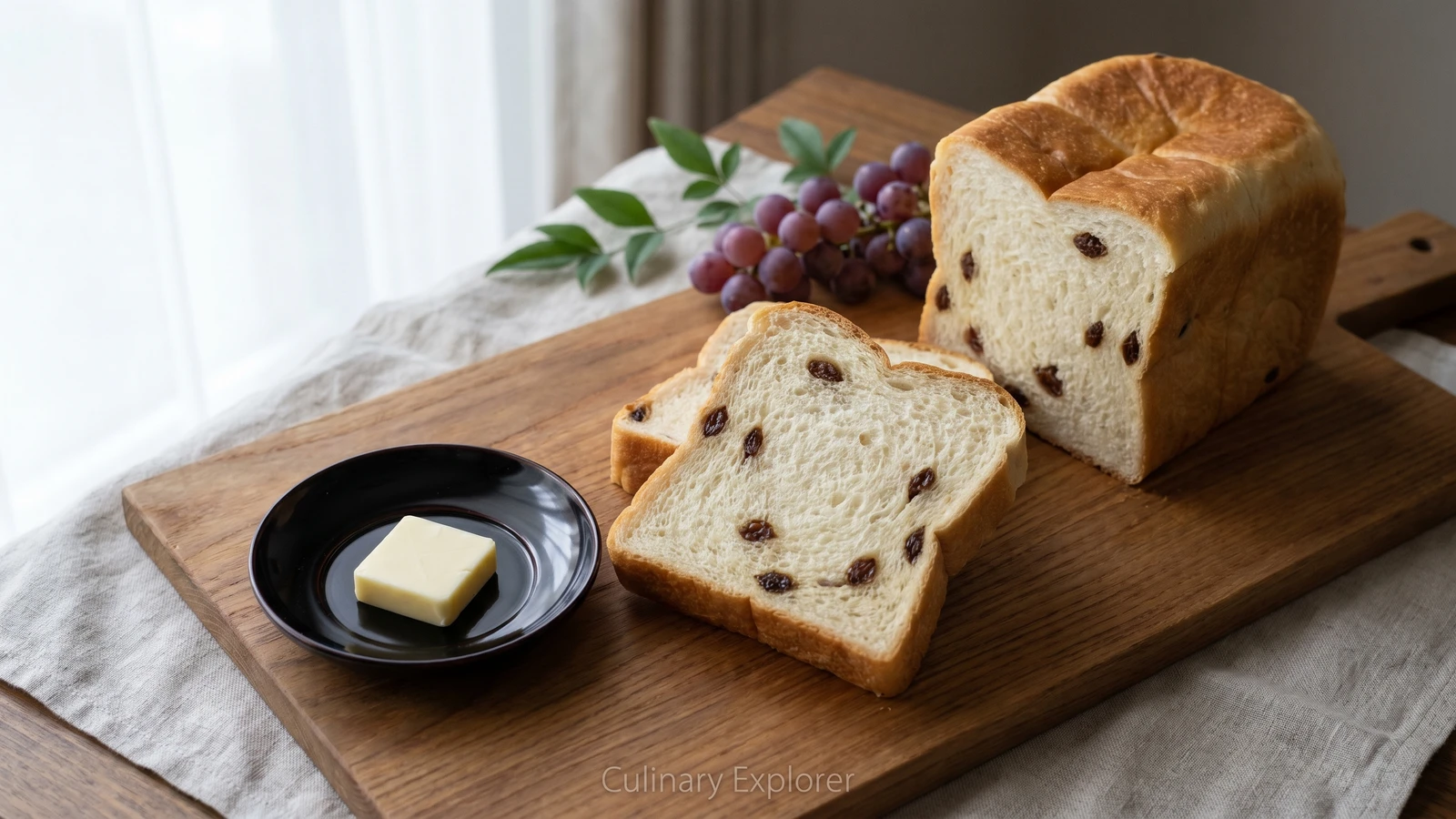
Soak the raisins first, then let yudane do its quiet work. The loaf bakes tall, tender, and gold, with sweet fruit ribboned through the crumb.
Raisins are greedy little things. Put them into bread dry and they'll steal water from the dough, then you wonder why the loaf that promised softness eats like yesterday's toast. So we soak them first. Not as fussing. As fairness.
At a panya counter, the bakery version is usually neat and tall, sold as thick slices for breakfast toast, with raisins running through the white crumb like small dark seams. At home, the same loaf is within reach if you respect two things: moisture and shaping. The moisture comes from yudane, a scalded-flour starter that pre-gelatinizes the starch so the crumb stays soft for days. This is Japanese baking science, not a trick with a pretty name.
The shaping decides the loaf. Roll the raisins into the dough after the first rise, not by scattering them wildly through the mixer, because whole soaked fruit tears gluten when the machine has its way with it. Roll gently, press out the big bubbles, and coil the dough into the tin so the fruit follows the spiral. Cut into it later and the crumb tells you whether your hands were calm.
Bake it lidded for kaku shokupan, a square Pullman loaf with fine, even slices, or unlidded for yamagata, the rounded mountain loaf that browns more proudly on top. One dough, two finished breads. Neither is more honmono. They simply answer different hungers.
Shokupan grew out of Japan's modern bread culture after the Meiji period, but it became an everyday household loaf in the twentieth century through urban bakeries and school-lunch bread programs. Raisin shokupan is a familiar panya counter variation, usually sliced thick and toasted, with the fruit folded into the same soft white pan bread dough used for plain shokupan. Yudane, the scalded-flour method used in Japanese baking, was studied by Japan's National Agriculture and Food Research Organization for its effect on starch gelatinization and bread softness.
Quantity
60g
Quantity
60g
Quantity
100g
Quantity
80g
for soaking the raisins
Quantity
240g
Quantity
25g
Quantity
5g
Quantity
5g
Quantity
120g
lukewarm
Quantity
35g
Quantity
25g
softened
Quantity
as needed
for greasing the tin
| Ingredient | Quantity |
|---|---|
| bread flour, for yudane | 60g |
| boiling water, for yudane | 60g |
| raisins | 100g |
| hot waterfor soaking the raisins | 80g |
| bread flour | 240g |
| sugar | 25g |
| fine sea salt | 5g |
| instant yeast | 5g |
| whole milklukewarm | 120g |
| beaten egg | 35g |
| unsalted buttersoftened | 25g |
| neutral oil or butterfor greasing the tin | as needed |
Put 60g bread flour in a heatproof bowl and pour the boiling water over it all at once. Stir with chopsticks or a small spatula until no dry flour remains and the paste looks slightly glossy. Cover and let it cool completely, at least 1 hour, or refrigerate it overnight. The boiling water gelatinizes the starch, and that is why the finished crumb stays moist instead of turning dry by the next morning.
Cover the raisins with the hot water and leave them for 20 minutes, until plump and flexible. Drain well, then spread them on a towel and pat dry. Soaked raisins stay tender in the loaf; dried ones drink from the dough and leave the crumb tight around them.
In the bowl of a stand mixer, combine the remaining bread flour, sugar, salt, and yeast. Tear the cooled yudane into small pieces and add it with the lukewarm milk and beaten egg. Mix on low until the dough gathers, then knead on medium-low for 6 to 8 minutes, until it looks smooth and pulls from the sides of the bowl. The dough should feel tacky, not dry; shokupan softness begins with enough water in the dough.
Add the softened butter in two or three pieces and knead another 5 to 7 minutes, until the dough is elastic and smooth again. It may look slippery at first. Be patient. Butter coats the gluten, so adding it after the dough has formed gives you strength first and tenderness after.
Shape the dough into a ball, place it in a lightly oiled bowl, cover, and let it rise in a warm place until doubled, about 60 to 80 minutes. Press a floured finger into the dough; if the dent slowly fills halfway, it is ready. If it springs back at once, give it more time. Yeast follows temperature, not your clock.
Turn the dough onto a lightly floured surface and press it gently into a rectangle about 25 by 30cm. Scatter the dried soaked raisins evenly over the surface, leaving a narrow border. Fold the dough in thirds like a letter, then press it out gently once more. This settles the fruit into layers without tearing the gluten in the mixer.
Grease a 20 by 10cm shokupan tin or small Pullman pan. Roll the dough from the short end into a tight cylinder, pinching the seam closed, then place it seam-side down in the tin. For a more even crumb, divide the dough into two equal pieces, roll each into a small cylinder, and set them side by side in the tin. Tight shaping builds the loaf upward instead of letting it spread flat.
Cover the tin and proof until the dough rises to about 1.5cm below the rim for kaku, or just over the rim for yamagata, about 45 to 70 minutes. For kaku, slide the lid on once the dough is nearly at height. Underproofed dough bakes dense at the bottom; overproofed dough collapses against the lid or spills over the tin.
Heat the oven to 190 C. Bake kaku shokupan with the lid on for 30 to 35 minutes, or yamagata uncovered for 28 to 33 minutes, until the crust is matte gold and the loaf sounds hollow when tapped. The center should reach about 93 C if you use a thermometer. The color matters, but the center decides doneness.
Remove the loaf from the tin at once and cool it on a rack for at least 1 hour before slicing. Hot shokupan looks ready before it is ready; slice too soon and the crumb compresses under the knife. Let it set, then cut thick slices for toast, where the raisins soften again and the crust catches a little more gold.
1 serving (about 70g)
Culinary guides, cultural storytelling, and the editorial depth that makes cooking meaningful.
Discover Culinary ExplorerChef Takumi
Anpan is not a pastry trick. It is soft bread, sweet azuki, and a careful seal, so the bean paste stays centered while the bun rises round and tender.
Chef Takumi
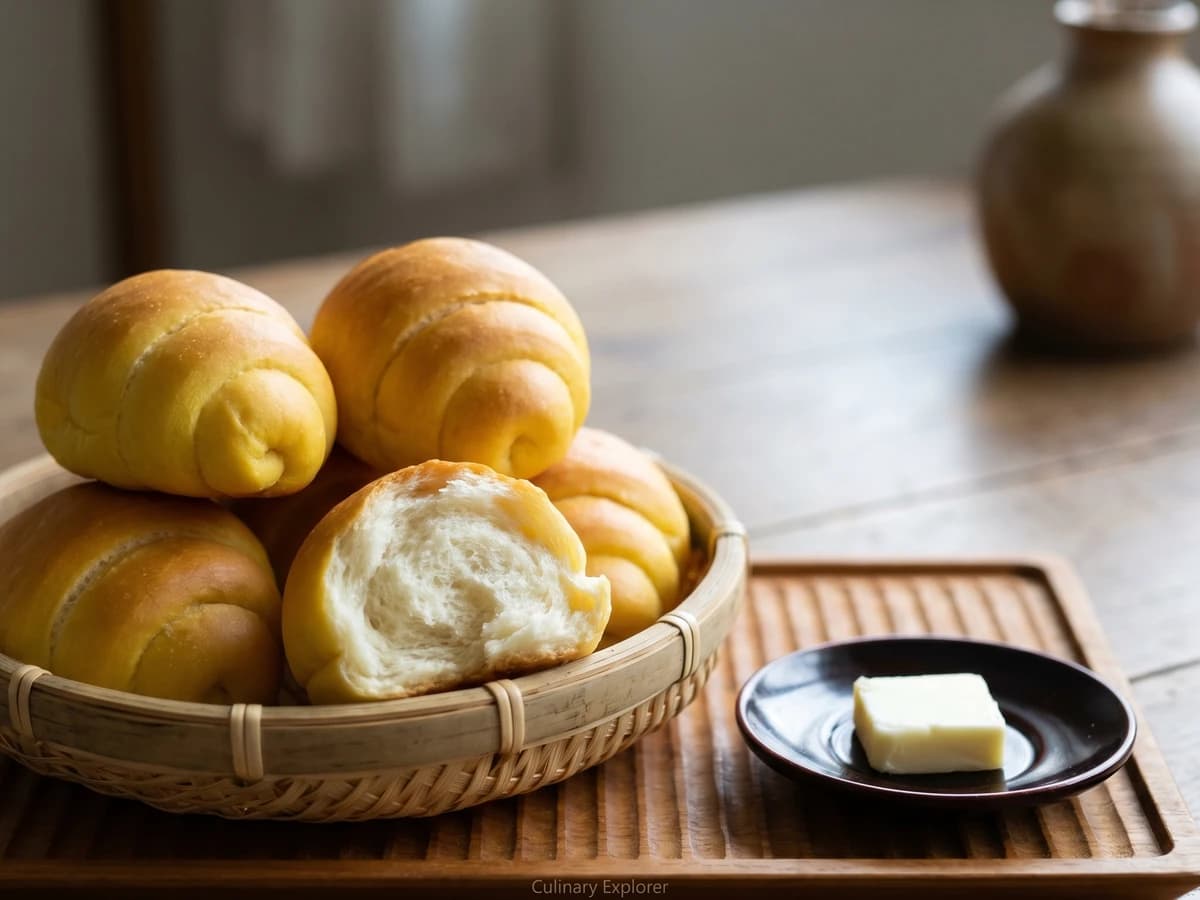
A panya staple made reachable: soft milk dough rolled wide-to-narrow into its little horn shape, proofed until light, then brushed with egg for that quiet gold crust.

Chef Takumi
Chigiri-pan is bread made small on purpose: soft enriched dough portioned into neat balls, crowded in a square tin, and baked until every tender roll tears away with its own golden edge.

Chef Takumi
Choco cornet looks clever, which is how bakery bread frightens sensible people. Wrap a soft rope around a cone, bake it golden, then pipe in chocolate cream only after the shell is cool.