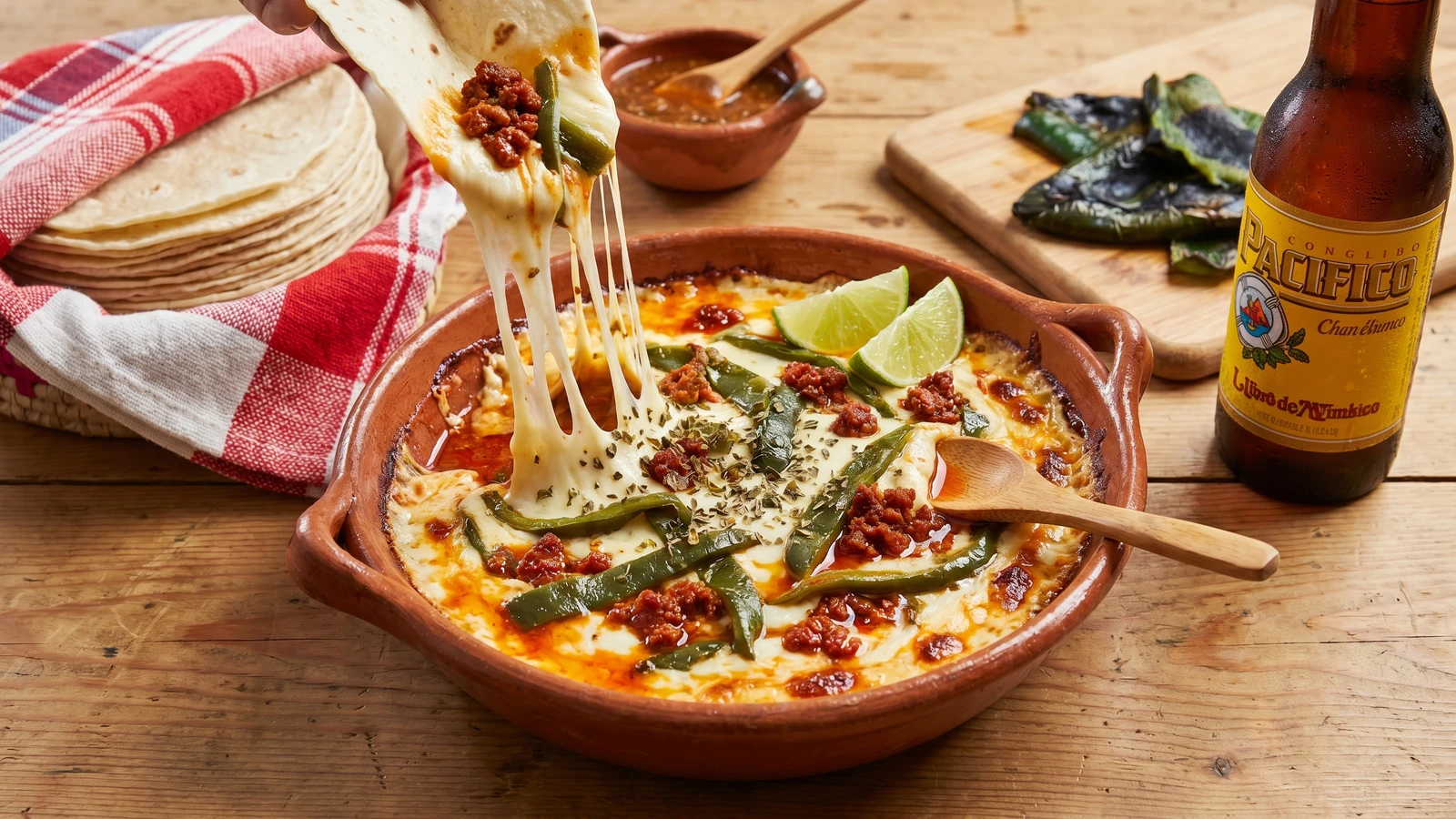
Sonora's molten cazuela of queso Oaxaca and asadero, layered with rendered chorizo rojo and roasted poblano rajas, scooped into the state's famously thin flour tortillas while the cheese still pulls.
Appetizers & Snacks
Mexican
Dinner Party
Comfort Food
BBQ
20 min
Active Time
25 min cook•45 min total
Yield6 to 8 servings
This is from Sonora. The northern state of cattle ranches, wheat fields, and the wide flour tortilla, where dairy is taken seriously and the queso fundido is built on layered cheese, not the mixed-up stew of melted everything that some places try to pass off.
Sonorense queso fundido is queso Oaxaca and queso asadero. That is the pairing. The Oaxaca pulls into long elastic strands and gives you the texture. The asadero, which Sonora and Chihuahua perfected, melts into a creamy body underneath. Together they do what no single cheese can do alone. The chorizo rojo is rendered until the achiote fat runs orange and crisps the meat at the edges. The rajas are cut from chile poblano roasted black over an open flame. Wider strips than the central-Mexico version. In Sonora the rajas are generous because the rajas matter.
Flour tortillas, not corn. I will say it once and I will not apologize for it. The flour tortilla is a northern tradition tied to the wheat that grows in Sonora's irrigated valleys, and it is the right vehicle for this dish. A real tortilla de harina sonorense is paper-thin, flexible, cooked on a comal, and almost translucent when you hold it up to the light. If you can find them or make them, do. If you reach for a corn tortilla here you have made a different dish. Cada estado, su propia cocina.
My mother was from Jalisco and queso fundido was not her tradition, but she had a friend from Hermosillo who taught her this version one winter in Mexico City. The friend brought her own flour tortillas in a tin and would not let anyone touch the cheese until the cazuela came out of the oven. She was right about that. La cocina no es decoracion, es trabajo.
Queso fundido is a child of the dairy belt of northern Mexico, particularly Sonora, Chihuahua, and Durango, where Mennonite communities established in the early 20th century built the cheese-making infrastructure that produced asadero, Chihuahua, and other meltable curd cheeses unlike anything in the central or southern Mexican repertoire. Asadero itself, whose name comes from the Spanish for 'roaster' or 'one for grilling,' was developed specifically as a melting cheese in northern ranch kitchens during the 19th and early 20th centuries. The dish's pairing with thin flour tortillas reflects Sonora's status as Mexico's largest wheat-producing state, a tradition rooted in the irrigated agriculture of the Yaqui and Mayo river valleys and in the Jesuit missions that introduced wheat cultivation to the region in the 17th century.
The technique, the tradition, and the story behind every dish.
fresh flour tortillas (tortillas de harina sonorenses)warmed
12 to 16
salsa de chile de arbol (optional)
for serving
lime wedges (optional)
for serving
Equipment Needed
•8-inch clay cazuela or small cast iron skillet for baking
•10-inch cast iron skillet for the chorizo and rajas
•Tongs for turning the poblanos over the flame
•Cast iron comal for warming the flour tortillas
•Box grater
Instructions
1
Roast the poblanos
Set the chiles poblanos directly over an open gas flame on high, or under a broiler turned to its highest setting. Turn them with tongs every minute or so until the skin is blackened and blistered on every side. The chile should look ruined. That is what you want. Drop the charred poblanos into a bowl, cover tightly with a plate or plastic wrap, and let them sweat for ten minutes. The trapped heat loosens the skin from the flesh.
Do not rinse the chiles under water to remove the skin. Water washes away the smoky oils that the fire just put there. Rub the skin off with a paper towel or your fingers. A few black flecks left behind are good. They are flavor, not dirt.
2
Cut the rajas
Once the poblanos are cool enough to handle, peel off the blackened skin. Stem them, slit them open, and scrape out the seeds and white veins. Slice the flesh into strips about a quarter-inch wide. These are your rajas. In Sonora the rajas are cut wider than they are in central Mexico, generous, not delicate. The poblano carries the dish.
3
Render the chorizo
Heat a 10-inch cast iron skillet over medium. Add the chorizo, breaking it up with a wooden spoon. Cook for six to eight minutes, until the fat renders out red and the meat darkens at the edges. Good chorizo will release a generous pool of orange-red fat. That is achiote and chile working. Do not drain it. Use a slotted spoon to lift the cooked chorizo into a small bowl, leaving the rendered fat in the skillet.
4
Cook the rajas with onion
Add the tablespoon of manteca to the chorizo fat in the skillet. Add the sliced onion and a pinch of salt. Cook over medium heat for five minutes, until the onion turns translucent and starts to take on color at the edges. Add the minced garlic and the poblano rajas. Cook another three minutes, stirring, until everything smells sweet and toasted. Stir in the oregano, crumbling it between your fingers as it goes in. Taste for salt. Pull the rajas off the heat and into a bowl. Wipe the skillet clean.
5
Layer the queso fundido
Heat the oven to 400F. In an 8-inch cazuela of clay or a small cast iron skillet, layer half the Oaxaca and half the asadero on the bottom. Scatter half the rajas and half the chorizo over the cheese. Repeat with the remaining cheese, then the remaining rajas and chorizo across the top. The Sonora way is layered, not stirred. Each spoonful that comes out should pull a little of everything.
Pre-shredded supermarket cheese will not work. It is coated in cellulose to keep the strands separate, and it melts into a grainy puddle instead of the long, elastic pull you want. Buy the cheese whole and shred it yourself. No me vengas con atajos.
6
Bake until bubbling
Slide the cazuela into the hot oven and bake for ten to twelve minutes. The cheese should be fully melted, glossy across the top, with browned bubbling spots where the chorizo fat has risen up through it. The edges should be deep gold and starting to crisp against the clay. Pull it out the moment you see those darkened edges. The cheese will keep cooking from the residual heat of the cazuela.
7
Warm the tortillas and serve
While the cheese bakes, heat a comal over medium-high. Warm the flour tortillas one at a time, about thirty seconds per side, until they are pliable and softly blistered. Stack them in a cloth servilleta to keep them warm. Bring the cazuela straight to the table on a wooden trivet. Set the salsa and lime alongside. Each person tears a tortilla open, scoops a generous spoonful of the molten cheese, the rajas, and the chorizo into the center, rolls it up, and eats it immediately. Eat it now. Queso fundido that sits ten minutes turns into a chewy, sad puck. Asi se hace y punto.
Chef Tips
•Buy your cheese from a Mexican market or a deli that cuts the wheel for you. Pre-shredded bagged cheese is treated with anti-caking starch that ruins the melt. Queso Oaxaca should pull apart in long ropes when you tear it. Asadero should slice cleanly and feel slightly springy.
•Sonoran chorizo is different from Toluca chorizo. If you can find chorizo sonorense, use it. Otherwise a good fresh Mexican chorizo rojo will do the job. Spanish cured chorizo is not a substitute. It is a different ingredient entirely and it will not render the same way.
•Roast the poblanos over an open flame if you have a gas stove. The smoky char from direct fire is part of the dish. A broiler works but it is the second-best option. Boiling or microwaving the chiles is not roasting and the result tastes flat.
•Make the flour tortillas yourself if you have the time. Real tortillas de harina sonorense use lard, not vegetable shortening, and they are stretched paper-thin by hand. The supermarket flour tortilla is a different food. La manteca es el sabor.
Advance Preparation
•The rajas can be roasted, peeled, and sliced one day ahead and refrigerated. The flavor actually improves overnight as the smoke deepens.
•The chorizo can be rendered one day ahead and stored in the refrigerator with its fat. Rewarm gently before assembling.
•The cheese should be shredded fresh on the day you cook. Shredded cheese left overnight dries at the edges and the melt suffers.
•Once the cazuela goes into the oven, queso fundido is a now-or-never dish. Do not bake it ahead. Reheated melted cheese turns rubbery and the magic is gone.
Frequently Asked Questions
Nutrition Information
1 serving (about 335g)
Calories
820 calories
Total Fat
43 g
Saturated Fat
19 g
Trans Fat
0.5 g
Unsaturated Fat
22 g
Cholesterol
90 mg
Sodium
1720 mg
Total Carbohydrates
73 g
Dietary Fiber
4 g
Sugars
3 g
Protein
33 g
Where cooking meets culture.
Culinary guides, cultural storytelling, and the editorial depth that makes cooking meaningful.