
Chef Lupita
Acitrón de Cidra Conventual
Puebla's convent-style acitrón, made from cidra peel instead of endangered biznaga, built through repeated syrup soakings until the cubes turn firm, translucent, and ready for rosca or chiles en nogada.
A cooking platform built around craft, culture, and the stories behind what we eat.
Created by
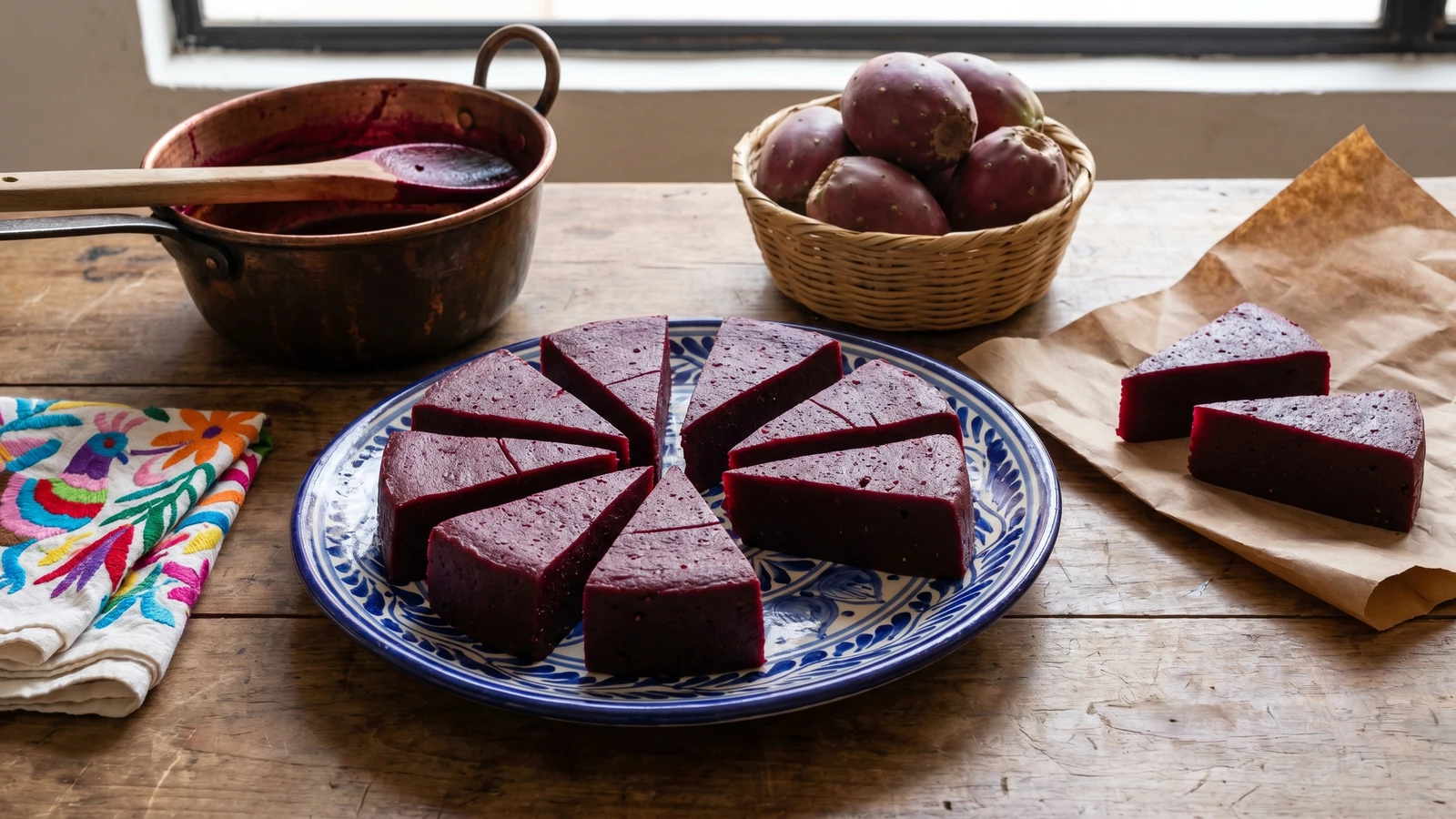
San Luis Potosi's dense, ruby-black queso de tuna, made only from tuna cardona cooked down slowly until the fruit sets firm enough to slice like cheese.
San Luis Potosi, the Altiplano Potosino, the old Gran Tunal: this is where queso de tuna belongs. Not in a pastry case with shiny wrappers. In the dry country where the nopal cardon gives tuna cardona, dark red fruit with seeds that crack under the teeth if you are careless. The women who perfected this were not decorating sweets. They were preserving the harvest.
This candy has no milk. The word queso comes from the shape and the slice, not from dairy. You cook the pulp of tuna cardona slowly until the water leaves and the fruit sugars tighten into a dense paste. Then you press it into a round mold, weight it, dry it, and cut it in wedges like a small cheese. Sin lacteo. Asi se hace y punto.
At the Mercado Gonzalez Ortega in San Luis Potosi, the older vendors will tell you the same thing: if the tuna cardona is not ripe, wait. If the market has garambullo and xoconostle instead, cook something else. No me vengas con atajos. This sweet depends on one fruit, one season, and patience at the cazo. Saber cocinar es saber vivir.
Queso de tuna is tied to the Gran Tunal, the semi-arid region of San Luis Potosi and neighboring Zacatecas where nopal cardon and tuna cardona shaped indigenous foodways long before the colonial haciendas. The Pame, Otomi, and Guachichil peoples preserved cactus fruits by reducing them into dense sweets, syrups, and pastes that could survive beyond the short harvest. The name 'queso' refers to the pressed round form, a colonial-era naming habit, but the technique of concentrating tuna pulp is older than dairy confectionery in the region.
Quantity
5 pounds
peeled
Quantity
1/4 cup
only if needed to start the fruit
Quantity
1 teaspoon
only if the tuna cardona tastes flat
| Ingredient | Quantity |
|---|---|
| ripe tuna cardonapeeled | 5 pounds |
| wateronly if needed to start the fruit | 1/4 cup |
| fresh lime juice (optional)only if the tuna cardona tastes flat | 1 teaspoon |
Use ripe tuna cardona, deep burgundy outside and heavy for its size. The pulp should be red-purple, juicy, and fragrant, not pale and watery. If the fruit is weak, the queso will be weak. Si no conoces el mercado, no conoces la cocina.
Wear gloves. Cut off both ends of each tuna cardona, make a shallow lengthwise cut through the skin, and peel it away from the pulp. Work over a bowl because the juice stains and you want every drop. Do not rinse the peeled fruit. Water is the enemy here.
Place the peeled tuna cardona in a wide copper cazo or heavy Dutch oven. Crush the fruit with a wooden spoon. Add the water only if the fruit is so firm that it might scorch before releasing juice. Set over medium-low heat and cook until the pulp loosens, about 15 minutes.
Pass the hot pulp through a food mill or a fine-mesh sieve, pressing firmly to extract the thick juice and pulp. Discard the seeds and skins left behind. You want a smooth red puree. Seeds in queso de tuna are laziness, and the senoras of the Altiplano would tell you so.
Return the puree to the cazo. Cook over medium-low heat, stirring often at first and constantly once it thickens. The color will darken from bright ruby to deep wine. The spoon should leave a clean path across the bottom before the paste slowly closes back in. This takes 2 to 3 hours depending on the water in the fruit.
Drop a spoonful onto a small plate and let it cool for 2 minutes. Push it with your finger. It should hold a wrinkle and lift as a soft sheet, not run like jam. If it spreads, keep cooking. Queso de tuna must slice. That is the whole point.
Line a small round mold, shallow bowl, or cheese basket with a clean cotton cloth. Scrape in the hot paste, smooth the top, fold the cloth over it, and place a small weight on top. Let it sit at room temperature for 12 hours, then uncover and let the surface dry another 12 to 24 hours until firm enough to cut.
Turn the queso de tuna out onto a clay platón and cut into thin wedges. Serve with queso fresco or requeson if you want contrast, but the candy itself contains no dairy. The flavor should be concentrated tuna cardona: dark fruit, desert sun, and patience.
1 serving (about 25g)
Culinary guides, cultural storytelling, and the editorial depth that makes cooking meaningful.
Discover Culinary ExplorerChef Lupita
Puebla's convent-style acitrón, made from cidra peel instead of endangered biznaga, built through repeated syrup soakings until the cubes turn firm, translucent, and ready for rosca or chiles en nogada.

Chef Lupita
Ciudad de México's Tulyehualco alegría is popped huautli folded into piloncillo honey, pressed with peanuts, pepitas, and raisins, then cut into the rectangular bars that built a pueblo's identity.

Chef Lupita
Oaxaca's pre-Columbian amaranth bar, popped on a hot comal and bound with piloncillo, honey, and the sacred Zapotec grain that the Spanish tried, and failed, to outlaw.

Chef Lupita
Querétaro's mercado candy of popped amaranto pressed with dark piloncillo syrup, pepitas, pecans, and cacahuate, a Bajío sweet that respects the seed before it decorates the table.