Culinary Explorer

A cooking platform built around craft, culture, and the stories behind what we eat.
Discover Culinary Explorer
Quelites Salteados con Ajo

Quelites Salteados con Ajo

Created by

Oaxacan wild greens, foraged or bought from the mercado, wilted in lard with garlic and white onion. The frugal weeknight side that has fed Oaxacan families for centuries.

Side Dishes
Mexican
Weeknight
Quick Meal
Budget Friendly
15 min
Active Time
10 min cook25 min total
Yield4 servings as a side

This is from Oaxaca. Quelites are the wild greens that grow between the rows of corn in the milpa, the small farming plot that has fed Mexican families since before the Spanish arrived. Quintoniles, verdolagas, huauzontles, papaloquelite, chepiche, hierba mora. Different states have different favorites. In Oaxaca, you find a dozen varieties at the Tlacolula market on Sunday morning, sold in fragrant bundles tied with corn husk strips by women who picked them at dawn.

This dish is the most basic preparation and also the truest. Lard, garlic, onion, salt. Nothing more. The quelites carry the flavor. If you smother them in cream or top them with cheese, you are no longer cooking quelites. You are hiding them. The senoras in Tlacolula would tell you the same thing, less politely.

My mother did not cook quelites in Mexico City the way they cook them in Oaxaca. In Colonia Roma the mercados rarely had them, and when they did, she did not know what to do with the unfamiliar varieties. I learned this from a woman named Dona Rufina who sold quintoniles at the Mercado de Abastos in Oaxaca City. She wilted them in lard right there at her stall on a small comal, gave me a taste on a tortilla, and said: "Esto es lo que comemos cuando no hay nada, y lo que comemos cuando hay todo." This is what we eat when we have nothing, and what we eat when we have everything. Saber cocinar es saber vivir.

Quelites refers collectively to the dozens of wild and semi-cultivated greens that have been part of the Mesoamerican diet for at least 8,000 years, growing alongside corn, beans, and squash in the traditional milpa polyculture system. Pre-Columbian codices including the Florentine Codex document the Mexica and Zapotec consumption of huauzontle, quintonil, verdolaga, and papaloquelite as everyday foods, and modern nutritional analysis has confirmed that quelites are exceptionally rich in iron, calcium, and folate, often surpassing cultivated greens like spinach. Despite this, the colonial period stigmatized quelites as "poor people's food," a prejudice that persisted into the 20th century and contributed to their near-disappearance from urban Mexican tables; their recent return to mercados and restaurant menus, particularly in Oaxaca and Puebla, is part of a broader reclamation of indigenous foodways led by Mexican home cooks and ethnobotanists.

The technique, the tradition, and the story behind every dish.

Discover Culinary Explorer

Ingredients

mixed quelites (quintoniles, verdolagas, huauzontles, or papaloquelite)

Quantity

1 1/2 pounds

stems trimmed, leaves washed in several changes of cold water

manteca de cerdo (pork lard)

Quantity

3 tablespoons

white onion

Quantity

1/2 medium

finely diced

garlic cloves

Quantity

5

thinly sliced

fresh chile serrano (optional)

Quantity

2

finely chopped

kosher salt

Quantity

1 teaspoon, plus more to taste

hand-pressed corn tortillas (optional)

Quantity

for serving

warmed

lime wedges (optional)

Quantity

for serving

salsa verde or salsa de molcajete (optional)

Quantity

for serving

Equipment Needed

  • Wide 12-inch heavy skillet or clay cazuela
  • Sharp knife for slicing garlic and onion
  • Deep bowl for washing the greens
  • Colander

Instructions

  1. 1

    Clean the quelites

    Quelites come from the field or from the mercado, and they bring the field with them. Fill a deep bowl with cold water. Submerge the greens, swish them around, and lift them out into a colander. The grit settles at the bottom. Repeat with fresh water until the bowl runs clean. Pinch off any thick, woody stems. The tender stems stay. They are part of the texture.

    Verdolagas (purslane) have crunchy, succulent stems that you want. Quintoniles have soft leaves and thin stems that wilt fast. Each green has its own character. Do not try to make them all behave the same.
  2. 2

    Heat the lard

    In a wide, heavy skillet or a clay cazuela, melt the lard over medium heat. La manteca es el sabor. Quelites in olive oil taste like a salad. Quelites in lard taste like Oaxaca. The fat should shimmer but not smoke.

  3. 3

    Build the base

    Add the diced white onion. Cook for two to three minutes, stirring, until the edges turn translucent. Add the sliced garlic and the chopped chile serrano if you are using it. Cook for about a minute more. The garlic should turn pale gold, never brown. Brown garlic in this dish goes bitter and you will taste it through everything.

  4. 4

    Wilt the greens

    Add the quelites to the skillet in two or three batches. They look like a mountain when they go in and they collapse to nothing in three minutes. Toss them with tongs or a wooden spoon as each batch wilts so the next handful has room. Add the salt halfway through. The salt pulls a little water out of the leaves and helps them cook down evenly.

    If you are using verdolagas, give them an extra minute. The stems hold water and they need a moment longer than the soft leaves to release it.
  5. 5

    Finish and taste

    Cook for one more minute after the last batch wilts. The greens should be glossy from the lard, the onion soft, the garlic just gold. Taste for salt now. Quelites have a mineral, slightly bitter edge that wants a firm hand with the salt. Pull the pan off the heat the moment they are tender. Overcooked quelites turn olive-drab and lose the grassy lift that makes them worth eating.

  6. 6

    Serve at the table

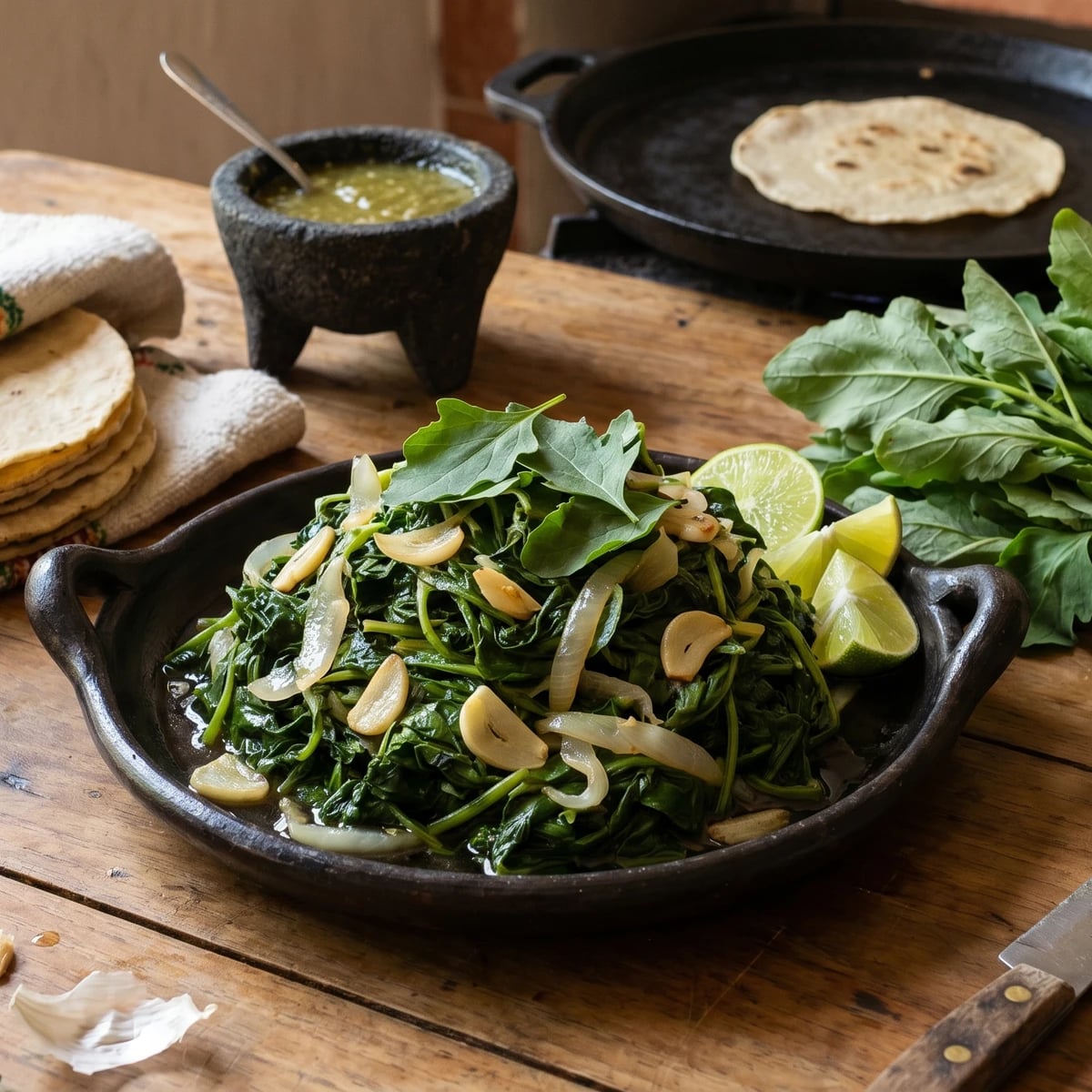
    Spoon the quelites into a small clay cazuela or onto a green-glazed plate. Serve with hot tortillas, lime wedges, and a salsa from the molcajete. This is a side dish in Oaxaca but it can be the center of the meal. Wrap a spoonful in a tortilla with a little salsa and you have a taco de quelites. Asi se hace y punto.

Chef Tips

  • If you cannot find quelites at your local mercado and you are outside Mexico, the closest substitutes are a mix of purslane (verdolaga, which does grow wild in many places), young amaranth leaves, and watercress. It is a compromise, not an upgrade. Real quelites have a mineral, grassy depth that the substitutes only approximate.
  • Do not skip the lard. Olive oil makes a different dish. Vegetable oil makes a sad one. Manteca de cerdo, ideally rendered from your last pot of carnitas, is what carries the flavor of the greens and softens their bitterness.
  • Quelites do not keep well once cooked. They taste of the moment. Cook only what you will eat at that meal. If you have leftover greens before cooking, store them wrapped in a damp cloth in the refrigerator for one or two days, no longer.

Advance Preparation

  • The greens can be cleaned and trimmed several hours ahead. Wrap them in a clean kitchen towel and refrigerate.
  • The garlic and onion can be sliced one hour ahead. Past that, the cut garlic loses its sharpness.
  • Do not cook the dish in advance. Quelites lose their character quickly once wilted. This is a dish you make minutes before it goes to the table.

Frequently Asked Questions

Nutrition Information

1 serving (about 90g)

Calories
140 calories
Total Fat
10 g
Saturated Fat
4 g
Trans Fat
0 g
Unsaturated Fat
6 g
Cholesterol
10 mg
Sodium
500 mg
Total Carbohydrates
9 g
Dietary Fiber
4 g
Sugars
2 g
Protein
5 g

Note: Chef personas and recipes are created with AI assistance. Cook with care: follow safe food-handling practices, check doneness with a thermometer when needed, and adapt for allergies and your kitchen.

Where cooking meets culture.

Culinary guides, cultural storytelling, and the editorial depth that makes cooking meaningful.

Discover Culinary Explorer

More from Oaxacan Side Dishes

Browse the full collection