
Chef Lupita
Acitrón de Cidra Conventual
Puebla's convent-style acitrón, made from cidra peel instead of endangered biznaga, built through repeated syrup soakings until the cubes turn firm, translucent, and ready for rosca or chiles en nogada.
A cooking platform built around craft, culture, and the stories behind what we eat.
Created by
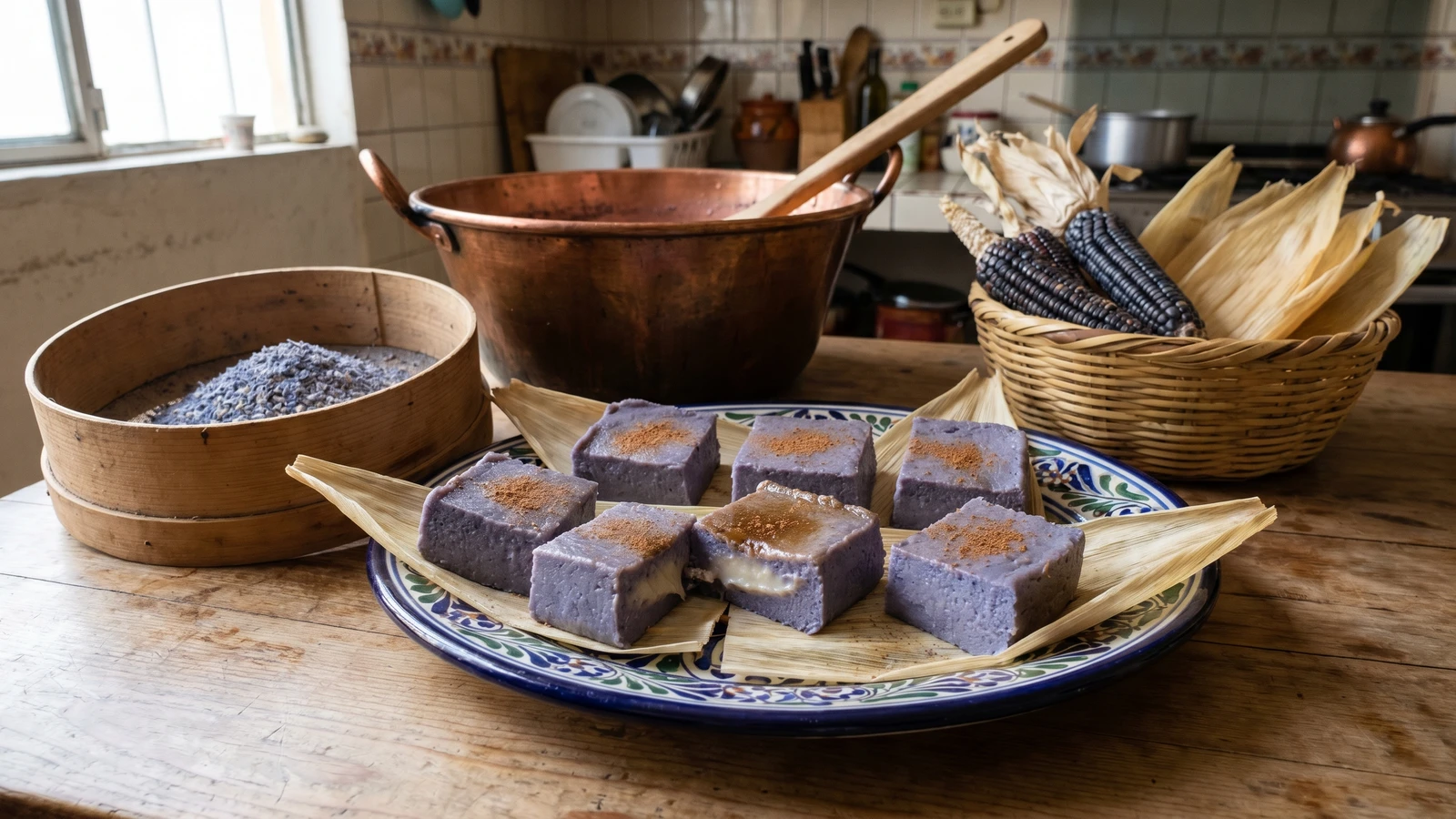
Puebla and Tlaxcala's Day of the Dead punche, a blue corn cuajado cooked like thick atole with milk, canela, and azahar, then cooled firm and cut on corn husks.
Puebla and Tlaxcala, the high valley around La Malinche, share this punche. You see it in the city of Puebla, in the old sweet memory of Cholula and Atlixco, and on the Tlaxcala side where blue corn is not a novelty, it is daily corn. This is a Day of the Dead dulce, thick as a cuajado, cut into square portions and laid on corn husk so the table remembers the milpa that gave it.
The ingredient is maíz azul. Not food coloring. Not purple corn powder from a health store that smells like cardboard. The grain is soaked, ground, cernido, and cooked with milk, canela, sugar, and azahar until the spoon opens a path on the bottom of the olla. That movement, the slow scraping with a wooden spoon, belongs to the women who kept ofrenda food alive while everyone else was busy buying things wrapped in plastic.
My mother did not make punche. She was Jalisciense. I learned this one in Puebla, then saw it again in Tlaxcala, and the lesson was the same both times: the corn sets the pudding. No eggs. No gelatin. No little tricks from a pastry case. Cada estado, su propia cocina, and here two neighboring states share a highland corn memory. Saber cocinar es saber vivir.
Punche appears in Puebla's documentary record by 1844, when La Cocinera de Todo el Mundo included a hot punche made with milk and aromatics. Later Puebla and Tlaxcala versions fixed the dish around blue corn, milk, sugar, canela, and azahar, cooked until it gelatinizes like a dense atole and served for Day of the Dead. Its resemblance to Oaxacan nicuatole is procedural, not regional: both rely on cooked corn starch to set, but punche belongs to the Puebla-Tlaxcala highlands and their ofrenda calendar.
Quantity
2 cups
picked over and rinsed
Quantity
as needed
Quantity
5 cups, divided
plus more if needed
Quantity
1 1/2 cups
Quantity
3/4 cup, plus more to taste
Quantity
1 raja
Quantity
2
Quantity
1/4 teaspoon
Quantity
6 blossoms or 3 leaves
rinsed
Quantity
1 teaspoon
Quantity
1/4 teaspoon
Quantity
1 teaspoon
for greasing the mold and corn husks
Quantity
8
soaked, rinsed, patted dry, and cut into squares
Quantity
for a light dusting
| Ingredient | Quantity |
|---|---|
| dried Mexican blue corn kernelspicked over and rinsed | 2 cups |
| water for soaking | as needed |
| waterplus more if needed | 5 cups, divided |
| whole milk | 1 1/2 cups |
| cane sugar | 3/4 cup, plus more to taste |
| Mexican canela | 1 raja |
| whole cloves | 2 |
| anise seed | 1/4 teaspoon |
| fresh orange blossoms or unsprayed orange leavesrinsed | 6 blossoms or 3 leaves |
| agua de azahar | 1 teaspoon |
| fine sea salt | 1/4 teaspoon |
| neutral oilfor greasing the mold and corn husks | 1 teaspoon |
| large dried corn huskssoaked, rinsed, patted dry, and cut into squares | 8 |
| ground Mexican canela (optional) | for a light dusting |
Place the blue corn kernels in a deep bowl and cover with water by three inches. Let them soak 12 hours, or overnight. If your kitchen is hot, put the bowl in the refrigerator. The grain needs time to soften before grinding. No me vengas con atajos.
Drain the soaked corn. Grind it on a metate or take it to a molino if you have that blessing nearby. In a modern kitchen, blend it in small batches with 2 cups of the measured water, just enough to make the blades move. Pass the blue corn slurry through a cernidor or fine-mesh sieve, pressing hard with a spoon. Reblend the coarse bagazo once and sieve again. The mixture should look like thick blue atole, not gritty cement.
In a heavy cazuela, copper cazo, or stainless pot, combine the remaining 3 cups water with the canela, cloves, anise seed, orange blossoms or orange leaves, and salt. Bring to a gentle simmer and cook 10 minutes, until the water smells like ofrenda season in Puebla. Strain out the solids and return the liquid to the pot.
Set the pot over medium heat. Stir the blue corn slurry once more, because the starch settles fast, then pour it into the hot infusion in a thin stream while stirring with a wooden spoon or molinillo. Keep the spoon moving across the bottom and corners. Corn starch grabs the pot when you get lazy.
Lower the heat to medium-low and cook 20 to 25 minutes, stirring almost constantly, until the raw corn smell disappears and the color deepens to a muted blue-purple. The mixture will thicken like a serious atole. If it tightens before the corn tastes cooked, add hot water two tablespoons at a time. You are cooking the corn, not just warming it.
Stir in the milk and sugar. Keep cooking 15 to 20 minutes more, scraping the bottom with discipline, until the spoon opens a path and you can see the bottom of the olla for a breath before the punche closes over it again. Add the agua de azahar during the last two minutes. Taste for sugar now. It should be sweet enough for a holiday table, not so sweet that the blue corn disappears.
Lightly oil a 9-inch square pan. Lay the softened corn husk squares across the bottom, smooth side up, overlapping slightly. Pour in the hot punche to about one inch deep and smooth the top with the back of the spoon. Let it cool at room temperature 45 minutes, then refrigerate at least 2 hours, until firm enough to cut cleanly.
Cut the firm punche into squares and lift each portion with its corn husk base. Arrange the pieces on a Puebla talavera platter. Dust with a little ground canela if you want it. Serve cool or at room temperature the same day. No chile powder, no berries, no pastry tricks. The blue corn is the color and the azahar is the perfume.
1 serving (about 210g)
Culinary guides, cultural storytelling, and the editorial depth that makes cooking meaningful.
Discover Culinary ExplorerChef Lupita
Puebla's convent-style acitrón, made from cidra peel instead of endangered biznaga, built through repeated syrup soakings until the cubes turn firm, translucent, and ready for rosca or chiles en nogada.

Chef Lupita
Ciudad de México's Tulyehualco alegría is popped huautli folded into piloncillo honey, pressed with peanuts, pepitas, and raisins, then cut into the rectangular bars that built a pueblo's identity.

Chef Lupita
Oaxaca's pre-Columbian amaranth bar, popped on a hot comal and bound with piloncillo, honey, and the sacred Zapotec grain that the Spanish tried, and failed, to outlaw.

Chef Lupita
Querétaro's mercado candy of popped amaranto pressed with dark piloncillo syrup, pepitas, pecans, and cacahuate, a Bajío sweet that respects the seed before it decorates the table.