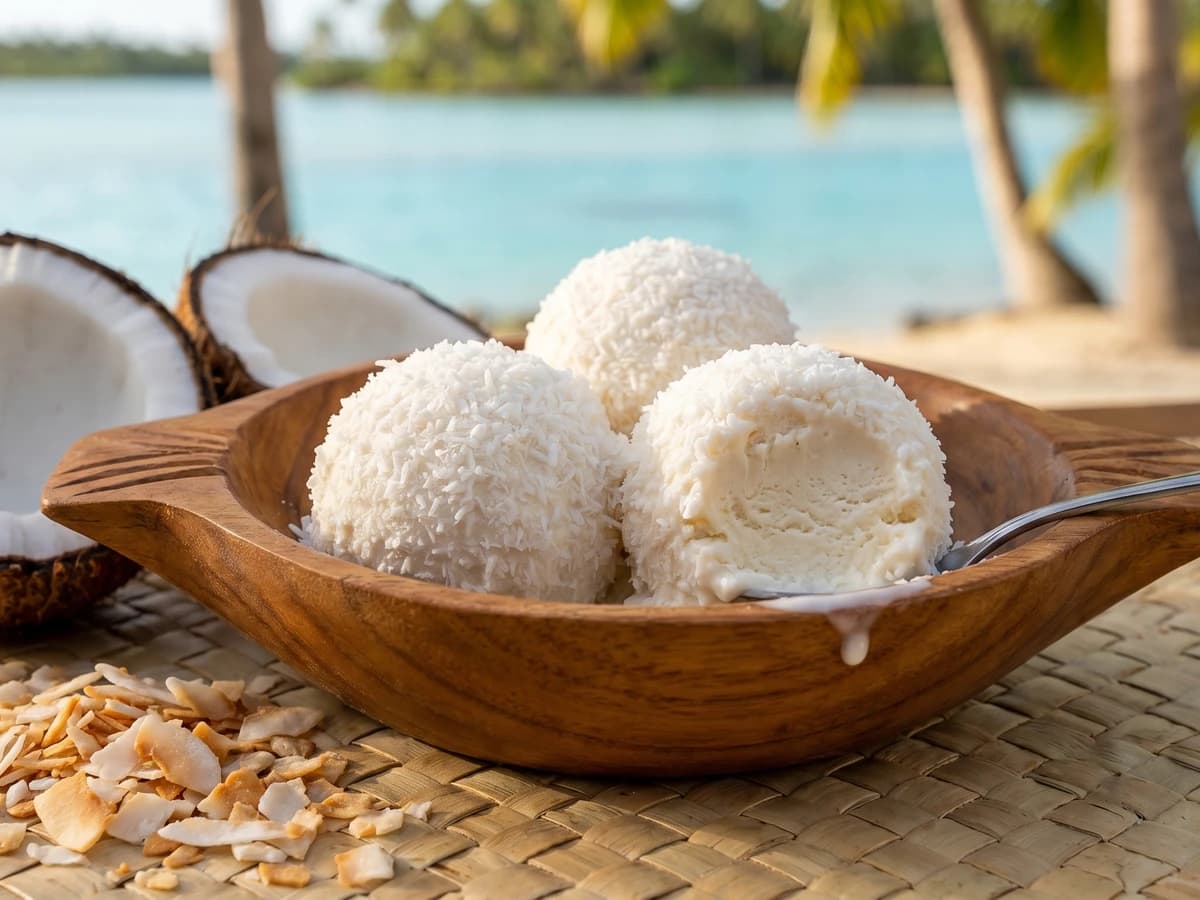
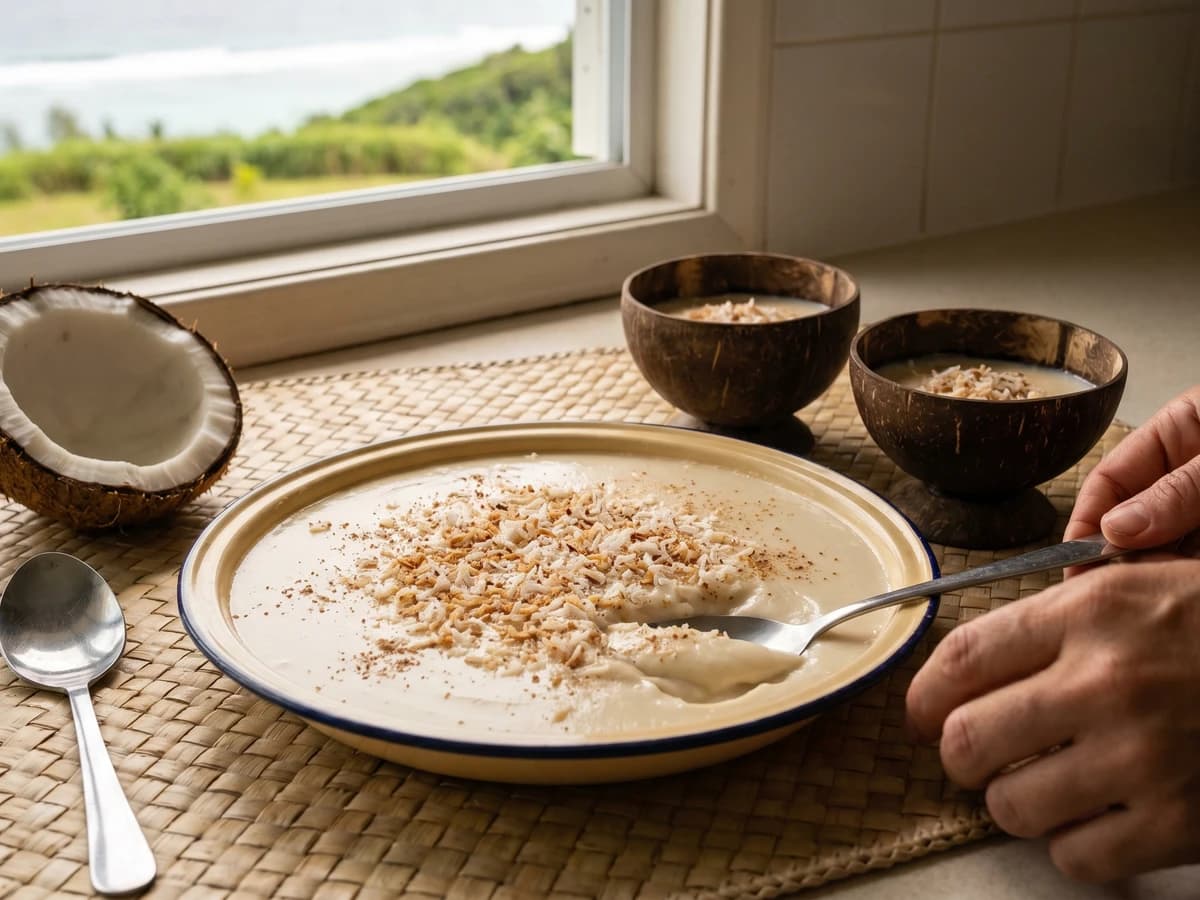
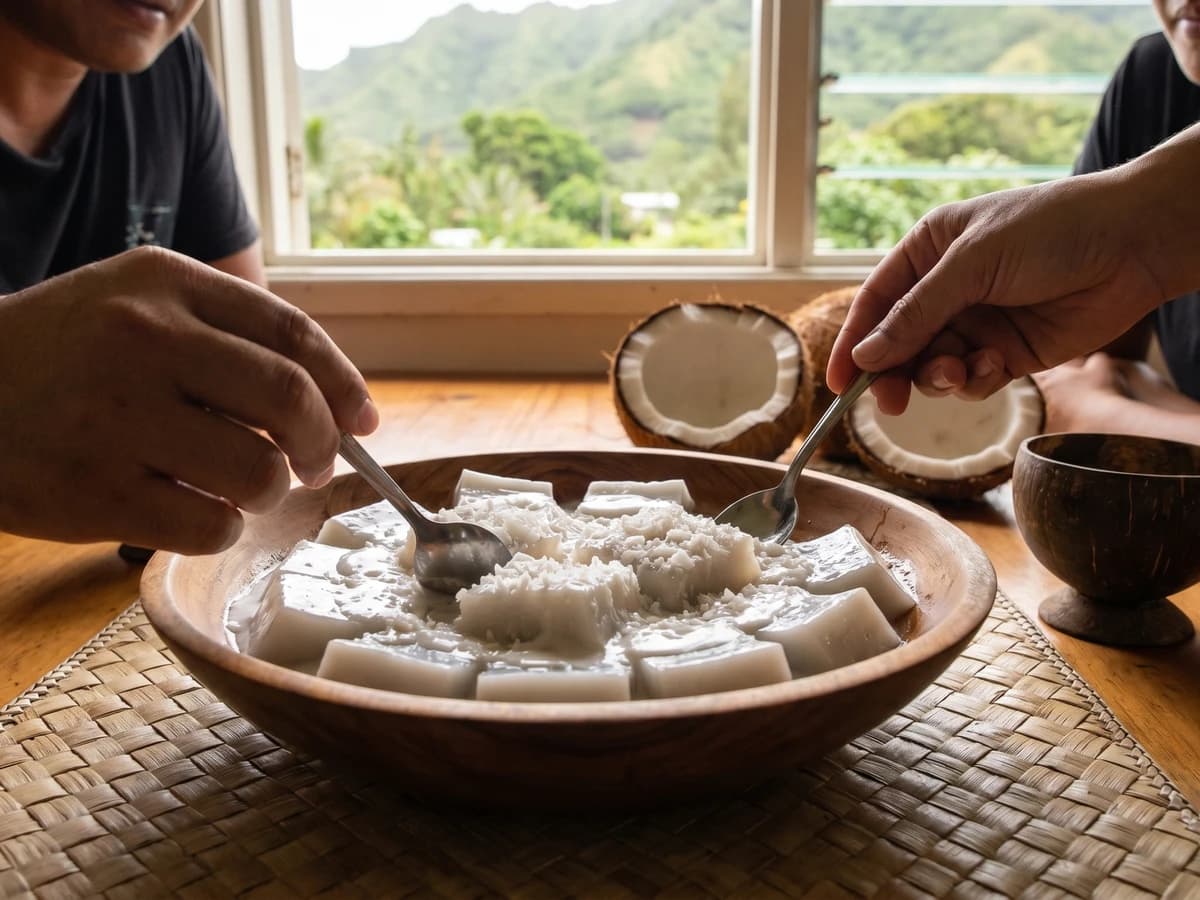
Golden Cook Islands poke, pumpkin cooked soft, set with pia (arrowroot starch), then cut into warm squares under sweet boiled coconut cream. It sits beside banana poke and Tahitian poʻe, cousin to cousin.
Desserts
Polynesian, Cook Islands
Comfort Food
Make Ahead
Special Occasion
25 min
Active Time
1 hr 10 min cook•1 hr 55 min total
Yield8 to 10 servings
My hands learned kinship at a Hawaiian poi board, but the canoe kept telling me the table was wider than my own island. In Kūki ʻĀirani (Cook Islands), that lesson came to me in a square of pumpkin poke, poke meaning pudding here, not the raw-fish poke we say back home. One auntie laughed because I heard the word and my mind went straight to ʻahi (tuna). No, boy, this one sweet.
This is the Cooks' hand, not mine to claim: golden pumpkin cooked soft, set with pia (Polynesian arrowroot starch), baked until it stands, then covered with boiled coconut cream until every cut edge shines. Banana poke is the close cousin at the same Cook Islands table. Tahiti has poʻe, fruit or breadfruit pudding fed with coconut milk, and back home in Hawaiʻi, kūlolo carries kalo (taro), coconut, and sugar into a firm sweet. One ocean, one canoe, one root, but every island keeps its own bowl.
So bring it forward without making it precious. Use the pumpkin you can find, kabocha or buttercup if the market has them because they cook dry and sweet. Cook it until it gives up easy, dry it down, cool it before the pia goes in, and don't rush the set. Deep food is not fancy. It is patient. It feeds the room.
In the Cook Islands, poke is a pudding family, not the Hawaiian raw-fish dish of the same spelling; the best-known forms use ripe banana, pawpaw, breadfruit, or pumpkin mashed with pia (Polynesian arrowroot starch) and served with coconut cream. Pumpkin itself is post-contact, an American squash that moved through mission and trading gardens in the nineteenth century, but Cook Islands cooks folded it into an older starch-and-coconut grammar already shared across the Triangle. Its closest cousins are Cook Islands banana poke and Tahitian poʻe, while Hawaiian kūlolo speaks from the taro side of the family, firm, sweet, and fed by coconut.
The technique, the tradition, and the story behind every dish.
pia (Polynesian arrowroot starch) or true arrowroot starch
Quantity
1 cup
sifted
coconut oil or neutral oil
Quantity
1 tablespoon
for greasing the pan
banana leaf or parchment sheet (optional)
Quantity
1
for lining the pan
fresh thick coconut cream
Quantity
2 cups
or 1 (13.5-ounce) can thick coconut cream
vanilla extract (optional)
Quantity
1 teaspoon
Ingredient
Quantity
firm-fleshed pumpkin or kabocha squashseeded, peeled, and cut into 2-inch chunks
3 pounds
raw sugar or packed light brown sugardivided
1/2 cup plus 2 tablespoons
fine sea saltdivided
1/2 teaspoon
pia (Polynesian arrowroot starch) or true arrowroot starchsifted
1 cup
coconut oil or neutral oilfor greasing the pan
1 tablespoon
banana leaf or parchment sheet (optional)for lining the pan
1
fresh thick coconut creamor 1 (13.5-ounce) can thick coconut cream
2 cups
vanilla extract (optional)
1 teaspoon
Equipment Needed
•8-inch square baking pan
•Steamer basket or wide 6-quart pot with lid
•Potato masher or sturdy wooden spoon
•Fine-mesh sieve for the pia
•Small heavy saucepan
Instructions
1
Line the pan
Heat the oven to 350F. Grease an 8-inch square baking pan with coconut oil, then line it with banana leaf if you have it, or parchment if you don't. If using banana leaf, pass it quickly over a burner flame or dip it in hot water so it bends without cracking.
2
Cook the pumpkin
Steam the pumpkin chunks in a covered pot until a fork slides through with no fight, 20 to 25 minutes. Drain well, then return the pumpkin to the warm pot and stir over low heat for 3 to 5 minutes, until the mash looks thick and no water pools at the bottom. Watery pumpkin makes a pudding that weeps.
Kabocha and buttercup squash cook dry and sweet, so they behave well here. If your pumpkin is watery, give it more time in the pot before the pia goes in.
3
Mash and cool
Mash the pumpkin until mostly smooth, with a few soft bits left if you like that homestyle texture. Measure out 4 packed cups of mash. Stir in 1/2 cup sugar, 1/4 teaspoon salt, and the vanilla if using, then let it cool until warm to the touch, not hot. No need make lumps and then blame the starch.
4
Set with pia
Sift the pia over the pumpkin in three additions, folding and pressing with a wooden spoon after each one until no white streaks remain. The mixture should turn thick, glossy, and heavy, almost like it wants to hold the spoon upright. If it slumps loose, add 1 to 2 more tablespoons of pia.
5
Bake it firm
Scrape the pumpkin mixture into the lined pan and smooth the top. Bake 40 to 45 minutes, until the edges pull slightly from the pan and the center springs back when touched. A knife should come out with a tacky orange smear, not milky raw starch. Let it rest 20 minutes so it cuts clean.
6
Boil the cream
While the poke rests, put the coconut cream, remaining 2 tablespoons sugar, and remaining 1/4 teaspoon salt in a small heavy saucepan. Bring it just to a boil around the edges, then lower the heat and simmer gently 5 to 8 minutes, stirring, until the cream turns satin-glossy and lightly thick. Don't boil it hard or it can split.
Fresh coconut cream has the deepest sweetness. A good thick can is fine for a weeknight, no shame, just stir it well before it goes in the pan.
7
Cut and serve
Cut the poke into squares or diamonds while warm or at room temperature. Set the pieces in a wooden bowl or on banana leaf and ladle the boiled coconut cream over the top so it runs down the sides and pools around the base. Serve family-style, enough for one more.
Chef Tips
•Choose a pumpkin that cooks dry, not watery. Kabocha, buttercup, or a dense eating pumpkin gives you a clean slice and a deeper orange color.
•Pia gives poke that glossy chew. Tapioca starch is the closest weeknight stand-in; cornstarch will set it, but the bite turns a little chalkier.
•Cool the pumpkin before adding the starch. Hot pumpkin grabs the pia too fast and makes little white beads that never fully smooth out.
•Poke should slice clean but still feel tender under the spoon. If it bounces like rubber, there was too much starch or too much oven time.
•Leftovers are good cold from the fridge, or warmed gently and spooned with fresh coconut cream. Eat what you have. We no waste good food.
Advance Preparation
•Cook and mash the pumpkin up to 1 day ahead. Chill it covered, then bring it back toward room temperature before mixing in the pia.
•Bake the poke up to 1 day ahead and keep it covered in the fridge. Serve it room temperature or warm it gently before adding coconut cream.
•Make the boiled coconut cream the day you serve. Fresh coconut cream turns quickly, and even canned cream tastes better when it has just been warmed and stirred glossy.
Frequently Asked Questions
Nutrition Information
1 serving (about 205g)
Calories
335 calories
Total Fat
17 g
Saturated Fat
15 g
Trans Fat
0 g
Unsaturated Fat
2 g
Cholesterol
0 mg
Sodium
145 mg
Total Carbohydrates
48 g
Dietary Fiber
5 g
Sugars
20 g
Protein
3 g
Where cooking meets culture.
Culinary guides, cultural storytelling, and the editorial depth that makes cooking meaningful.