Chef Lupita
Acúmara Tatemada al Comal
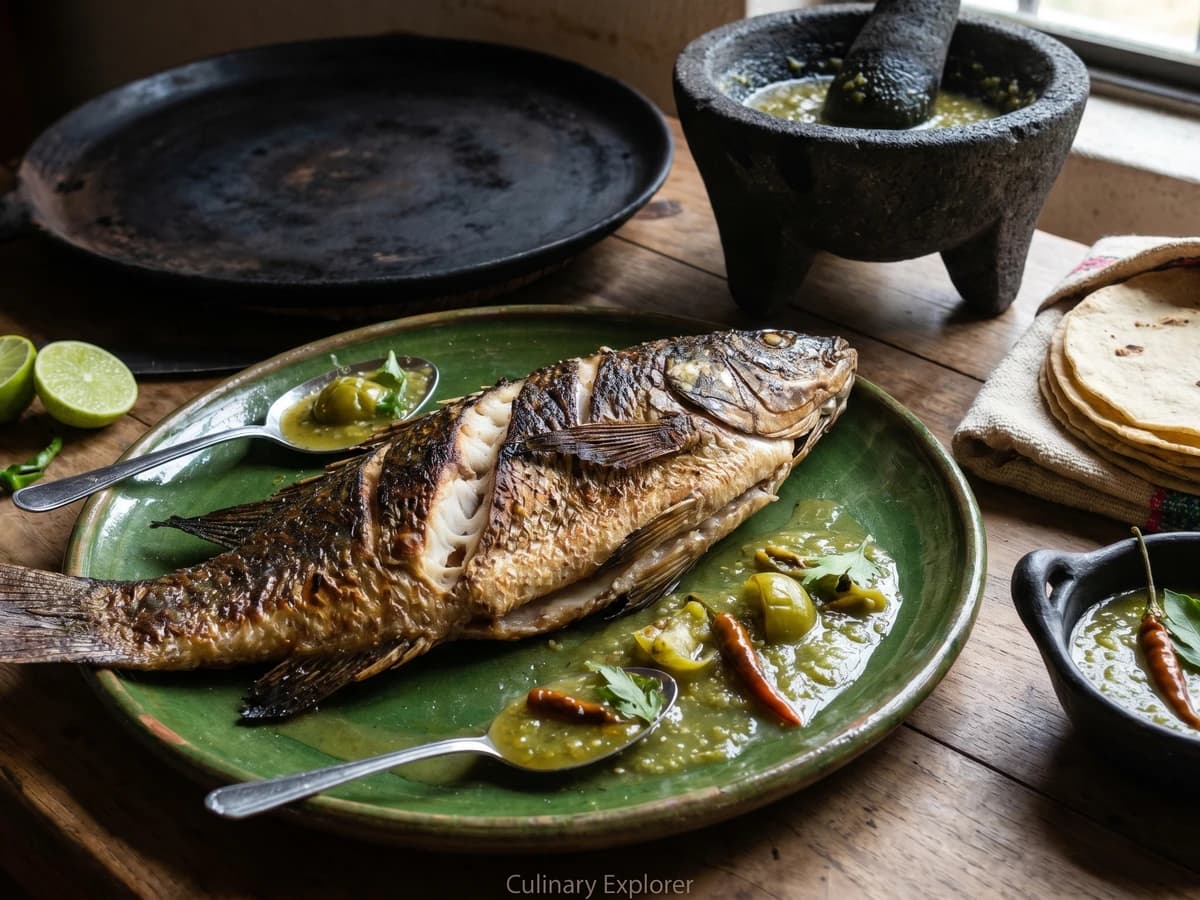
Michoacán's Lake Pátzcuaro acúmara, a whole kurucha from the lago tatemada on a comal de leña and served with chile perón atápakua, corn tortillas, and P'urhépecha discipline.
A cooking platform built around craft, culture, and the stories behind what we eat.
Created by
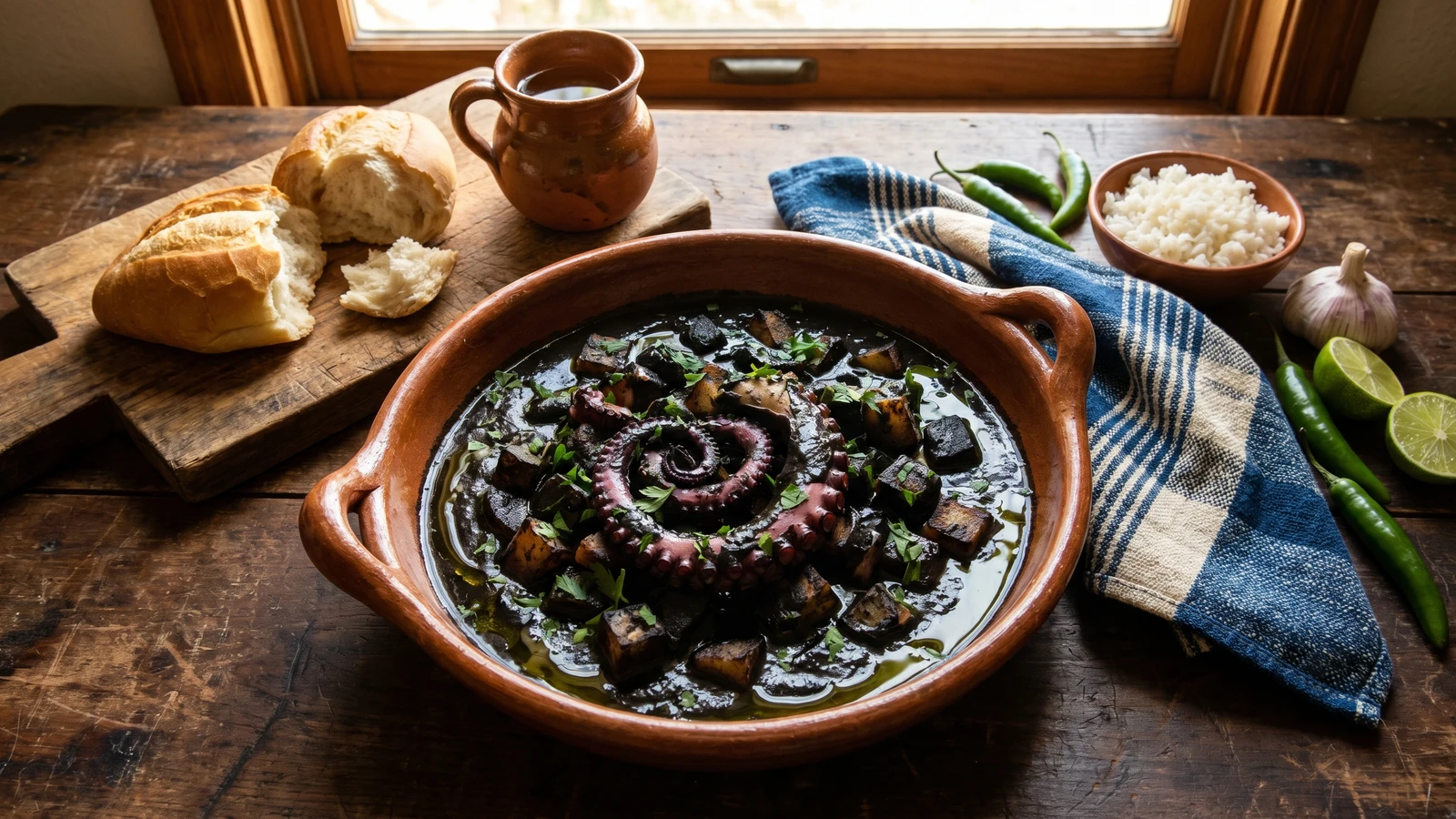
La Paz's Spanish-rooted main: octopus simmered in its own ink with white wine, potatoes, and chile serrano. The black-sauced cazuela that anchors a Sunday lunch on the Sea of Cortez.
This is from Baja California Sur. Specifically from La Paz, the small capital city on the Sea of Cortez where the fishing boats come in at dawn and the home kitchens still cook the way the Spanish brought it, adapted to what the Pacific gives them. Pulpo en su tinta is not Mexico City food. It is not Yucatecan. It is sudcaliforniano, and that means Spanish lineage, Mexican hand, and a peninsula that has always cooked closer to Sevilla than to Oaxaca.
The dish is a sofrito built on olive oil, onion, garlic, tomato, and chile serrano, deglazed with white wine, then darkened with the octopus's own ink. The sauce turns the color of a moonless night over the gulf. The potatoes go in to drink up that black sauce and the octopus simmers with everything until it is tender enough to cut with a fork. La manteca es el sabor in most of Mexico. Here it is the olive oil and the wine. Sudcaliforniano cooking sits on a Spanish hinge that the rest of the country never had.
My mother did not cook this dish. She was from Jalisco and a peninsula six hours by plane from her kitchen might as well have been another country. I learned it in La Paz from a senora named Doña Cristina who ran a small comedor near the malecon and served it over rice every Sunday for thirty years. She showed me how to dip the octopus three times before submerging it. She showed me the wine corks she still drops in the boiling water. She told me the ink is the dish, that without the tinta you have made something else and you should call it something else. Asi se hace y punto.
Pulpo en su tinta arrived in Mexico through Spanish colonial cuisine, a direct descendant of the Galician and Andalusian tradition of cooking cephalopods in their own dark liquid, and it took root most firmly along the Baja California peninsula where Spanish missionaries and settlers established fishing communities beginning in the 17th century. The peninsula's relative isolation from central Mexico, separated by the Sea of Cortez and the Sonoran desert, allowed Iberian dishes to persist with less indigenous adaptation than they underwent in mainland states like Oaxaca or Veracruz. Baja California Sur's commercial octopus fishery, centered in the Bahia de La Paz and the Pacific waters off Magdalena Bay, supplies the bulk of Mexico's wild-caught octopus and has made the dish a regional fixture rather than a special-occasion import.
Quantity
1, about 3 pounds
cleaned, beak and ink sac reserved if available
Quantity
2
the old Spanish trick to keep the octopus tender
Quantity
1 medium
halved
Quantity
1
halved crosswise
Quantity
2
Quantity
1 tablespoon, plus more to taste
Quantity
4 packets (4 grams each), or 2 tablespoons reserved octopus ink
Quantity
1/4 cup
Quantity
1 medium
finely chopped
Quantity
6
finely chopped
Quantity
3
finely chopped
Quantity
2
finely chopped, seeds in
Quantity
1 cup
Quantity
2 medium
peeled and cut into 1/2-inch cubes
Quantity
1 teaspoon
Quantity
1/2 teaspoon
Quantity
1
Quantity
2 tablespoons
chopped
Quantity
for serving
Quantity
for serving
Quantity
for serving
| Ingredient | Quantity |
|---|---|
| whole octopuscleaned, beak and ink sac reserved if available | 1, about 3 pounds |
| wine corks (optional)the old Spanish trick to keep the octopus tender | 2 |
| white onion (for the boil)halved | 1 medium |
| head of garlic (for the boil)halved crosswise | 1 |
| bay leaves | 2 |
| kosher salt | 1 tablespoon, plus more to taste |
| squid or octopus ink | 4 packets (4 grams each), or 2 tablespoons reserved octopus ink |
| Spanish olive oil | 1/4 cup |
| white onionfinely chopped | 1 medium |
| garlic clovesfinely chopped | 6 |
| ripe Roma tomatoesfinely chopped | 3 |
| fresh chile serranofinely chopped, seeds in | 2 |
| dry white wine | 1 cup |
| yellow potatoespeeled and cut into 1/2-inch cubes | 2 medium |
| dried Mexican oregano | 1 teaspoon |
| freshly ground black pepper | 1/2 teaspoon |
| bay leaf | 1 |
| flat-leaf parsleychopped | 2 tablespoons |
| cooked white rice (optional) | for serving |
| lime halves (optional) | for serving |
| hand-pressed corn tortillas or crusty bolillo (optional) | for serving |
If your octopus came whole and uncleaned, rinse it well under cold water, remove the beak from the underside of the body, and turn the head inside out to clean it. If the ink sac is intact, snip it free with kitchen scissors and reserve it in a small bowl with two tablespoons of cold water. Beat the octopus on a hard surface or against the side of the sink for a minute or two. Sounds violent. It is. The connective tissue needs the abuse or the meat will fight you for an hour.
Fill a large stockpot with water and bring it to a rolling boil. Add the halved onion, halved garlic head, bay leaves, salt, and the wine corks if you have them. The corks are an old Spanish trick the senoras of La Paz still use. Whether they actually do anything is a debate I will not enter. Holding the octopus by the head, dip it into the boiling water three times, letting it curl, then submerge it fully. This sets the tentacles in their pretty curl. Reduce to a low simmer and cook for 45 minutes to an hour, until a knife slides into the thickest part of a tentacle with no resistance.
Lift the octopus out of the broth and set it on a cutting board. Let it cool for ten minutes, just enough to handle. Reserve one cup of the cooking liquid. Cut the tentacles off the body and slice them on a slight bias into 1/2-inch pieces. Cut the body open, scrape away anything still inside, and chop it into similar-sized pieces. The skin and the suckers stay on. Those purple suckers are part of what makes the dish look like the dish.
Heat the olive oil in a wide cazuela or heavy skillet over medium heat. Add the chopped onion and cook until it turns translucent, about five minutes. Add the chopped garlic and the chile serrano. Cook another two minutes, stirring, until the garlic is fragrant but not browned. Add the chopped tomatoes and a good pinch of salt. Cook for ten minutes, stirring now and then, until the tomatoes break down completely and the oil starts to separate from the sofrito at the edges. This is when you know the base is ready. Rushing this step is the most common mistake.
Pour the white wine into the sofrito and let it bubble hard for two minutes to cook off the harsh alcohol. In a small bowl, stir the squid ink packets (or the reserved octopus ink) with a few tablespoons of the reserved octopus broth until smooth. Pour the ink mixture into the cazuela. The whole pot will turn black within seconds. That is the dish announcing itself. Stir to combine and let it simmer for another two minutes.
Add the cubed potatoes, the dried oregano, black pepper, bay leaf, and the cut octopus to the cazuela. Pour in the remaining reserved octopus broth, enough to barely cover everything. Lower the heat to a gentle simmer. Cook uncovered for 25 to 30 minutes, stirring occasionally. The potatoes should turn jet black on the outside and tender on the inside. The sauce should thicken to coat the back of a spoon. Taste for salt now. The octopus broth is salty already, so wait until the end to adjust.
Pull the cazuela off the heat. Fish out the bay leaf. Scatter the chopped parsley over the top. Serve directly from the cazuela, ladled over white rice in shallow bowls. Set lime halves and warm tortillas or crusty bolillo on the table. The bread is for sopping up the black sauce, and you will want to. Recetas probadas y garantizadas.
1 serving (about 330g)
Culinary guides, cultural storytelling, and the editorial depth that makes cooking meaningful.
Discover Culinary ExplorerChef Lupita
Michoacán's Lake Pátzcuaro acúmara, a whole kurucha from the lago tatemada on a comal de leña and served with chile perón atápakua, corn tortillas, and P'urhépecha discipline.

Chef Lupita
Puebla's weekday adobo of pork shoulder braised in a thick guajillo and ancho sauce sharpened with vinegar, cumin, and clove. The deep red of a market spice stall, the dish a poblana cooks without thinking.

Chef Lupita
Loreto's pit-roasted clams, planted hinge-up in beach sand and tatemadas under a fast fire of dried romerillo brush, the resinous Baja desert shrub that gives this dish its smoke.

Chef Lupita
Oaxaca's eighth mole, the silky, almond-and-cinnamon almendrado, served over poached chicken. Mild, sweet, restrained, and a quiet rebuttal to anyone who thinks Mexican food has to be hot to be Mexican.