Culinary Explorer

A cooking platform built around craft, culture, and the stories behind what we eat.
Discover Culinary Explorer
Pudding à la Mode (プリンアラモード, Purin a la Mode)

Pudding à la Mode (プリンアラモード, Purin a la Mode)

Created by

The Shōwa kissaten showpiece is only firm purin, cold glass, good fruit, and gentle timing. Set the custard softly, chill it fully, then give each piece room.

Desserts
Japanese
Birthday
Special Occasion
Date Night
35 min
Active Time
30 min cook5 hr 35 min total
Yield4 servings

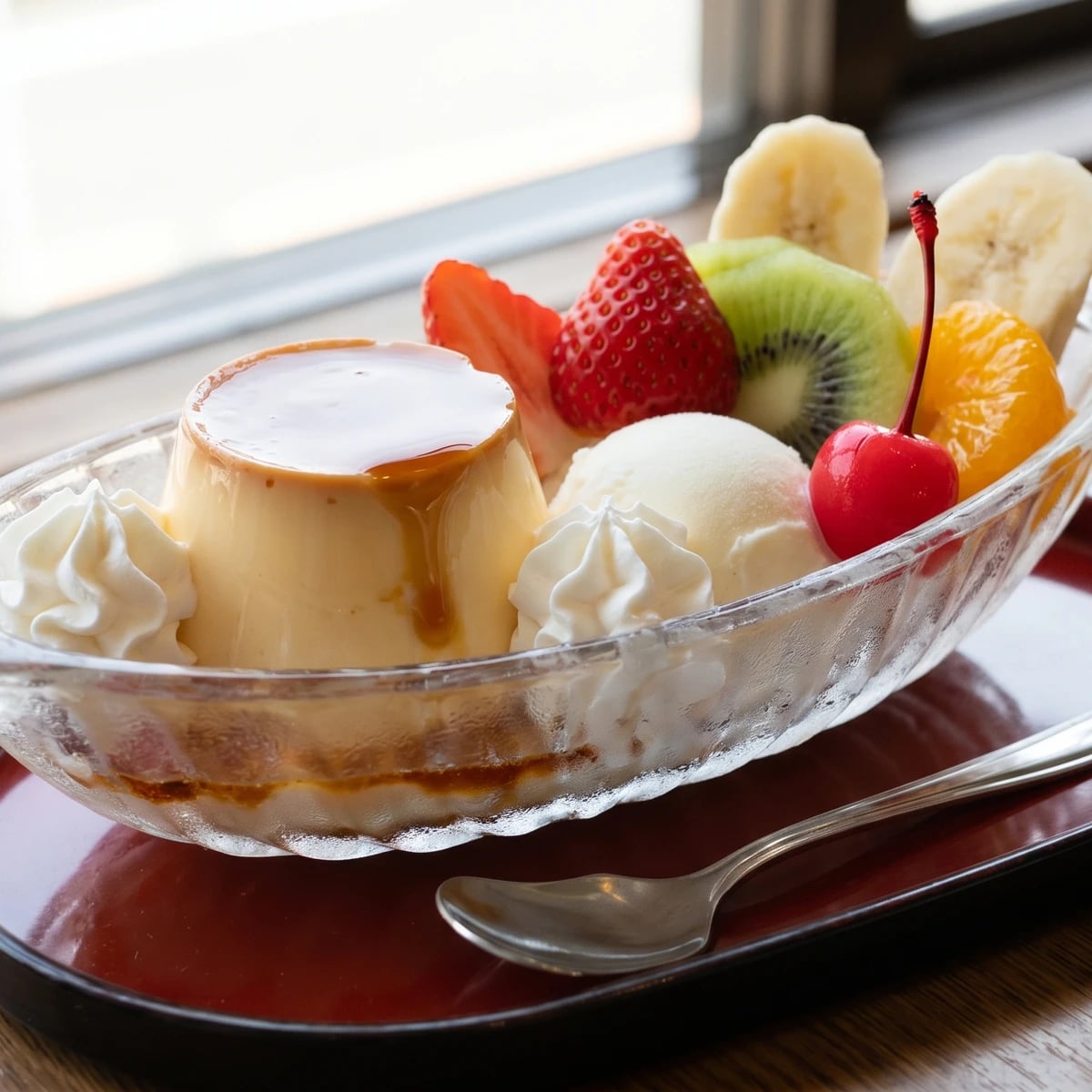
The long glass dish is the first promise. Pudding à la Mode is celebration arranged in a line: caramel purin, one scoop of ice cream, a little cream, fruit cut cleanly, one red cherry sitting where everyone expects it. It looks like a hotel dessert because it is one. That doesn't make it difficult. It only means the pieces must be made with care and given space.

Honmono here is not severity. It is the proper shape: firm purin in a long dish, fruit clear enough to see itself, and no heap of sweet things trying to outshout the custard. The purin decides the whole plate. We want it firm enough to unmold and stand in its caramel, but not rubbery, the way too much heat makes eggs tighten like a scolded schoolmaster.

Gentle steam sets the eggs slowly, so the surface stays smooth and the inside cuts clean. Strain the custard, keep the heat low, chill it thoroughly. Those are not ceremonies. They are the shortest path to a pudding that behaves.

Then comes the fruit, and here shun still matters, even in a Shōwa kissaten dish. Use strawberries when they're bright and fragrant, kiwi that yields a little, banana sliced at the last moment, and a cherry for the old-fashioned crown. Nothing hidden under cream. The cream and ice cream are there to make a small holiday, not to rescue tired fruit. Leave the long dish room, and the dessert reads generous without becoming a parade.

Hotel New Grand in Yokohama identifies Pudding à la Mode as a late-1940s creation of its postwar coffee house, after the hotel had been requisitioned during the Allied occupation. The dessert placed Japanese purin in a long glass dish with ice cream, whipped cream, fruit, and a cherry, using the phrase à la mode in its American sense of served with ice cream. From Yokohama it spread into Shōwa-era kissaten and later family restaurants, where its fixed arrangement became part of the pleasure.

The technique, the tradition, and the story behind every dish.

Discover Culinary Explorer

Ingredients

granulated sugar

Quantity

80g

for caramel

water

Quantity

2 tablespoons

hot water

Quantity

2 tablespoons

whole milk

Quantity

550ml

granulated sugar

Quantity

70g

for custard

large eggs

Quantity

4

large egg yolk

Quantity

1

fine sea salt

Quantity

1 pinch

vanilla extract

Quantity

1 teaspoon

heavy cream

Quantity

1 cup

chilled

granulated sugar

Quantity

1 tablespoon

for cream

vanilla ice cream

Quantity

4 small scoops

strawberries

Quantity

4 small

hulled and halved

kiwi

Quantity

1

peeled and sliced

banana

Quantity

1

sliced on the bias just before serving

canned mandarin orange segments

Quantity

8

drained

maraschino cherries or cherries in syrup

Quantity

4

Equipment Needed

  • 4 pudding cups (purin-gata) or 6-ounce ramekins
  • Japanese steamer (mushi-ki) or a deep pot with a low rack
  • Fine-mesh strainer
  • Long glass boat dishes, or chilled shallow oval plates
  • Piping bag with star tip, or a spoon
  • Instant-read thermometer, helpful but not required

Instructions

  1. 1

    Make the caramel

    Put 80g sugar and 2 tablespoons water in a small heavy saucepan and cook over medium heat without stirring. Swirl the pan when the edges color, and take it off the heat when the caramel is deep amber and smells faintly toasted. Add the hot water carefully, a spoonful at a time, because hot sugar spits. Pour a thin layer into four warmed pudding cups at once. The caramel should be dark enough to give bitterness under the milk, not so dark that it tastes burnt.

    Warming the cups gives you a few extra seconds before the caramel hardens. A pale caramel disappears under custard; a dark amber one gives the purin its backbone.
  2. 2

    Warm the milk

    In a saucepan, warm the milk, 70g sugar, and salt over medium-low heat until the sugar dissolves and the milk is hot but not boiling, about 60 C if you keep a thermometer near the stove. Take it off the heat and stir in the vanilla, then let it stand five minutes. Warm milk gives a smooth custard; boiling milk makes a skin and gives the eggs a bad surprise.

  3. 3

    Mix the custard

    Beat the eggs and yolk gently, just until the whites are broken. Pour in the warm milk slowly while stirring, then strain the custard through a fine-mesh strainer twice. Try not to froth it. Foam becomes pinholes on top, and little threads of egg become flecks. Smooth purin is made here, before it reaches the steamer.

    If bubbles gather on the surface, skim them off or touch them lightly with a strip of paper towel. The top you see now is the top you'll unmold later.
  4. 4

    Steam gently

    Pour the custard into the caramel-lined cups and cover each cup with foil. Set a steamer over water at a quiet simmer, not a rolling boil. Arrange the cups in the steamer, and wrap the lid in a clean cloth with the ends tied up away from the heat if condensation tends to drip. Steam 18 to 22 minutes, keeping the water just murmuring. The custard is done when the edges are set and the center trembles when you nudge a cup. Hard steam punches holes through purin and makes it tough; soft steam lets the egg proteins set slowly and evenly.

    No mushi-ki, the Japanese steamer, is needed. A deep pot with a low rack works as long as the cups sit above the water and the heat stays gentle.
  5. 5

    Chill the purin

    Move the cups to a rack and cool them for 20 minutes, then refrigerate at least 4 hours, or overnight. Chilling finishes the set and turns the caramel into sauce. To unmold, dip each cup in warm water for 5 to 10 seconds, run a thin knife around the edge, and invert onto a chilled dish. If it resists, warm it for another second. Don't shake hard; a firm purin still bruises.

  6. 6

    Cut the fruit

    Whip the chilled cream with 1 tablespoon sugar until soft peaks bend but hold, then keep it cold. Hull and halve the strawberries, slice the kiwi, drain the mandarin segments, and slice the banana last. The fruit should be ripe but firm. Soft fruit collapses under its own juice, and banana browns while you admire your knife work.

  7. 7

    Assemble the dish

    Chill four long glass dishes. Set one purin just off center in each and spoon its caramel over the top. Place one small scoop of vanilla ice cream on the wider side, pipe or spoon two small rosettes of cream, arrange strawberry, kiwi, banana, and mandarin in small odd-number groups along the length, and set a cherry on a cream rosette. Leave at least a third of the glass visible. Work quickly and serve at once. The cold dish slows the ice cream, the off-center line gives height, and the open glass keeps this from becoming a fruit pile.

    The long dish is part of the form. If you don't have one, use a chilled shallow oval plate, but keep the order and the breathing room.

Chef Tips

  • Use whole milk and fresh eggs. Low-fat milk makes the custard thin, while too much cream makes it heavy. Purin should taste cleanly of milk, egg, caramel, and restraint.
  • Watch the caramel by smell as much as color. When it smells toasted and turns deep amber, stop. It will keep darkening in the pan for a few seconds after the heat is off.
  • The sign of overheated purin is a honeycomb of holes inside. It still tastes sweet, yes, but the texture has told on you. Lower the heat and let the next batch take its time.
  • Buy fruit with fragrance, not only color. Strawberries are best when they smell bright at the stem, kiwi should yield slightly, and banana should be ripe but not soft. Nothing hidden under cream.
  • For the Showa kissaten feeling, the cherry belongs on top. It isn't subtle. That is rather the point.

Advance Preparation

  • Make the purin up to 2 days ahead. Keep the cups covered in the refrigerator and unmold only when you're ready to assemble.
  • Pre-scoop the ice cream onto a chilled tray and freeze until hard. It keeps assembly calm, which is more useful than it sounds.
  • Whip the cream up to 2 hours ahead and keep it cold. Whisk it once or twice before piping if it loosens.
  • Slice strawberries and kiwi a few hours ahead if needed, but slice the banana at the last moment. It browns quickly and no amount of cream makes that more handsome.

Frequently Asked Questions

Nutrition Information

1 serving (about 425g)

Calories
695 calories
Total Fat
38 g
Saturated Fat
22 g
Trans Fat
1 g
Unsaturated Fat
14 g
Cholesterol
340 mg
Sodium
230 mg
Total Carbohydrates
73 g
Dietary Fiber
2 g
Sugars
70 g
Protein
15 g

Note: Chef personas and recipes are created with AI assistance. Cook with care: follow safe food-handling practices, check doneness with a thermometer when needed, and adapt for allergies and your kitchen.

Where cooking meets culture.

Culinary guides, cultural storytelling, and the editorial depth that makes cooking meaningful.

Discover Culinary Explorer

More from Yogashi: Japanese Cakes, Cheesecakes & Pudding

Browse the full collection