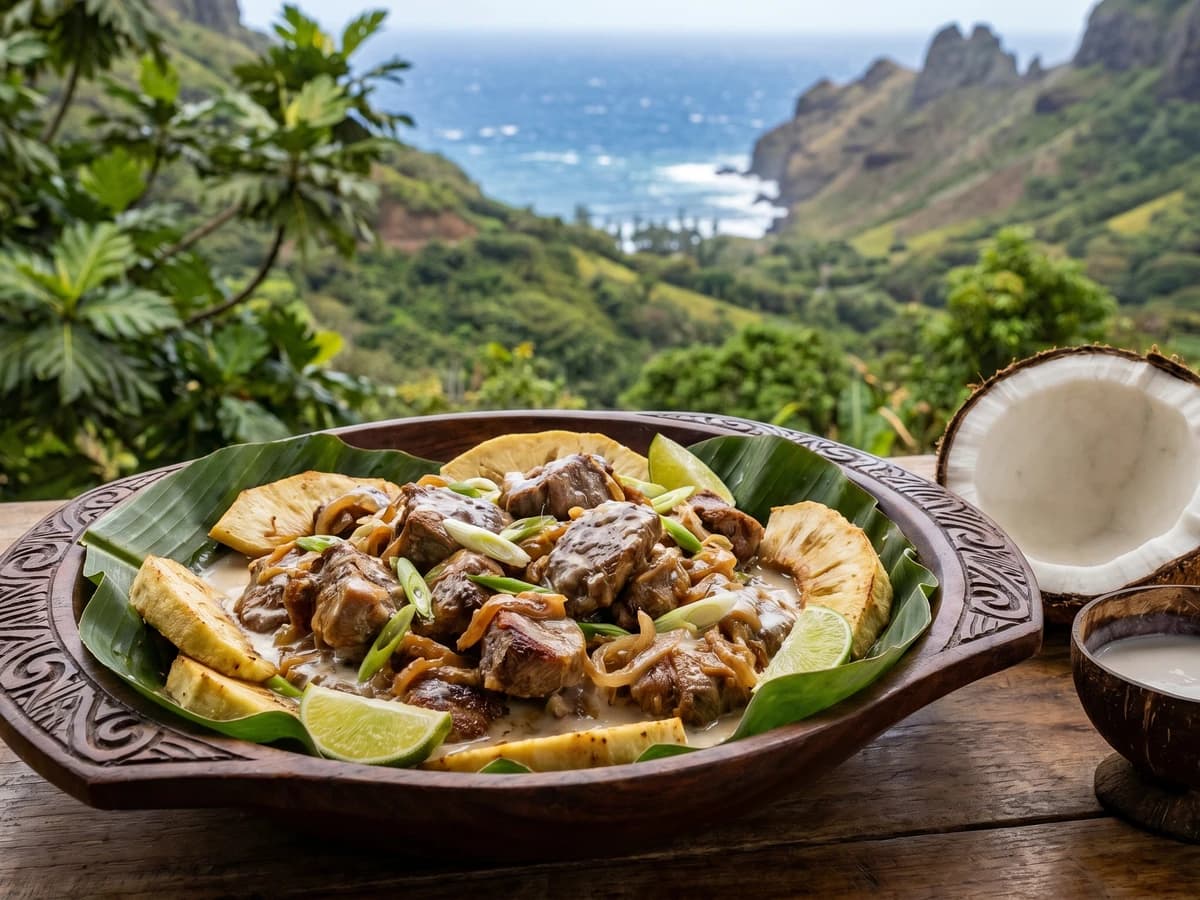
Wild valley pig from the Marquesas, salted, wrapped in leaf, roasted slow until the fat shines, then served with fresh miti haari and breadfruit for the celebration table.
Main Dishes
Polynesian
Special Occasion
Celebration
Outdoor Dining
45 min
Active Time
4 hr 30 min cook•5 hr 15 min total
Yield8 to 10 servings
The canoe taught all of us to eat from the place we landed, but Henua ʻEnana, the Marquesas, makes you listen harder. No soft lagoon wrapping those islands. High ridges, black-rock bays, deep green valleys, and the open Pacific hitting straight on. The wild pig there, puaʻa vao, belongs to that country of steep trails and hunters, not to a resort table and not to somebody's generic island plate.
This is Marquesan food, and I say that first. The cousins have their own earth-oven meat: Hawaiian kālua puaʻa in the imu, Sāmoan and Tongan puaʻa from the umu, Māori pork or mutton from the hāngī, Tahitian meat from the ahimaʻa, Cook Islands pork from the umukai. The umu by any name is one oven, but every island's hand is its own. Henua ʻEnana gives this one the valley pig and the breadfruit, the mei, because the Marquesas are breadfruit heartland in a way my Hawaiian table leans more toward kalo.
Most of us are not opening a Marquesan umu kai in the yard, and I no pretend this oven roast is the same as festival fire. It is a respectful kitchen road: salt, leaf, slow heat, then fresh miti haari, the coconut sauce, bright and rich over the meat. The why is simple. Wild boar is strong and lean, so you give it time, fat, leaf, and rest. No rush the animal that already gave you hard work.
For the deep parts of the Festival des Marquises, the hunt, the cutting, the umu kai, and the chants and protocols around it, go to Marquesan elders. This is their food. I cook it open-handed from my Hawaiian home seat because one ocean, one canoe, one root made us family, but family still calls each cousin by name.
The Marquesas, Henua ʻEnana, were settled by East Polynesian voyagers more than a thousand years ago, and breadfruit, mei or ʻuru, became one of the great anchors of Marquesan food life where other islands leaned harder on taro. Feral pigs, descended from animals brought and managed across different periods of island history, are still hunted in the valleys and brought to celebration tables, including the wider feast grammar around the umu kai. The dish sits beside its Polynesian earth-oven cousins, but it is not Tahitian and not generic: it belongs to the rugged Marquesan high islands and the people who know those valleys.
The technique, the tradition, and the story behind every dish.
bone-in wild boar shoulder or legtrimmed of hard silver skin
1 (5 to 6 pounds)
coarse sea saltplus more to taste
2 tablespoons
cracked black pepper
1 tablespoon
garlicpounded or finely grated
8 cloves
fresh gingerfinely grated
1 thumb-size piece
lime juice or sour orange juice
1/3 cup
coconut oil or neutral oil
2 tablespoons
ti leaves or banana leavesthick ribs softened or removed
8 to 10
water or unsalted pork stockfor the pan
1 cup
fresh coconut cream for miti haari
2 cups
lime juice for miti haari
1/4 cup
shallot or green onionsfinely sliced
1 small shallot or 2 green onions
small hot chile (optional)seeded and finely sliced
1
sea salt
to taste
roasted mei or ʻuru (breadfruit)
for serving
Equipment Needed
•Heavy 7-quart Dutch oven or deep covered roasting pan
•Instant-read thermometer for checking the thickest part
•Citrus press or coconut scraper if squeezing fresh miti haari
Instructions
1
Honor the meat
Pat the puaʻa vao, the wild pig, very dry and trim away only the hard silver skin, not the good fat. In the Marquesas, Henua ʻEnana, this animal comes from the valleys, from steep wet ground and hard walking, so the meat can be leaner and darker than farm pork. Salt it like meat that worked for its life.
2
Rub and rest
Mix the sea salt, pepper, garlic, ginger, citrus juice, and oil into a rough paste. Rub it into every side of the boar, especially around the bone and through any cuts in the fat. Cover and rest at least 1 hour, or overnight in the fridge if you can; the salt needs time to walk inward.
If your wild boar is very lean, lay a few strips of pork belly or fatty bacon over the top before wrapping. No shame. Eat what you have, and keep the meat from drying out.
3
Wrap in leaf
Heat the oven to 300F. Pass ti leaves briefly over heat to make them flexible, or rinse banana leaves and soften them. Lay the leaves in a deep roasting pan or Dutch oven, set the boar in the middle, and fold the leaves over it tight. Pour the water or stock around the bundle, not over the top.
4
Roast slow
Cover the pan tight with a lid or foil and roast for 4 to 5 hours, until a fork slides in without argument and the meat pulls in thick, glossy pieces. This is the kitchen road toward the Marquesan umu kai, the earth-oven feast, not the ceremony itself. For that deep part, go sit with Marquesan elders. They should tell their own story.
5
Brown the surface
Open the leaves, spoon some of the salty juices over the meat, and raise the oven to 425F for 15 to 20 minutes, just until the outside goes dark mahogany and the rendered fat shines. Watch it close. Wild meat can go from proud to dry fast.
6
Make miti haari
While the boar rests, stir the fresh coconut cream with lime juice, shallot or green onion, chile if using, and salt. Miti haari is the coconut sauce at the table, cool and rich against the roasted meat. Squeeze the coconut fresh if you can; that cream carries the soul here.
7
Pull and share
Pull the boar into big pieces with the grain, folding a little of the pan juice back through so every bite has sheen. Serve it family-style with roasted mei or ʻuru, the breadfruit that Henua ʻEnana leans on so deeply, and pass the miti haari beside it. Deep food is not fancy. It is enough, and one more person can sit down.
Chef Tips
•Wild boar varies hard. A young shoulder may cook like pork; an older valley animal may need another hour and more liquid. Tender is the test, not the clock.
•Ask where the meat came from and how it was handled. Clean field dressing matters more than any rub. Sourcing first, always.
•Fresh miti haari makes the plate feel Marquesan. Canned coconut cream will work on a weeknight, but if the coconut is good and mature, grate and squeeze it close to serving.
•Serve breadfruit with this if you can. Henua ʻEnana is mei country, and the roasted starch catches the pork juices and coconut sauce better than anything precious.
Advance Preparation
•Rub the boar the night before and refrigerate it covered; bring it toward room temperature for 45 minutes before roasting.
•Roast the meat a day ahead if needed, store it in its juices, then rewarm covered at 300F until glossy and tender before browning.
•Make the miti haari within a few hours of serving. Fresh coconut cream separates and can sour if it waits too long.
Frequently Asked Questions
Nutrition Information
1 serving (about 400g)
Calories
610 calories
Total Fat
28 g
Saturated Fat
21 g
Trans Fat
0 g
Unsaturated Fat
7 g
Cholesterol
105 mg
Sodium
1780 mg
Total Carbohydrates
48 g
Dietary Fiber
9 g
Sugars
19 g
Protein
46 g
Where cooking meets culture.
Culinary guides, cultural storytelling, and the editorial depth that makes cooking meaningful.