
Chef Lupita
Agua de Chilacayota
Oaxaca's market agua fresca built on chilacayota squash, piloncillo, and Mexican canela, served cold with the spaghetti-like strands of squash and toasted seeds floating in the glass.
A cooking platform built around craft, culture, and the stories behind what we eat.
Created by
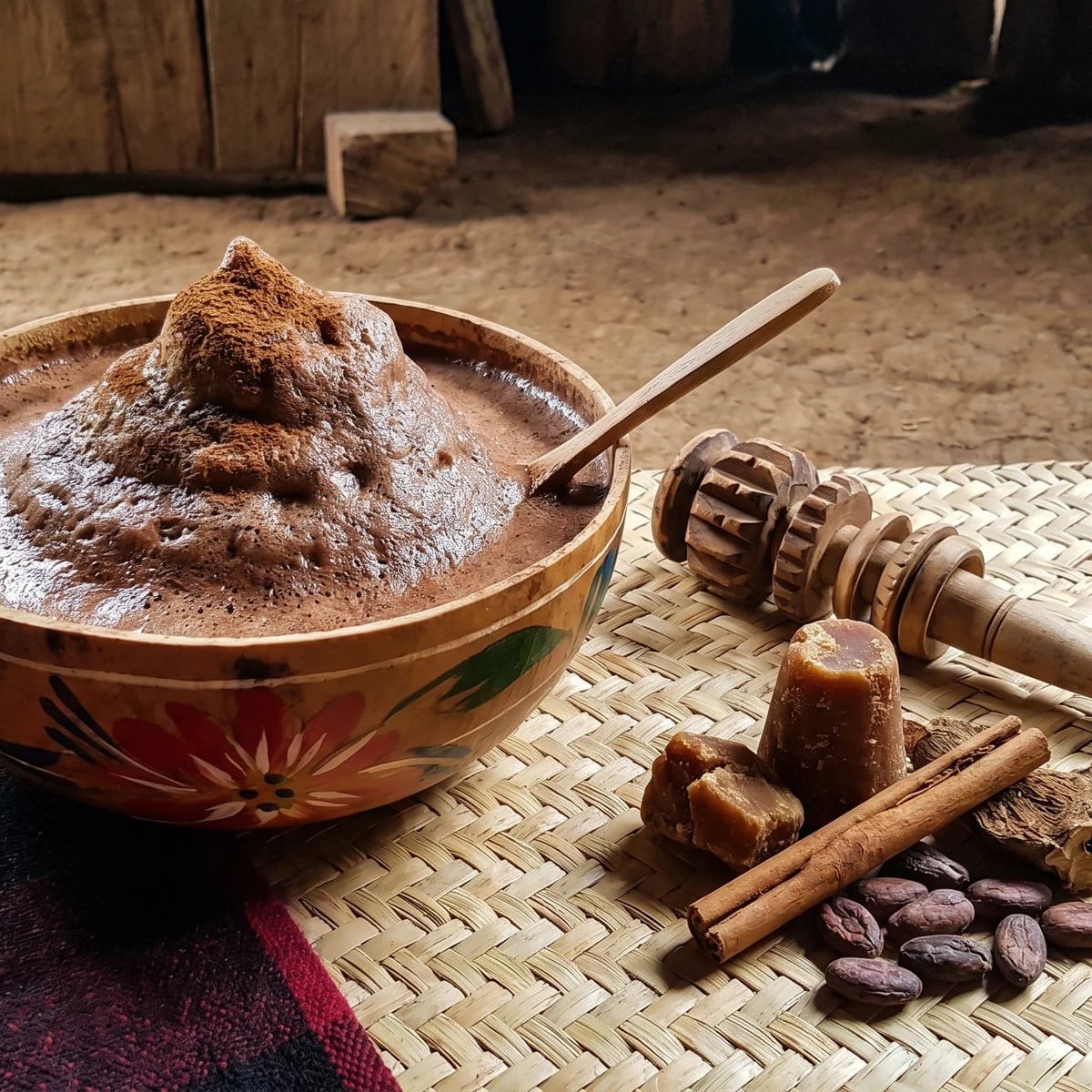
The Mixe ceremonial drink of Oaxaca's Sierra Norte. Toasted cacao, nixtamalized corn masa, and the foaming root cocolmeca whipped into a foam so dense you eat it with a spoon before you drink what is underneath.
Pozontle is from the Sierra Norte de Oaxaca. Specifically from the Mixe highlands, the towns of Ayutla, Tlahuitoltepec, Tamazulapam, where the Ayuujk people have been preparing this drink for centuries as ceremony, not refreshment. If you have heard of tejate, the foaming Zapotec drink from the Valles Centrales, pozontle is its mountain cousin. Cousins, not the same. Cada estado, su propia cocina, and inside Oaxaca alone there are dozens of cocinas, each one its own.
Three ingredients carry this drink: nixtamalized corn, cacao toasted on a comal, and cocolmeca, a foraged root the Mixe women pull from the cloud forest. The cocolmeca is what makes pozontle pozontle. Without that root, the masa and the cacao stay in the bottom of the cup. With it, the drink rises into a foam so dense you scoop the top with a spoon before you drink what is below. That foam is the entire point. It is not garnish. It is the dish.
I traveled to Tlahuitoltepec in 2014 to learn this drink from a senora named Dona Florencia, who had been making pozontle for weddings and harvest festivals for fifty-two years. She ground the masa on a metate her mother had used. She whipped the foam in a jicara the size of a small bucket, palms moving so fast on the molinillo I could not see the wood. When I asked her how she knew when the foam was ready, she said: 'Cuando se queda parada,' when it stands up on its own. That is the only test. Saber cocinar es saber vivir, and the Mixe have known how to live for a long time.
Pozontle (also spelled pozontle, popo, or chocolate-atole in different Sierra Norte municipalities) belongs to a family of pre-Columbian foamed cacao-and-corn beverages that were considered offerings to the gods among Mesoamerican cultures, with the Nahuatl word 'pozonalli' meaning 'that which foams.' The Mixe (Ayuujk) people of the Sierra Norte de Oaxaca preserved the use of cocolmeca (Smilax aristolochiifolia or related Smilax species) as the foaming agent long after lowland communities shifted toward other thickeners, because the root grows abundantly in their highland forests above 1,800 meters. Pozontle remains a ceremonial drink rather than a daily one, served at weddings, funerals, harvest celebrations (called muk in Mixe), and the inauguration of new community authorities, and its preparation is traditionally a collective task carried out by the women of the host household.
Quantity
1 1/2 cups
Quantity
2 tablespoons
Quantity
8 cups, plus more as needed
Quantity
1 ounce
broken into small pieces
Quantity
4 cups
Quantity
4 ounces
cacao criollo preferred
Quantity
1/2 cup, plus more to taste
chopped
Quantity
1 small stick, about 2 inches
Quantity
8 cups
Quantity
pinch
| Ingredient | Quantity |
|---|---|
| dried white corn kernels (maiz blanco) | 1 1/2 cups |
| cal (calcium hydroxide / pickling lime) | 2 tablespoons |
| water for nixtamalizing | 8 cups, plus more as needed |
| dried cocolmeca root (raiz de cocolmeca)broken into small pieces | 1 ounce |
| water for the cocolmeca infusion | 4 cups |
| cacao beans, whole and unroastedcacao criollo preferred | 4 ounces |
| piloncillochopped | 1/2 cup, plus more to taste |
| true Mexican cinnamon (canela de Ceilan) | 1 small stick, about 2 inches |
| cold water for serving | 8 cups |
| sea salt | pinch |
Combine the dried corn, cal, and 8 cups of water in a heavy non-reactive pot. Use stainless steel or clay, never aluminum. Bring to a gentle simmer over medium heat, then lower the flame. Cook for 45 minutes, until the kernels are softened but still hold their shape and the skins slip off when you press a kernel between your fingers. Remove from the heat, cover, and let the corn rest in the cooking liquid overnight or at least 8 hours. This is nixtamal. There is no shortcut. Asi se hace y punto.
Drain the corn and rinse it under cold running water, rubbing the kernels between your hands to release the loosened skins. Keep rinsing until the water runs clear and the corn no longer feels slick. The kernels should now be plump, pale, and clean. This corn is what becomes the masa, and the masa is what gives pozontle its body.
While the corn rests, simmer the broken cocolmeca root in 4 cups of water for 30 minutes over low heat. The water will turn a deep tea color, somewhere between rust and mahogany. This is the foaming agent that gives pozontle its character. Without cocolmeca you have a chocolate atole, not pozontle. The Mixe women in the Sierra Norte forage this root from the highland forests around Ayutla and Tlahuitoltepec, and there is no real substitute. Strain and reserve the liquid. Discard the spent root.
Heat a dry comal over medium-low. Toast the cacao beans, shaking the pan, for 8 to 10 minutes. The shells will start to crack and the kitchen will smell like a chocolate workshop in Oaxaca city. Pull them off the heat. When cool enough to handle, slip the shells off with your fingers. The nibs inside should be glossy and deep brown. Grind the nibs in a spice grinder or molcajete until you have a coarse paste. The natural cacao butter will start to release. This is cacao the way it was used before machinery, and the texture matters.
Pass the rinsed nixtamal through a metate, or, more practically, grind it in a food processor or high-powered blender with just enough of the cocolmeca infusion to move the blades, about 1/2 cup. Work it in batches if you need to. You want a smooth, dense paste with the texture of wet clay. In the Sierra Norte, women grind this on the metate for an hour. A blender does it in three minutes and the abuelas will forgive you. La cocina no es decoracion, es trabajo, but the work is in the steps that matter.
In a wide cazuela or heavy pot, combine the masa, the ground cacao paste, the piloncillo, the cinnamon stick, and the salt. Pour in the remaining cocolmeca infusion. Cook over medium-low heat, stirring constantly with a wooden spoon, for 15 to 20 minutes. The mixture will thicken into a dark, fragrant paste that pulls away from the sides of the pot. The smell shifts from raw masa to something deeper, toasted corn married to chocolate and the woody perfume of the canela. Taste and adjust the piloncillo. Pozontle should be barely sweet, never dessert sweet.
This step is non-negotiable. Transfer the paste to a wide bowl and let it cool to room temperature. Cocolmeca only foams in cold liquid. If you whip the paste while it is warm, you will get sludge. The Mixe women set the bowl outside in the sierra air and wait. You can use the refrigerator if you must. No me vengas con atajos here. The foam is the dish. Skip the cooling and you will not have pozontle, you will have hot chocolate.
Transfer the cooled paste to a tall jicara, a deep clay cazuela, or a sturdy mixing bowl. Add 4 cups of cold water and start whipping with a molinillo, working it between your palms with a fast back-and-forth twist. If you do not have a molinillo, an electric hand mixer with the whisk attachment will do the work in less time and with less honor. Keep adding cold water in small additions, up to 4 more cups, while whipping. Within five minutes the surface will rise into a thick brown foam, dense and stable, the kind that sits proud above the liquid. The foam should be tall enough to scoop with a spoon. That is pozontle.
Ladle the pozontle into jicaras (the dried gourd cups used across the Sierra Norte) or small clay cups. Each serving should be mostly foam on top, with the darker chocolate-corn liquid below. Eat the foam with a small wooden spoon first. Drink the liquid after. This is the order. In Mixe ceremonies, pozontle is shared at weddings, funerals, harvest festivals, and the appointment of new authorities. It is not a cafe drink. Treat it with the seriousness it carries. Recetas probadas y garantizadas.
1 serving (about 380g)
Culinary guides, cultural storytelling, and the editorial depth that makes cooking meaningful.
Discover Culinary Explorer
Chef Lupita
Oaxaca's market agua fresca built on chilacayota squash, piloncillo, and Mexican canela, served cold with the spaghetti-like strands of squash and toasted seeds floating in the glass.

Chef Lupita
Oaxaca's deep-red hibiscus agua, steeped slow with piloncillo, canela, and a strip of orange peel. The pitcher that sits on every comedor table from Tlacolula to Juchitan.

Chef Lupita
Oaxaca's mercado float, a tall glass of cold rice horchata crowned with a scoop of magenta prickly pear nieve, eaten with a long spoon while the colors bleed into each other.

Chef Lupita
Tlaxiaco's home digestif from the Mixteca Alta of Oaxaca, cane aguardiente steeped for two months with wild damiana, piloncillo, and canela, served in copitas at the end of the night.