
Chef Lupita
Aguascalientes Beef Tongue Pozole (Pozole de Lengua)
Aguascalientes' Bajio pozole de lengua, built with cacahuazintle hominy, tender beef tongue, chile ancho and guajillo, with xoconostle brightness and table garnishes.
A cooking platform built around craft, culture, and the stories behind what we eat.
Created by
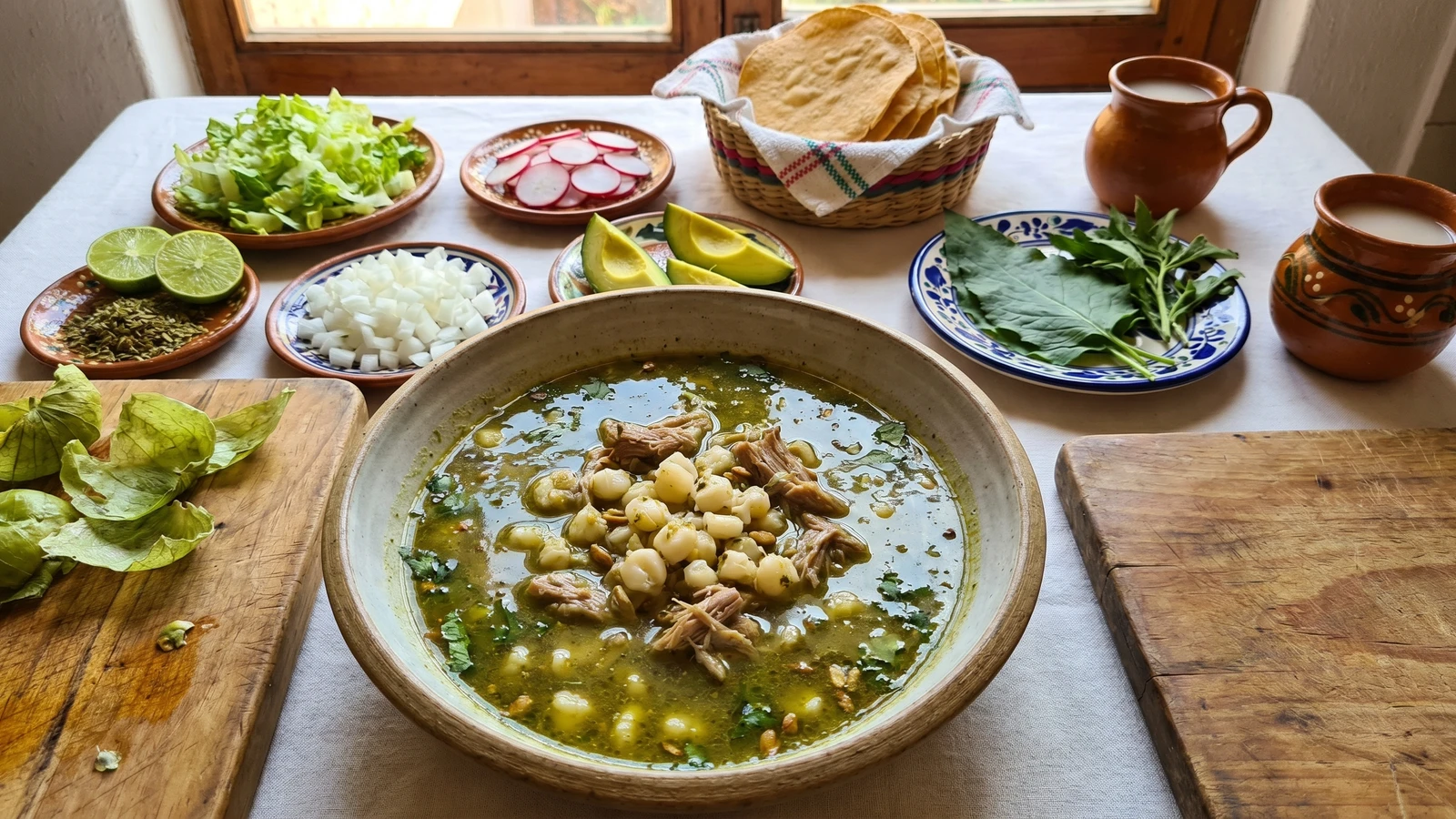
Puebla's pozole verde, built on charred tomatillos, toasted pepitas, hoja santa, and cacahuazintle hominy, cooked into a green broth that is brighter than rojo and just as deep.
Pozole verde is from the central highlands. Guerrero claims its own version and they are right to. But the poblana version, the one I am writing here, comes from the kitchens of Puebla state, where hoja santa grows in backyard gardens and where the pepita is treated with the same seriousness that other states give to dried chile.
The color does not come from food coloring. It comes from charred tomatillo, chile poblano, cilantro, hoja santa, epazote, and a generous cup of toasted pepitas that thicken the broth from within. The pepitas are the bones of this pozole. They are what separates a poblana pozole verde from a thin tomatillo soup. Toast them until they are the color of pale honey and pull them off the heat the second they smell nutty. One shade darker and the salsa turns bitter. Así se hace y punto.
Use cacahuazintle hominy if you can find it. It is the large white maize variety that Puebla and Tlaxcala have grown for centuries and the kernels burst open in the pot like flowers, soft on the outside, firm at the center. The supermarket can of Mexican hominy is a compromise. A reasonable one, but a compromise. La Costena or Juanita's will get you most of the way.
My mother did not cook pozole verde. She was from Jalisco and she cooked rojo every Sunday until I was sixteen. I learned this version from a señora named Doña Rosalia who runs a fonda in San Pedro Cholula and who let me sit at her counter for three afternoons while she explained why the hoja santa goes in raw and the epazote goes in twice. I copied her words into the same notebook my mother left me. Saber cocinar es saber vivir, and one notebook can hold both of them.
Pozole verde appears to have developed in the central highlands and Guerrero in parallel through the colonial and post-independence periods, with each region adapting the pre-Columbian pozolli ceremony to its own ingredients: Guerrero leaned on sardine-style ground pumpkin seed and a leaner broth, while Puebla and Tlaxcala built theirs around hoja santa, epazote, and the cacahuazintle maize variety cultivated in the region for centuries. The cacahuazintle corn is so closely tied to Puebla and the Valley of Toluca that it carries Denomination of Origin discussions in Mexican culinary circles, and the large white kernel is considered the standard for any pozole worth the name. Hoja santa (Piper auritum), the anise-scented leaf the Nahua called tlanepaquelite, was used in pre-Columbian sauces and tamales long before the conquest, and its survival in dishes like pozole verde poblano represents an unbroken line of indigenous cooking practice in Mexico's central highlands.
Quantity
3 pounds
cut into 2-inch chunks
Quantity
1 pound
Quantity
1 medium
halved
Quantity
1, plus 4 cloves
halved crosswise (head); cloves reserved for the salsa
Quantity
2
Quantity
1 tablespoon, plus more to taste
Quantity
2 cans (29 ounces each)
drained and rinsed, or 2 cups dried, nixtamalized and cooked
Quantity
1 1/2 pounds
husked and rinsed
Quantity
4
stemmed
Quantity
3
stemmed (use 2 if you want less heat)
Quantity
1 cup, plus more for garnish
Quantity
1
roughly chopped
Quantity
1 cup, packed
Quantity
1/2 cup, torn (about 2 large leaves)
or 1 tablespoon dried
Quantity
1 small bunch (about 6 sprigs)
Quantity
2
roughly chopped (for the salsa, not garnish)
Quantity
2 tablespoons
Quantity
for serving
Quantity
for serving
Quantity
for serving
Quantity
for serving
Quantity
for serving
Quantity
for serving
Quantity
for serving
| Ingredient | Quantity |
|---|---|
| bone-in pork shouldercut into 2-inch chunks | 3 pounds |
| pork neck bones or pork backbone | 1 pound |
| white onionhalved | 1 medium |
| head of garlichalved crosswise (head); cloves reserved for the salsa | 1, plus 4 cloves |
| bay leaves | 2 |
| kosher salt | 1 tablespoon, plus more to taste |
| cacahuazintle hominydrained and rinsed, or 2 cups dried, nixtamalized and cooked | 2 cans (29 ounces each) |
| tomatilloshusked and rinsed | 1 1/2 pounds |
| fresh chile poblanostemmed | 4 |
| fresh chile serranostemmed (use 2 if you want less heat) | 3 |
| raw hulled pumpkin seeds (pepitas) | 1 cup, plus more for garnish |
| small white onionroughly chopped | 1 |
| fresh cilantro leaves and tender stems | 1 cup, packed |
| fresh hoja santa leavesor 1 tablespoon dried | 1/2 cup, torn (about 2 large leaves) |
| fresh epazote | 1 small bunch (about 6 sprigs) |
| romaine lettuce leavesroughly chopped (for the salsa, not garnish) | 2 |
| lard (manteca de cerdo) | 2 tablespoons |
| shredded romaine or iceberg lettuce (optional) | for serving |
| sliced radishes (optional) | for serving |
| diced white onion (optional) | for serving |
| dried Mexican oregano (optional) | for serving |
| lime wedges (optional) | for serving |
| sliced avocado (optional) | for serving |
| tostadas (optional) | for serving |
Place the pork shoulder and neck bones in a heavy 8-quart stockpot. Cover with cold water by two inches. Add the halved onion, the halved head of garlic, the bay leaves, and the tablespoon of salt. Bring to a slow simmer over medium heat. Skim the gray foam that rises in the first fifteen minutes and discard it. Cold water draws the flavor out slowly. A rolling boil clouds the broth and toughens the meat. You want a clean caldo, not a cloudy one.
Lower the heat until you see lazy bubbles every few seconds. Cover partially and cook for two hours, until the pork pulls apart with a fork but still holds its shape. Strain the broth and reserve it. Pull the meat off the bones in rough shreds and set aside. Discard the spent onion, bay leaves, and bones. You should have about ten cups of clean pork broth. If you have less, top up with water until you do.
Heat a dry comal or heavy skillet over medium. Add the cup of pumpkin seeds in a single layer. Toast them, stirring almost constantly, for about five minutes. They will start popping and turning the pale gold of toasted almond. Pull them off the heat the moment they smell nutty and look just shy of brown. Burned pepitas turn the salsa bitter and there is no fixing it. Set aside to cool. Reserve a small handful for garnish.
On the same comal over medium-high heat, char the tomatillos, the chile poblano, the chile serrano, the four garlic cloves, and the small chopped onion. Turn them as the skins blister and blacken in spots. The tomatillos take about eight minutes and will turn olive-drab and soft. The poblanos take six to eight minutes and the skins should char in patches. The serranos take three or four minutes. The char is the flavor. A pozole verde made from raw tomatillos tastes flat and grassy.
Transfer the charred tomatillos, poblanos, serranos, garlic, and onion to a blender. Add the toasted pepitas (save the handful you set aside for garnish), the cilantro, the hoja santa, half the epazote, the chopped romaine, and one cup of the reserved pork broth. Blend on high until completely smooth and bright green. It should be the color of a wet jade stone, thick enough to coat the back of a spoon. If it is too thick to move in the blender, add more broth a quarter cup at a time.
Heat the lard in a wide heavy pot over medium-high until it shimmers. Pour the green salsa in all at once. It will sputter and seize. Stir constantly with a wooden spoon for eight to ten minutes. The color will darken from bright jade to a deeper, more serious green and the salsa will thicken. The fat will start to separate around the edges. This is the step that turns ingredients into pozole. La manteca es el sabor. No me vengas con atajos.
Pour the remaining nine cups of reserved pork broth into the pot with the fried salsa. Whisk to combine. Add the drained hominy, the shredded pork, and the rest of the epazote. Bring to a gentle simmer and cook, uncovered, for 30 minutes. The flavors marry and the broth thickens slightly as the pepitas continue to release. Taste for salt now. The hominy and the pepitas absorb seasoning, so the broth should taste assertive in the pot, not shy.
Ladle the pozole into deep clay bowls, making sure every bowl gets meat, hominy, and a generous amount of the green broth. Set the shredded lettuce, radishes, diced onion, oregano, lime, avocado, the reserved toasted pepitas, and the tostadas in small platitos around the table. Each person builds their own. That ritual is the dish as much as the broth is. Recetas probadas y garantizadas.
1 serving (about 500g)
Culinary guides, cultural storytelling, and the editorial depth that makes cooking meaningful.
Discover Culinary ExplorerChef Lupita
Aguascalientes' Bajio pozole de lengua, built with cacahuazintle hominy, tender beef tongue, chile ancho and guajillo, with xoconostle brightness and table garnishes.

Chef Lupita
Veracruz's Gulf coast rice from Alvarado, built with seafood stock, tomato, chile chipotle, epazote, shrimp, fish, jaiba, and pulpo, served loose and brothy in a clay cazuela.

Chef Lupita
Costa Chica's wet salt-beef stew, built from chile costeño, guajillo, tomato, manteca, yuca, plantain, and masa dumplings, the ranching pot of Cuajinicuilapa and Pinotepa.

Chef Lupita
Michoacán's P'urhépecha atápakua is a masa-thickened sauce and stew at once, built with pork, chile guajillo, and hierbabuena added only at the end.