
Chef Dimitra
Agrafa Batzina (Μπατζίνα), Courgette and Feta Pie
Agrafa's batzina is the no-phyllo pie of Karditsa: grated courgette, feta, eggs, milk, and flour poured thin into a hot oiled tapsi.
A cooking platform built around craft, culture, and the stories behind what we eat.
Created by
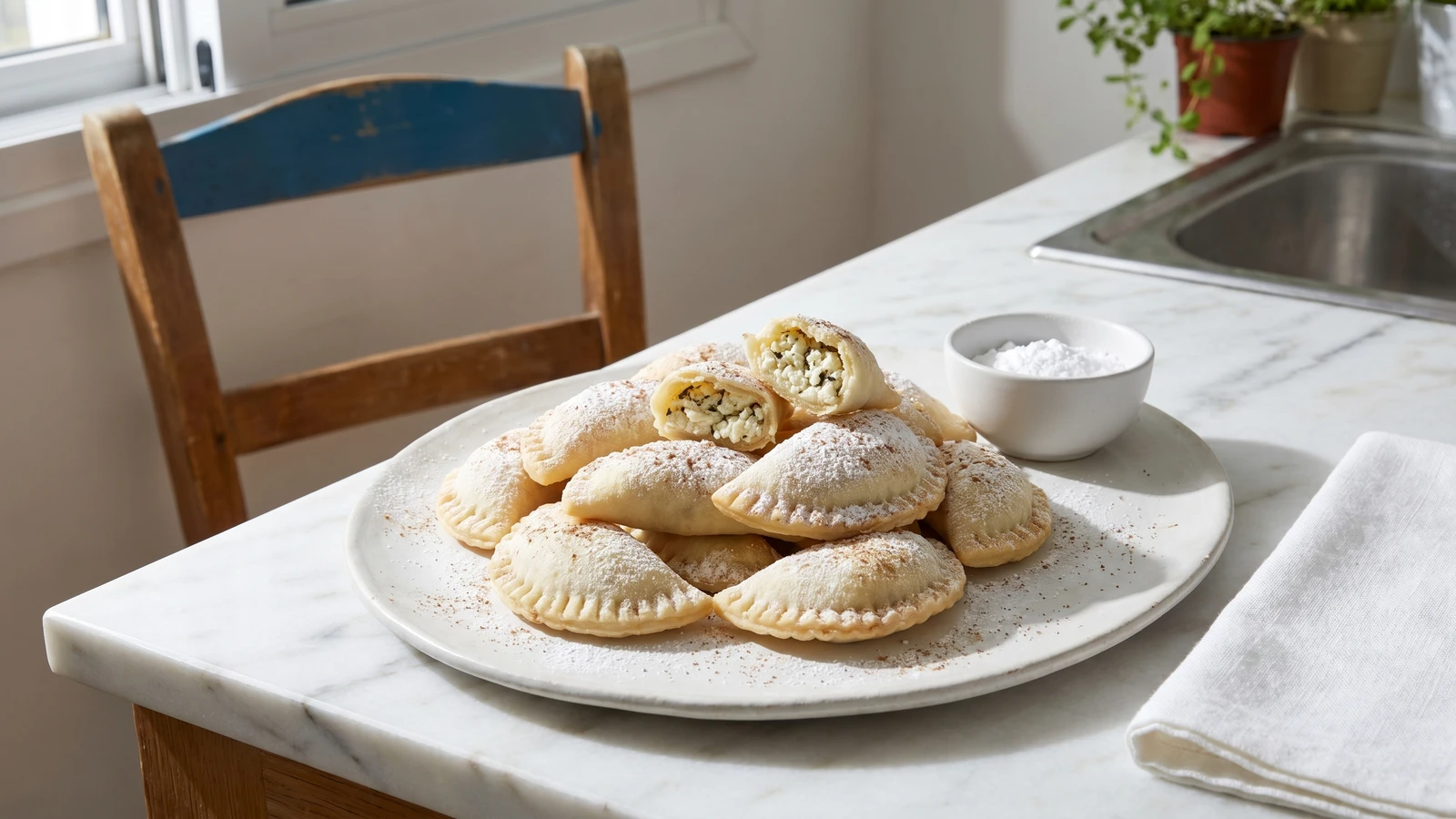
Cypriot pourekia me anari are thin fried turnovers for Tsiknopempti, filled with fresh cheese, cinnamon, sugar, and mint, then dusted white while warm.
Pourekia me anari are Cyprus's sweet cheese turnovers, folded thin around fresh unsalted anari and fried for the Carnival table. They are small, crisp, and white with icing sugar, with cinnamon and dried mint giving the cheese its Cypriot voice.
The dough must be rolled thin and the edges sealed hard. That is the whole trick. Too thick, and you get bread around cheese. Too loose, and the filling escapes into the oil before the pastry has time to blister and crisp.
I keep them small because that's how they behave best in the pan. One or two bites, still warm, sugar on the fingers. The region is the dish's surname, and here the surname is Cyprus: anari, mint, and the generous sweet table before Lent begins.
Pourekia me anari belong especially to Cyprus's Carnival season and Tsiknopempti, the Thursday before Lent when meat, dairy, and festive frying still fill the table. Anari, the island's fresh whey cheese, appears in both sweet and savory Cypriot cooking; in these pastries it is mixed with sugar, cinnamon, and often dried mint, a pairing that marks them clearly as Cypriot rather than mainland Greek.
Quantity
500g
plus extra for rolling
Quantity
1/2 tsp
Quantity
80ml
Quantity
220ml
plus 1 tbsp if needed
Quantity
1 tsp
Quantity
500g
drained
Quantity
80g
Quantity
1 tsp
Quantity
1 tbsp
rubbed fine
Quantity
1 tsp
Quantity
1 litre
for frying
Quantity
60g
for dusting
| Ingredient | Quantity |
|---|---|
| plain flourplus extra for rolling | 500g |
| fine sea salt | 1/2 tsp |
| mild olive oil or neutral oil | 80ml |
| lukewarm waterplus 1 tbsp if needed | 220ml |
| lemon juice or white vinegar | 1 tsp |
| fresh unsalted anari cheese (αναρή)drained | 500g |
| caster sugar | 80g |
| ground cinnamon | 1 tsp |
| dried mintrubbed fine | 1 tbsp |
| rosewater or orange blossom water (optional) | 1 tsp |
| light olive oil or neutral oilfor frying | 1 litre |
| icing sugarfor dusting | 60g |
Put the flour and salt in a wide bowl. Rub in the oil with your fingertips until the flour feels faintly sandy, then add the water and lemon juice. Knead for 6 to 8 minutes, until the dough is smooth, firm, and no longer sticky. Cover and rest it for 30 minutes.
Crumble the drained anari into a bowl. Add the sugar, cinnamon, mint, and rosewater if using, then mash lightly with a fork. The filling should hold together in soft clumps, not run like cream. If your anari is very wet, leave it in a sieve for another 20 minutes.
Divide the dough into 4 pieces. Keep three covered while you roll one piece on a lightly floured surface into a thin sheet, about 2mm thick. Thin dough is what makes pourekia crisp instead of bready, so don't leave it heavy.
Place heaped teaspoons of filling along one half of the dough, leaving 5cm between them. Fold the dough over, press around each mound to push out trapped air, then cut half-moons with a pastry wheel or glass. Press the edges firmly with a fork. This is the step that decides the dish: seal them tight, or the anari leaks into the oil and the pastry opens.
Heat the oil in a deep pan to 170C. Fry 4 to 5 pourekia at a time, turning once, for 2 to 3 minutes until pale gold and crisp. Don't crowd the pan. Lift them to a rack or paper towels and let the oil return to temperature before the next batch.
While still warm, dust generously with icing sugar. Eat the pourekia the day they are fried, when the shell is crisp and the anari inside is soft and scented with cinnamon and mint.
1 serving (about 55g)
Culinary guides, cultural storytelling, and the editorial depth that makes cooking meaningful.
Discover Culinary ExplorerChef Dimitra
Agrafa's batzina is the no-phyllo pie of Karditsa: grated courgette, feta, eggs, milk, and flour poured thin into a hot oiled tapsi.

Chef Dimitra
Zagori's flour pie skips phyllo completely: a loose egg-and-flour batter, crumbled feta, and a hot buttered tapsi that makes the edges crisp.

Chef Dimitra
Hydra and Andros give amygdalota their island surname: ground almond, sugar, egg white, and rosewater, baked pale so the center stays soft as marzipan.

Chef Dimitra
Asia Minor ekmek kataifi is built in three clear layers: crisp syruped kataifi, thick semolina custard, and cold kaimaki cream under pistachios.