Chef Graziella
Arrosto di Maiale alle Erbe Aromatiche
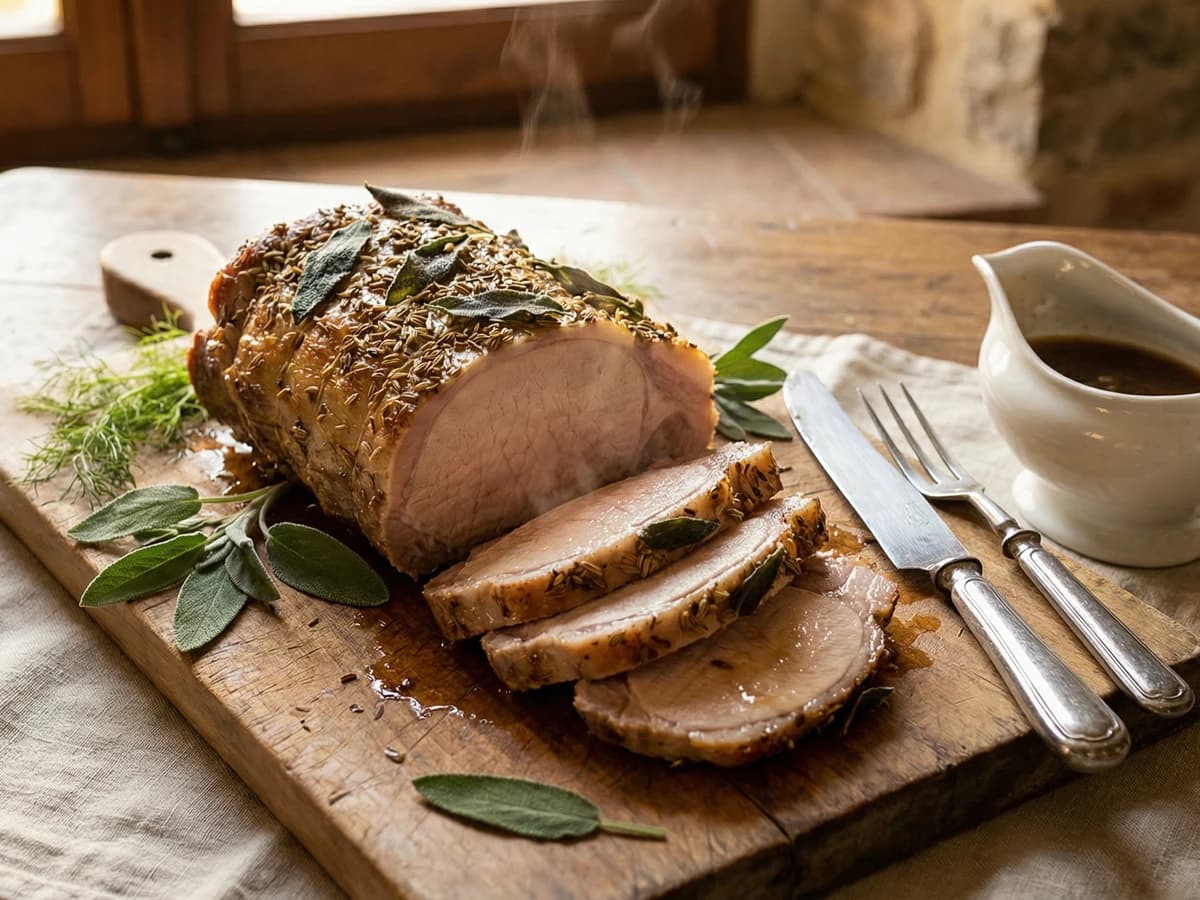
Bone-in pork loin rubbed with fennel, rosemary, and sage, roasted until the herbs form a crackling crust and the meat stays pink and succulent. This is the roast that brings Sunday to life.
A cooking platform built around craft, culture, and the stories behind what we eat.

Created by
The fennel-perfumed roast pork of central Italy, where a humble loin wrapped in seasoned belly becomes the centerpiece that brings an entire family to the table.
True porchetta is a whole pig, deboned and rolled with fennel and garlic, roasted in a wood-fired oven until the skin shatters at the touch of a knife. You see it at every market in Umbria and the Marche, carved to order and stuffed into crusty rolls. This is not something most home cooks can attempt. A whole pig requires equipment, space, and the kind of confidence that comes from doing it a hundred times.
What you can do is capture the essence. A pork loin provides the lean, tender center. A piece of pork belly, scored and seasoned, wraps around it to create that crackling exterior. The aromatics remain the same: fennel, rosemary, garlic, sage. The technique adapts to a home oven without losing the soul of the dish.
The garlic here is gentle. You use whole cloves, not minced paste. They perfume the meat during roasting and become soft enough to spread on bread. The fennel seeds must be toasted and crushed, releasing oils that define porchetta as surely as any ingredient. What you keep out matters: no liquid smoke, no brown sugar, no American barbecue thinking. This is Italian roasting at its most elemental.
Porchetta has been the street food of central Italy since at least the 15th century, when whole pigs roasted on spits appeared at festivals and markets from Umbria to Lazio. The town of Ariccia, in the hills south of Rome, became so famous for its porchetta that Romans still make pilgrimages there on Sundays. The IGP designation now protects the traditional preparation, though every village insists its version is the authentic one.
Quantity
3 pounds
trimmed
Quantity
2 pounds
in one piece
Quantity
3 tablespoons
Quantity
2 tablespoons
chopped fine
Quantity
1 tablespoon
chopped fine
Quantity
8
peeled
Quantity
1 teaspoon
Quantity
2 tablespoons
Quantity
1 teaspoon
freshly ground
Quantity
3 tablespoons
Quantity
1
zested
| Ingredient | Quantity |
|---|---|
| boneless pork loin roasttrimmed | 3 pounds |
| skin-on pork bellyin one piece | 2 pounds |
| fennel seeds | 3 tablespoons |
| fresh rosemary leaveschopped fine | 2 tablespoons |
| fresh sage leaveschopped fine | 1 tablespoon |
| garlic clovespeeled | 8 |
| red pepper flakes | 1 teaspoon |
| kosher salt | 2 tablespoons |
| black pepperfreshly ground | 1 teaspoon |
| extra virgin olive oil | 3 tablespoons |
| lemonzested | 1 |
Place the fennel seeds in a small dry skillet over medium heat. Toast, shaking the pan frequently, until fragrant and lightly golden, about 2 minutes. Transfer immediately to a cutting board and let cool. Crush coarsely with the flat of a knife or the bottom of a heavy pan. You want pieces, not powder. The texture matters.
Mince 4 of the garlic cloves fine. In a small bowl, combine the crushed fennel, minced garlic, rosemary, sage, red pepper flakes, lemon zest, 1 tablespoon of the salt, and the black pepper. Add the olive oil and stir to form a rough paste. The fragrance should be intoxicating. If it is not, your herbs are not fresh enough.
Score the skin of the pork belly in a crosshatch pattern, cutting through the skin and into the fat but not into the meat. The cuts should be about half an inch apart. This allows the fat to render and the skin to crisp. Turn the belly skin-side down. Spread half of the seasoning paste evenly over the meat side. Scatter the remaining 4 whole garlic cloves across the surface.
Season the pork loin all over with the remaining 1 tablespoon salt. Rub the remaining seasoning paste over the entire surface of the loin. Place the loin lengthwise along one edge of the prepared belly. Roll the belly tightly around the loin, keeping the seam on the bottom. Tie securely with kitchen twine at 1-inch intervals. The package should be snug but not strangling the meat.
Place the roast seam-side down on a wire rack set over a rimmed baking sheet. Refrigerate uncovered for at least 8 hours, preferably 24. The refrigerator air dries the skin, which is essential for proper crackling. This is not optional. Wet skin steams instead of crisping.
Remove the roast from the refrigerator 1 hour before cooking. Heat the oven to 325 degrees. Place the roast on a rack in a roasting pan and cook until an instant-read thermometer inserted into the center of the loin reads 135 degrees, about 2 to 2 and a half hours. The skin will be pale and leathery at this point. This is correct.
Increase the oven temperature to 500 degrees. Continue roasting until the skin puffs and crackles, 15 to 25 minutes more. Watch carefully. The skin should blister and turn deep golden brown, but it burns quickly at this temperature. If some spots brown faster than others, that is natural. The final internal temperature should reach 145 degrees.
Transfer the roast to a cutting board and let rest for at least 20 minutes. Do not tent with foil, which softens the crackling you worked to achieve. The resting allows juices to redistribute throughout the meat. Cut away the twine. Carve into slices about half an inch thick, ensuring each slice has both the tender loin and a piece of crackling belly.
1 serving (about 210g)
Culinary guides, cultural storytelling, and the editorial depth that makes cooking meaningful.
Discover Culinary ExplorerChef Graziella
Bone-in pork loin rubbed with fennel, rosemary, and sage, roasted until the herbs form a crackling crust and the meat stays pink and succulent. This is the roast that brings Sunday to life.

Chef Graziella
The ancient technique of salt-baking creates a sealed chamber where the fish steams in its own moisture. What emerges is flesh of remarkable purity, seasoned perfectly, ready for nothing but your best olive oil.

Chef Graziella
The ugly fish that cooks like veal, braised in tomatoes until the firm white flesh absorbs the briny sweetness of olives and capers. Fishermen's wives along the Adriatic knew its worth before restaurants discovered it.

Chef Graziella
A fifteen-minute lesson in restraint: pork chops, butter, sage, and the understanding that what you leave out matters as much as what you put in.