
Chef Lupita
Agua de Alfalfa
Ciudad de México's highland market agua fresca, fresh alfalfa blended with pineapple and lime until bright green, strained clean, and poured cold from the vitrolero.
A cooking platform built around craft, culture, and the stories behind what we eat.
Created by
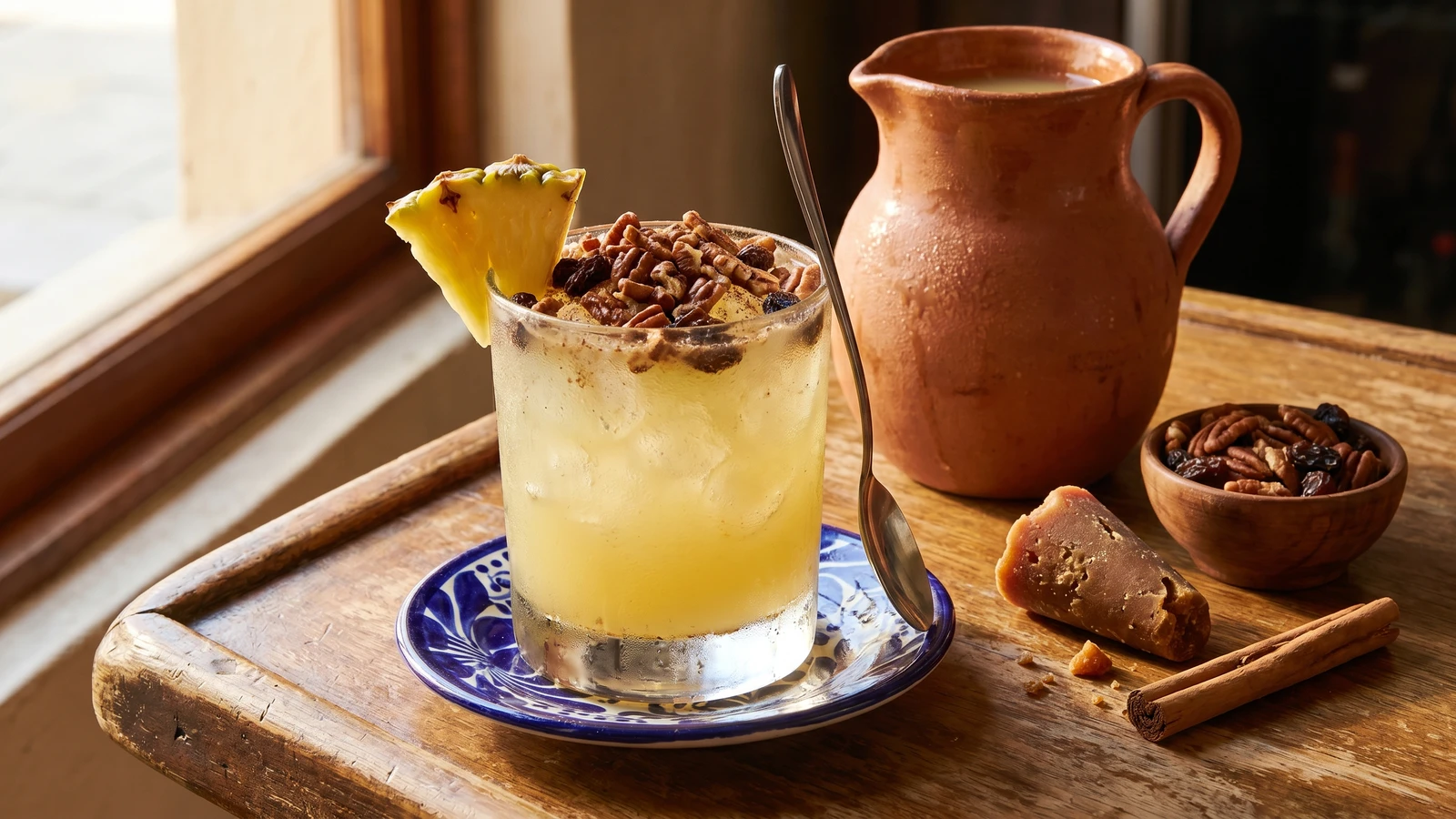
Sinaloa's cold pineapple punch built on macerated piña, evaporated milk, and piloncillo with canela, finished with toasted pecans and raisins. Fiesta in a tall glass.
This is from Sinaloa. Not a Christmas ponche, not a hot punch with tejocote and guava, but the cold one, the festive milky pineapple punch that comes out of refrigerators across Culiacan, Mazatlan, and Los Mochis at quinceaneras, baptisms, and Sunday family lunches when the heat is climbing toward forty degrees and nobody wants anything warm in a glass.
The Sinaloan kitchen is a northwest kitchen. The desert pours into the glass. Wheat country, cattle country, pineapple from the lowlands, dairy from the ranches, pecans from the orchards along the rio. The evaporated milk is not a shortcut here. It is the ingredient. Agua de cebada norteña takes evaporated milk. So does ponche de piña. The cooks of the north built their dulces and their bebidas around canned milk because that is what their pantries held, and they perfected it until the result was unmistakable. Defend the can or you have not understood the cuisine.
The pineapple has to macerate. Hours, not minutes. The syrup of piloncillo and canela needs time to crawl into the fruit and the fruit needs time to give its perfume back to the syrup. If you blend raw pineapple with milk, you get a smoothie. If you blend macerated piña with evaporated milk, condensed milk, and a little whole milk, you get ponche sinaloense. The difference is patience. Saber cocinar es saber vivir.
My mother kept a page in her notebook for the cold ponches of the north. She copied them from a Sinaloan compadre of my father in the 1980s, written in pencil with a small note in the margin: 'la piña tiene que estar madura, casi pasada.' The pineapple has to be ripe, almost overripe. She was right. A green pineapple gives you sour ponche. A bronze, fragrant one with give at the base gives you the real thing.
Sinaloa's ponche de piña frío belongs to the broader northwest Mexican tradition of milk-based cold drinks that emerged in the late 19th and early 20th centuries, when the spread of canned evaporated milk through the Pacific railroad and the establishment of the state's first dairy ranches gave home cooks a shelf-stable cream that survived the brutal coastal heat. The pineapple itself, native to South America and brought north through Mesoamerican trade routes long before the conquest, became a Sinaloa lowland crop in the colonial era and a fixture of celebratory bebidas across the state. Unlike the spiced fruit ponche of central Mexico associated with Christmas, the ponche frío of Sinaloa is a year-round fiesta drink, served at quinceaneras and family gatherings as a counterpoint to the heat, and it shares its conceptual lineage with agua de cebada norteña and cocorchata in its embrace of dairy as a cooling agent.
Quantity
1 (about 4 pounds)
peeled, cored, and cut into 1-inch chunks
Quantity
1 cup
chopped (or 3/4 cup packed dark brown sugar)
Quantity
2 sticks, about 4 inches each
Quantity
4
Quantity
3 cups
Quantity
1 can (12 ounces)
well chilled
Quantity
1 can (14 ounces)
well chilled
Quantity
1 cup
well chilled
Quantity
1 teaspoon
Quantity
pinch
Quantity
plenty, for serving
Quantity
1/2 cup
toasted on a comal and roughly chopped
Quantity
1/3 cup
Quantity
for dusting
Quantity
for the rim
| Ingredient | Quantity |
|---|---|
| ripe pineapplepeeled, cored, and cut into 1-inch chunks | 1 (about 4 pounds) |
| piloncillochopped (or 3/4 cup packed dark brown sugar) | 1 cup |
| Mexican canela (Ceylon cinnamon) | 2 sticks, about 4 inches each |
| whole cloves | 4 |
| cold water | 3 cups |
| evaporated milkwell chilled | 1 can (12 ounces) |
| sweetened condensed milkwell chilled | 1 can (14 ounces) |
| whole milkwell chilled | 1 cup |
| Mexican vanilla extract | 1 teaspoon |
| fine sea salt | pinch |
| crushed ice | plenty, for serving |
| pecanstoasted on a comal and roughly chopped | 1/2 cup |
| dark raisins | 1/3 cup |
| ground canela (optional) | for dusting |
| pineapple wedges (optional) | for the rim |
In a 2-quart saucepan, combine the cold water, piloncillo, canela sticks, and cloves. Bring to a low simmer over medium heat. Stir until the piloncillo dissolves completely, about eight minutes. Lower the heat and let it tick along for another five minutes so the canela has time to give up its perfume. Pull off the heat and let the syrup cool to room temperature with the spices still in it. The canela keeps working as it cools.
Place the pineapple chunks in a large glass or ceramic bowl. Strain the cooled syrup over the fruit, discarding the spices. Stir, cover, and refrigerate for at least four hours, or overnight if you have the time. The piña drinks the syrup and the syrup borrows the perfume of the fruit. This step is the recipe. No me vengas con atajos.
While the fruit macerates, heat a dry comal or heavy skillet over medium-low. Spread the pecans in a single layer and toast them, shaking the pan often, until they smell sweet and the kitchen fills with that warm baked-nut perfume, about five minutes. Slide them onto a plate to stop the cooking. Burned pecans turn bitter and there is no fixing them. Once cool, chop them coarsely. Set aside with the raisins.
Working in two batches if your blender is small, combine the macerated pineapple and its syrup with the evaporated milk, condensed milk, whole milk, vanilla, and the pinch of salt. Blend on high until the mixture is smooth and a pale, creamy yellow, about one minute per batch. Pour through a medium-mesh strainer into a large pitcher to catch any stray pineapple fiber. Press lightly on the pulp with the back of a spoon. The texture you want is loose, drinkable, with body like a thin atole.
Cover the pitcher and refrigerate for at least one hour. The ponche should be cold enough that the glass sweats the moment you pour. A lukewarm ponche tastes flat and the cream feels heavy. Cold and bright is the whole point. Stir well before serving, since the pineapple solids settle at the bottom.
Fill heavy glass tumblers (vasos jarocho) with crushed ice. Pour the ponche over the ice until the glass is nearly full. Top each one with a generous spoonful of chopped toasted pecans and a scattering of raisins. Dust with ground canela and tuck a wedge of pineapple onto the rim. Serve immediately, with a long spoon so guests can chase the pecans and raisins at the bottom. This is a fiesta drink. Pour generously. Asi se hace y punto.
1 serving (about 325g)
Culinary guides, cultural storytelling, and the editorial depth that makes cooking meaningful.
Discover Culinary ExplorerChef Lupita
Ciudad de México's highland market agua fresca, fresh alfalfa blended with pineapple and lime until bright green, strained clean, and poured cold from the vitrolero.

Chef Lupita
Aguascalientes' Lenten agua fresca, jewel-red from cooked beet and full of apple, banana, orange, lettuce, and ground peanuts, served cold when Holy Week meets the Feria de San Marcos.

Chef Lupita
Sonora and Sinaloa's creamy malted barley water, built on toasted cebada perla, Mexican canela, vanilla from Papantla, and evaporated milk. Pink-beige, rich, and served cold over heavy ice in a heavy glass tumbler. Liquid cookie comfort the northwest way.

Chef Lupita
Yucatán's everyday tonic of boiled chaya leaves blended with lima agria, sugar, and ice. The bright green jarra that sits on every Peninsula table from Mérida to Valladolid.