
Chef Lupita
Almendrados Conventuales Poblanos
Puebla's convent almond cookies, made from blanched almonds, sugar syrup, egg yolks, canela, and patient hands, the kind of sweet that belongs beside coffee in talavera, not in a plastic bakery box.
A cooking platform built around craft, culture, and the stories behind what we eat.
Created by
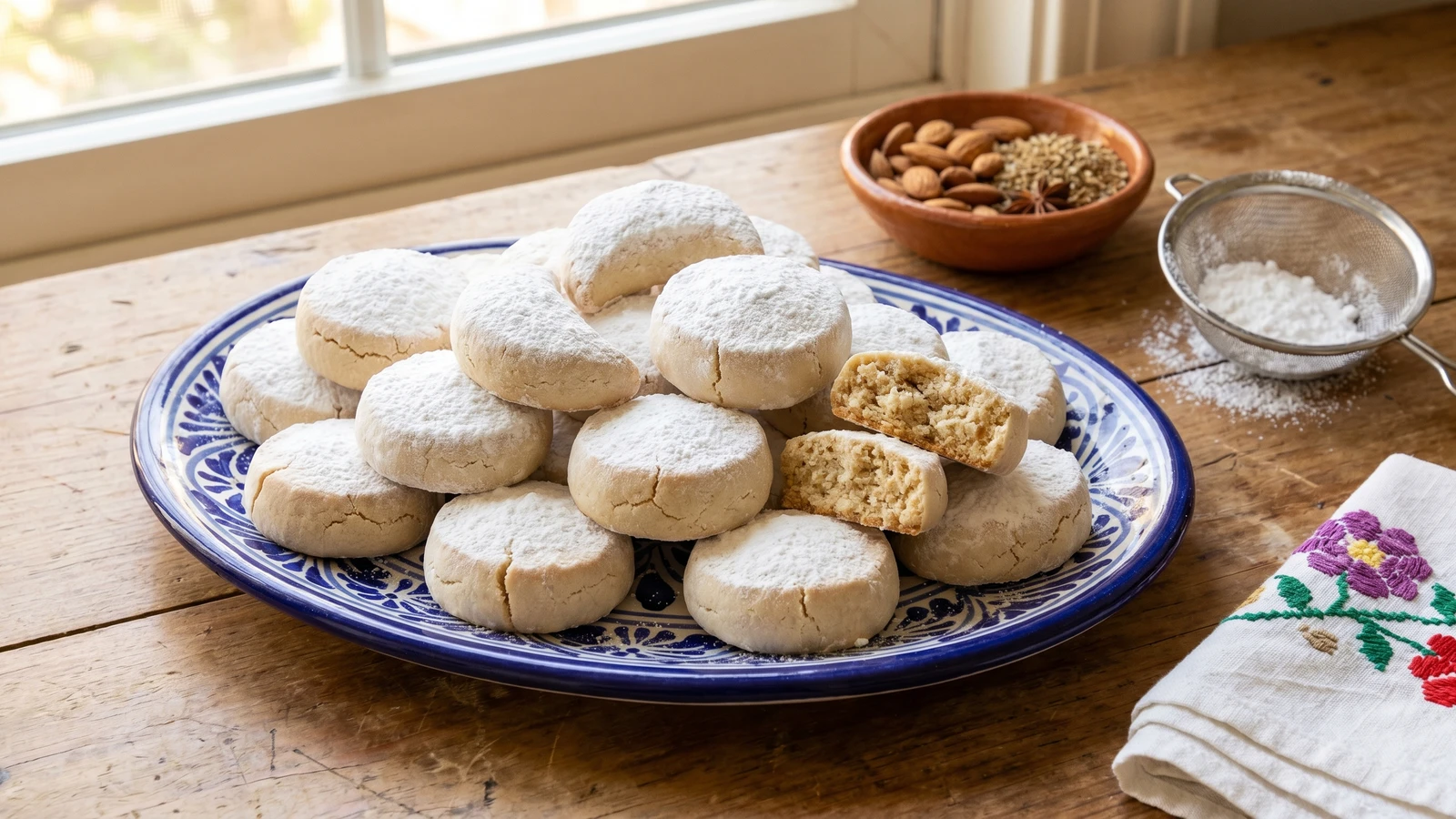
Puebla's convent wedding cookies, built on toasted wheat flour, ground almond, anise, cinnamon, and manteca de cerdo, are the tender sugar-coated bites passed around after baptisms and bodas.
Puebla de los Angeles, in the central highlands between the volcanoes, is where I place these polvorones de boda. Not every crumbly sugar cookie with nuts is the same cookie. This one belongs to the convent kitchens and sweet shops of Puebla, the city that learned to put wheat, sugar, almonds, anise, cinnamon, and pork lard into disciplined order.
The defining ingredient is manteca de cerdo. Not butter. Not vegetable shortening. Manteca. It gives the cookie its short, sandy break under your teeth and carries the scent of anise the way a good dough should. The flour is toasted first because the convent women knew what they were doing: remove the raw taste, dry the flour, and the cookie will crumble cleanly instead of turning pasty.
I learned this style from the sweet sellers around Puebla's Calle de los Dulces and from a señora who tested the dough by squeezing a fistful in her palm. If it held its shape, she rolled it. If it fell apart, she worked it two more turns and said nothing. My mother wrote one line in her notebook next to a Puebla recipe: 'manteca limpia, harina tostada.' She was right.
These are for weddings, baptisms, saint days, and trays set out after the serious food has been eaten. No chile, no salsa, no trick. Mexican cooking is not one flavor. This is a 32-state cuisine, and Puebla's convent sweets deserve the same respect as its mole poblano. Saber cocinar es saber vivir.
Polvorones descend from Iberian convent and holiday sweets, especially Andalusian polvorones and mantecados, which relied on wheat flour, almonds, sugar, cinnamon, anise, and pork lard. After Puebla was founded in 1531, its convents, including Santa Clara, Santa Rosa, and Santa Monica, became important producers of sweets in New Spain, using Spanish ingredients alongside Mexican vanilla and colonial sugar. By the 19th century, Puebla's Calle de los Dulces had made convent sweets part of the city's public identity, and wedding polvorones carried that convent technique into family celebrations.
Quantity
2 cups
Quantity
1 cup
Quantity
1 cup
cool room temperature
Quantity
1/2 cup
sifted
Quantity
1 1/2 cups
sifted
Quantity
2 teaspoons
lightly toasted and crushed
Quantity
1 teaspoon
Quantity
1/2 teaspoon
Quantity
1 teaspoon
Quantity
1 tablespoon
| Ingredient | Quantity |
|---|---|
| all-purpose wheat flour | 2 cups |
| blanched almonds | 1 cup |
| fresh pork lard (manteca de cerdo)cool room temperature | 1 cup |
| powdered sugar for the doughsifted | 1/2 cup |
| powdered sugar for coatingsifted | 1 1/2 cups |
| anise seedslightly toasted and crushed | 2 teaspoons |
| ground Mexican cinnamon (canela) | 1 teaspoon |
| fine sea salt | 1/2 teaspoon |
| Mexican vanilla extract | 1 teaspoon |
| aguardiente de anis or anise liqueur | 1 tablespoon |
Heat the oven to 325F. Spread the flour on a rimmed baking sheet in a thin layer. Bake for 14 to 16 minutes, stirring every five minutes, until it smells nutty and turns pale beige. Do not brown it. Toasting dries the flour and takes away the raw taste. That sandy texture is the backbone of a proper polvoron.
Spread the almonds on another baking sheet and toast for 8 to 10 minutes, until the edges smell sweet and lightly roasted. Cool them completely. Toast the anise seeds on a dry comal or small skillet for 30 to 45 seconds, just until fragrant, then crush them in a molcajete or spice grinder. Grind the cooled almonds with 2 tablespoons of the dough sugar until fine, stopping before they turn into almond paste.
Beat the manteca de cerdo with the remaining dough sugar for 2 minutes, until smooth and a shade lighter. Do not whip it like cake batter. This is a short dough, not pan dulce. Add the vanilla and aguardiente de anis and beat only until combined. La manteca es el sabor, and in these cookies it is also the structure.
Whisk together the cooled toasted flour, ground almonds, crushed anise, canela, and salt. Add the dry mixture to the lard in three additions, pressing and folding with a spatula or your hand until the dough clumps when squeezed. Do not knead. Kneading wakes up the gluten and gives you a hard cookie. Press the dough into a disk, wrap it, and chill for 30 minutes.
Line two baking sheets with parchment. Roll the chilled dough between two sheets of parchment to 1/2 inch thick. Cut into 1 1/2-inch rounds or small crescents. A wedding polvoron should be two bites, not a plate-sized cookie pretending to be generous. Place them 1 inch apart. If the edges crack, press them back together with your fingers. Reroll scraps once.
Bake at 325F for 14 to 16 minutes, rotating the pans once. The tops should stay pale and matte, with faint gold on the bottoms. Do not wait for deep browning. These are polvorones, not toasted biscuits. Let them rest on the baking sheet for 8 minutes so the lard-set crumb firms enough to move.
While the cookies are warm but not hot, roll them gently in the powdered sugar for coating. Hot cookies break and turn the sugar pasty. Warm cookies grab it correctly. Move them to a rack, cool completely, then roll them in sugar a second time. The first coat seals the crumb. The second gives the white finish people expect at a boda or baptism.
Let the polvorones sit at least two hours before serving, and overnight if you can. The anise settles, the lard firms, and the almond comes forward. Serve them on a Puebla talavera platter with cafe de olla or hot chocolate. No chile belongs here. No lime, no drizzle, no costume. This is Mexican food too. Cada estado, su propia cocina.
1 serving (about 23g)
Culinary guides, cultural storytelling, and the editorial depth that makes cooking meaningful.
Discover Culinary ExplorerChef Lupita
Puebla's convent almond cookies, made from blanched almonds, sugar syrup, egg yolks, canela, and patient hands, the kind of sweet that belongs beside coffee in talavera, not in a plastic bakery box.

Chef Lupita
Ciudad de Mexico's panaderia banderillas are long sticks of hojaldre pressed with sugar, baked until amber, and finished with a hard glaze for coffee at the kitchen table.

Chef Lupita
Mérida's pale egg-yolk-and-vanilla kisses, tiny cookies built on eight yolks and a perfume of orange blossom, sandwiched with guava paste and dusted heavy with powdered sugar.

Chef Lupita
Hidalgo's bisquet de nata carries Pachuca's mining history into the breakfast table: a Cornish-style bread softened by Mexican nata, split warm and eaten with café de olla.