
Chef Dimitra
Agrafa Batzina (Μπατζίνα), Courgette and Feta Pie
Agrafa's batzina is the no-phyllo pie of Karditsa: grated courgette, feta, eggs, milk, and flour poured thin into a hot oiled tapsi.
A cooking platform built around craft, culture, and the stories behind what we eat.
Created by
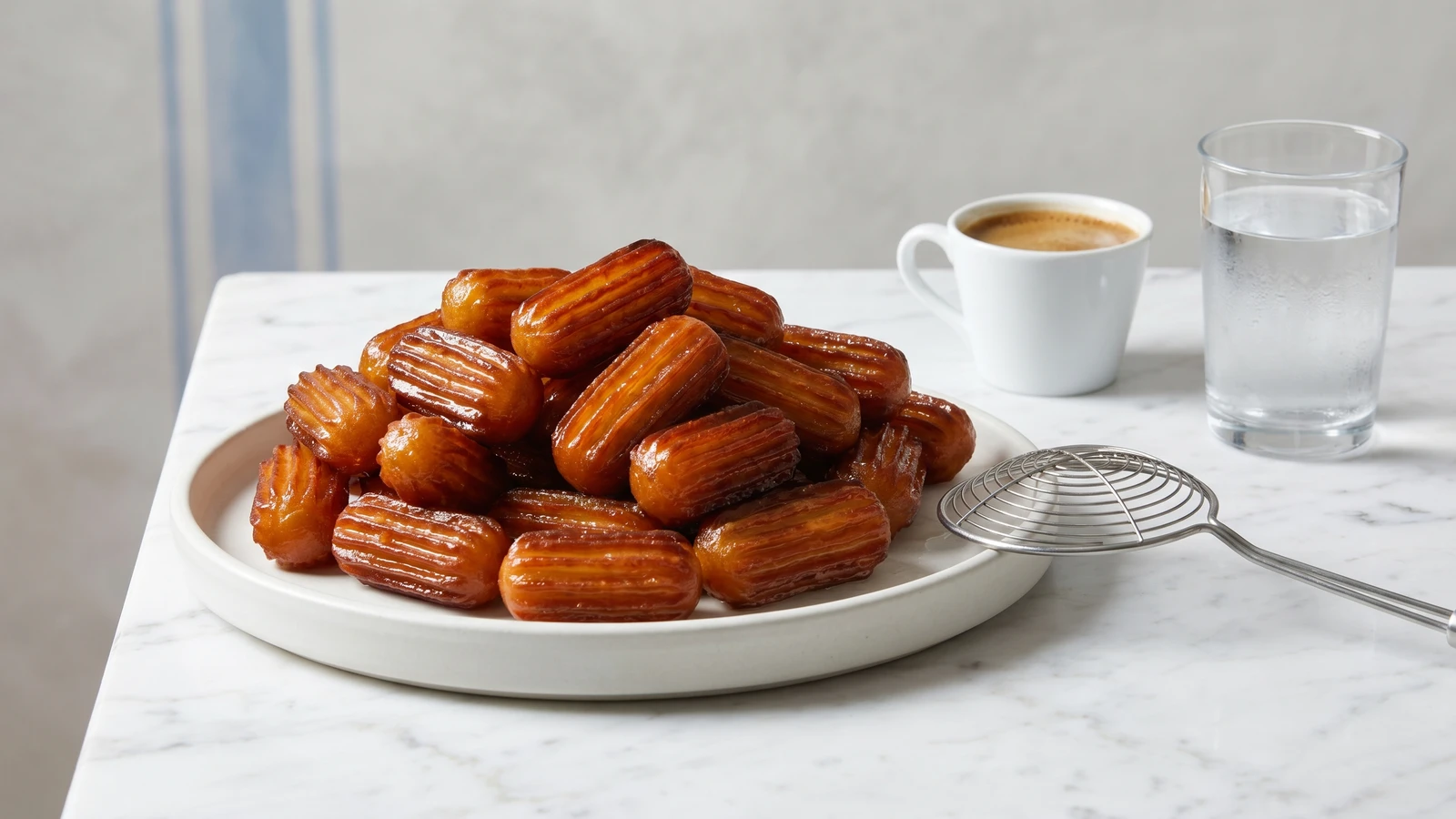
Politiki touloumbes are ridged cooked-dough fingers fried slowly until amber, then dropped hot into cold lemon syrup so every groove drinks and the center stays tender.
Politiki touloumbes are the syrup sweet of the City: short ridged fingers of cooked dough, fried until amber and soaked in cold lemon syrup. The region is the dish's surname. Here the surname is Politiki, from Constantinople, where syrup sweets sat in the pastry shop window beside trays of baklava and kadaifi.
One thing decides them: the ridges. Use a deep open star nozzle, fry the ridges firm before the dough gets too dark, and send the hot pastry into cold syrup. Those grooves are not decoration. They hold the syrup while the shell keeps its bite. A smooth tube may be sweet, but it isn't a proper touloumba.
This is not a pale sweet, and it doesn't want perfume on top. Lemon syrup, patient frying, and a cup of Greek coffee are enough. In Thessaloniki, where so many refugee sweets settled after 1922, I keep this version plain in the notebook because plain is how you can see whether the method is honest.
Touloumbes belong to the syrup-sweet family that moved through Constantinople and Asia Minor into Greek kitchens of the refugee neighborhoods. After the 1922 expulsion, Asia Minor Greek pastry makers helped make them common in Thessaloniki, Piraeus, and other cities where Politiki kouzina took root. The name comes through Turkish tulumba, meaning pump, a clue to the pressed, ridged shape that defines the sweet.
Quantity
600g
Quantity
420ml
for the syrup
Quantity
1 wide strip
Quantity
30ml
Quantity
250ml
for the dough
Quantity
60g
cut into pieces
Quantity
10g
Quantity
3g
Quantity
160g
Quantity
20g
Quantity
10g
Quantity
3
about 150g without shells, at room temperature
Quantity
1.5L
for frying
| Ingredient | Quantity |
|---|---|
| granulated sugar | 600g |
| waterfor the syrup | 420ml |
| lemon peel | 1 wide strip |
| fresh lemon juice | 30ml |
| waterfor the dough | 250ml |
| unsalted buttercut into pieces | 60g |
| granulated sugar | 10g |
| fine sea salt | 3g |
| all-purpose flour | 160g |
| fine semolina (simigdali psilo) | 20g |
| cornstarch | 10g |
| large eggsabout 150g without shells, at room temperature | 3 |
| sunflower oil or neutral frying oilfor frying | 1.5L |
Put the 600g sugar, 420ml water, and lemon peel in a saucepan. Bring to a boil, stirring only until the sugar dissolves, then boil for 6 minutes. Add the lemon juice and boil 1 minute more. Pour the syrup into a wide bowl, remove the peel, and chill until fully cold.
In a heavy saucepan, bring the 250ml water, butter, 10g sugar, and salt to a full boil. Pull the pan off the heat and add the flour, semolina, and cornstarch all at once. Stir hard with a wooden spoon until no dry flour remains, then return to low heat and cook 2 to 3 minutes, until the dough pulls from the sides and a thin film coats the bottom of the pan.
Transfer the dough to a mixer bowl or a sturdy mixing bowl and let it cool 8 to 10 minutes, until warm but not hot. Beat in the eggs one at a time, mixing well after each addition. The finished paste should be glossy, sticky, and stiff enough to hold deep ridges. If it pours, the touloumbes will flatten.
Fit a sturdy piping bag with a 12-14mm open star nozzle and fill it halfway. Pour the oil into a heavy pot, no more than one-third full, and warm it to 130°C. Hold the nozzle close to the oil and pipe 6cm lengths, cutting each one with oiled scissors. Give them room. They puff as they fry.
Raise the heat gently so the oil climbs to 155-160°C. Fry the touloumbes 8 to 10 minutes, turning often, until they are deep amber, firm along the ridges, and light for their size. Pale touloumbes soften in syrup. For the next batch, let the oil fall back to about 130°C before piping again.
Lift the hot touloumbes with a spider and drain them for 20 seconds, then drop them into the cold syrup. Turn them for 2 to 3 minutes, until glossy and heavy with syrup, then move them to a rack set over a tray. If the syrup warms up, pause and chill it again.
Let the touloumbes rest at least 20 minutes before serving, so the syrup settles into the ridges. Serve at room temperature with Greek coffee. They are best the day they are fried; an airtight box softens the crust, so cover them only loosely.
1 serving (about 220g)
Culinary guides, cultural storytelling, and the editorial depth that makes cooking meaningful.
Discover Culinary ExplorerChef Dimitra
Agrafa's batzina is the no-phyllo pie of Karditsa: grated courgette, feta, eggs, milk, and flour poured thin into a hot oiled tapsi.

Chef Dimitra
Zagori's flour pie skips phyllo completely: a loose egg-and-flour batter, crumbled feta, and a hot buttered tapsi that makes the edges crisp.

Chef Dimitra
Hydra and Andros give amygdalota their island surname: ground almond, sugar, egg white, and rosewater, baked pale so the center stays soft as marzipan.

Chef Dimitra
Asia Minor ekmek kataifi is built in three clear layers: crisp syruped kataifi, thick semolina custard, and cold kaimaki cream under pistachios.