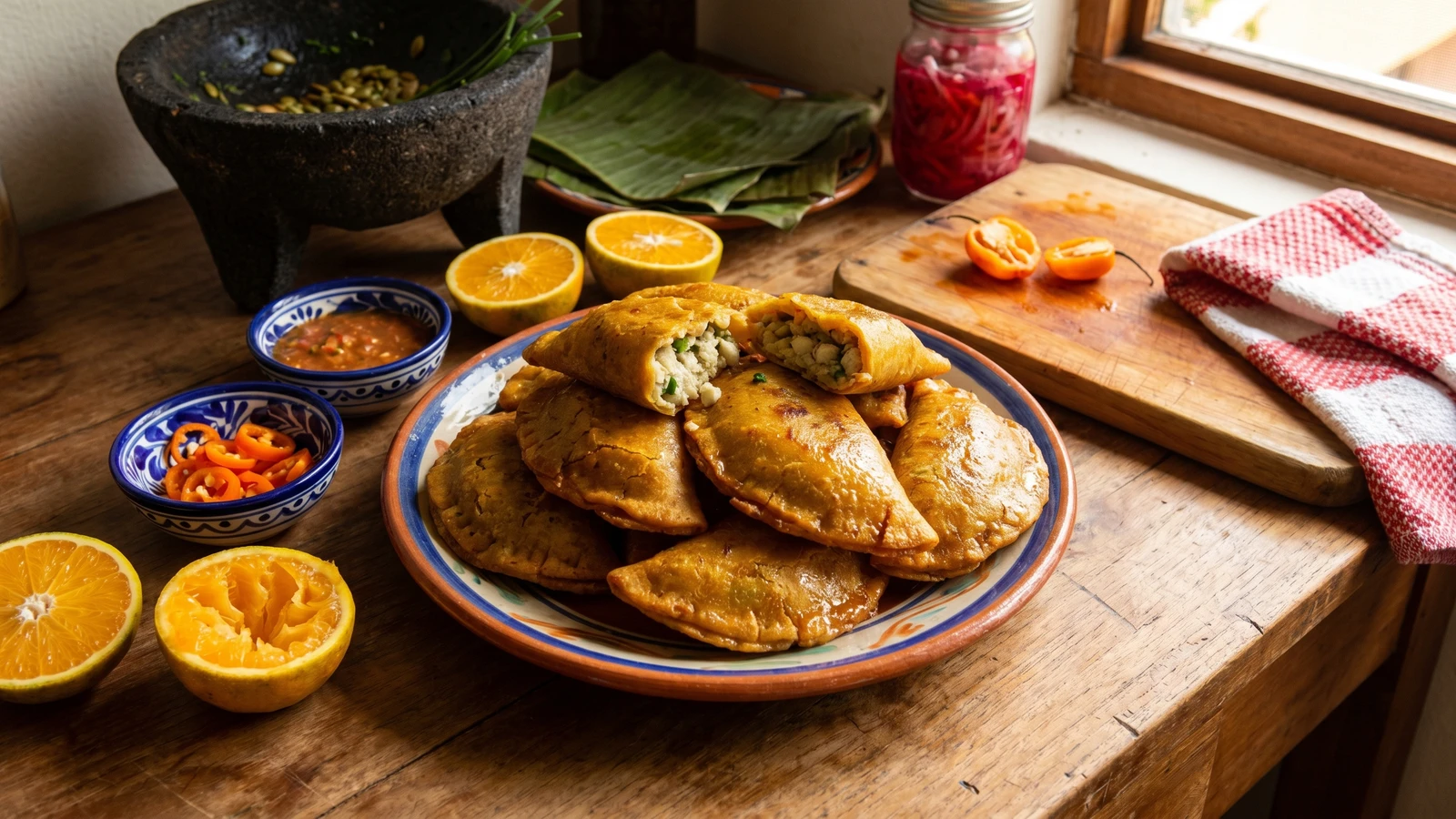
Yucatan's masa pockets shaped like a snake's head, stuffed with toksel of ibes beans, toasted pepita, and cebollin. Fried in lard and eaten with x'nipec and chile habanero, the way the senoras in Merida have always done it.
Appetizers & Snacks
Mexican
Dinner Party
Potluck
Celebration
45 min
Active Time
25 min cook•1 hr 10 min total
Yield6 servings (about 18 polcanes)
This is from Yucatan. Specifically from the Mayan kitchens of the Peninsula, where the language of the food, polcan, toksel, x'nipec, sikil p'aak, is still Mayan and not Spanish. Polcan means snake's head. Toksel is the filling of ibes, pepita, and chive that has lived inside these masa pockets for centuries.
The ibes is the bean that makes this dish what it is. Small, white, creamy, grown in the milpa system across the Peninsula alongside corn and squash. If your bean vendor does not know what ibes are, you are not in a Yucatecan market. Pepita gives the toksel its body. Cebollin, the local chive, gives it its lift. Salt holds it together. There is no chile in the filling. The chile arrives at the table in the form of habanero, sliced raw or pickled with red onion in sour orange. The Peninsula keeps its heat separate from its body. That is how this cuisine thinks.
I learned to make polcanes from a senora at the Mercado de Santiago in Merida one August afternoon when the heat was so thick the masa would not hold its shape. She told me, in a mix of Spanish and Mayan I barely followed, that the snake's head was not decoration. It was a signature. A Mayan stamp on a Mayan dish. La manteca es el sabor, and the lard in the masa and the lard in the pan are what separate a polcan from a sad fried dumpling. No me vengas con atajos.
Polcanes are part of the broader Peninsular tradition of antojitos derived from pre-Columbian Mayan cookery, alongside salbutes, panuchos, and codzitos, in which masa is fried or griddled and dressed with toppings rather than rolled around fillings. The word 'polcan' comes from the Yucatec Mayan 'pol' (head) and 'kan' (snake), referring to the dumpling's shape, while 'toksel' is the Mayan name for the bean-and-pepita filling that predates Spanish contact and reflects the milpa trinity of corn, beans, and squash. Yucatecan cuisine was inscribed alongside Michoacan cooking in UNESCO's 2010 recognition of Traditional Mexican Cuisine, and dishes like polcanes con toksel are cited specifically because they preserve pre-Columbian Mayan technique, ingredients, and language largely intact.
The technique, the tradition, and the story behind every dish.
or substitute small white lima beans if ibes are unavailable
white onion
Quantity
1/2 medium, plus 2 tablespoons finely chopped
garlic cloves
Quantity
2
peeled
fresh epazote
Quantity
1 sprig
kosher salt
Quantity
1 teaspoon, plus more to taste
raw hulled pepita (pumpkin seeds)
Quantity
1 cup
unsalted
Yucatecan chives (cebollin)
Quantity
1/4 cup
finely chopped; substitute fresh chives with a little scallion green if needed
masa harina
Quantity
2 cups
preferably Maseca for tortillas
warm water
Quantity
1 1/4 cups, plus more as needed
manteca de cerdo (pork lard)
Quantity
1 tablespoon
melted and slightly cooled
kosher salt for the masa
Quantity
1/2 teaspoon
manteca de cerdo or neutral oil for frying
Quantity
about 3 cups
x'nipec (pickled red onion with sour orange and habanero) (optional)
Quantity
1 cup, for serving
fresh chile habanero (optional)
Quantity
1
sliced, for serving
naranja agria wedges (optional)
Quantity
for serving
or a mix of orange and lime
Ingredient
Quantity
dried ibes beansor substitute small white lima beans if ibes are unavailable
1 cup
white onion
1/2 medium, plus 2 tablespoons finely chopped
garlic clovespeeled
2
fresh epazote
1 sprig
kosher salt
1 teaspoon, plus more to taste
raw hulled pepita (pumpkin seeds)unsalted
1 cup
Yucatecan chives (cebollin)finely chopped; substitute fresh chives with a little scallion green if needed
1/4 cup
masa harinapreferably Maseca for tortillas
2 cups
warm water
1 1/4 cups, plus more as needed
manteca de cerdo (pork lard)melted and slightly cooled
1 tablespoon
kosher salt for the masa
1/2 teaspoon
manteca de cerdo or neutral oil for frying
about 3 cups
x'nipec (pickled red onion with sour orange and habanero) (optional)
1 cup, for serving
fresh chile habanero (optional)sliced, for serving
1
naranja agria wedges (optional)or a mix of orange and lime
for serving
Equipment Needed
•Cast iron comal or heavy skillet for toasting the pepita
•Molcajete or dry blender for grinding the pepita
•Heavy pot for cooking the beans
•Wide cast iron skillet or deep pot for frying
•Slotted spoon or kitchen spider
•Wire rack set over a sheet pan
Instructions
1
Cook the ibes
Rinse the ibes and pick out any stones. Place them in a heavy pot with the half onion, the two garlic cloves, the epazote sprig, and enough water to cover by three inches. Bring to a gentle simmer and cook uncovered for 45 minutes to an hour, until the beans are completely tender and the broth has thickened slightly. Add the teaspoon of salt only in the last ten minutes. Salt early and the skins toughen. Drain the beans and discard the onion, garlic, and epazote. Save half a cup of the cooking liquid.
Ibes are the small white beans of the Peninsula, smaller and creamier than alubias. The senoras in the Mercado Lucas de Galvez in Merida sell them by the kilo. If you cannot find them, baby lima beans are the closest compromise. Not an upgrade.
2
Toast the pepita
Heat a dry comal or heavy skillet over medium heat. Add the pepita in a single layer. Stir constantly with a wooden spoon. The seeds will puff and pop within three to four minutes and turn a pale gold. Pull them off the heat the moment they smell nutty and look like toasted bread, not the color of burnt toast. Burned pepita turns the toksel bitter and there is no fixing it. Let them cool completely on a plate.
3
Build the toksel
Grind the cooled pepita in a molcajete or pulse in a dry blender until you have a coarse, sandy meal. Not a paste. You want texture. Transfer to a bowl. Mash the drained ibes by hand with a wooden spoon or a bean masher until rough, not smooth. Add the ground pepita, the 2 tablespoons of finely chopped raw white onion, and the chopped cebollin. Mix with your hands. Taste and adjust salt. The toksel should hold its shape when pressed but still look like food, not like a paste. This is the filling. Asi se hace y punto.
Toksel is the Mayan name. The dish is older than the Spanish, older than the colony, older than the cookbook. Honor it by keeping the filling clean: beans, seed, allium, salt. No cheese, no sour cream, no garlic powder. The Peninsula does not need them.
4
Mix the masa
In a wide bowl, combine the masa harina and the half teaspoon of salt. Add the melted lard and the warm water. Knead with your hands for three minutes until you have a smooth, pliable dough that feels like soft clay. Press a piece between your fingers. If the edges crack, add water by the tablespoon. If it sticks to your palms, add a little more masa harina. La manteca es el sabor. The lard is not optional. It is what gives the polcan its tenderness inside and its crisp outside.
5
Shape the polcanes
Divide the masa into 18 equal balls, each about the size of a small walnut. Cover them with a damp kitchen towel so they do not dry out. Working one at a time, flatten a ball in your palm into a disk about three inches across and a quarter inch thick. Place a heaping tablespoon of toksel in the center. Fold the masa over the filling and pinch the edges to seal, pressing the dough into the shape of a snake's head, pointed at one end and round at the other. The polcan should look like a small empanada with a snout. That snake's head is where the name comes from in Mayan.
6
Heat the frying fat
Pour about an inch and a half of manteca or oil into a heavy skillet or wide pot. Heat over medium until the fat reaches 350F. Test it with a small piece of masa. It should sizzle steadily on contact and rise to the surface within seconds. If the fat is too cool, the polcanes absorb grease and turn soggy. Too hot and the outside scorches before the masa cooks through.
Manteca for frying gives the right flavor and the right crust. Neutral oil works but the polcan loses something. In Yucatan they fry in pork lard. They do not apologize for it.
7
Fry to a deep gold
Slip the polcanes into the hot fat in batches of four or five, never crowding the pot. Fry for two to three minutes per side until the outside is deep gold and crisp. The masa will puff slightly and the surface will harden into a thin shell. Lift them out with a slotted spoon and drain briefly on a wire rack set over a sheet pan. Never on paper towels alone. The steam underneath softens the bottom.
8
Serve at the table
Arrange the polcanes on a warm plate. Set the x'nipec, sliced habanero, and naranja agria wedges in small bowls around them. Each person opens a polcan and spoons the pickled onion and habanero inside, squeezes naranja agria over the top, and eats them with their hands. This is a Peninsula dish and it is served the Peninsula way. Cada estado, su propia cocina.
Chef Tips
•Ibes are the bean. If you cannot find them, baby lima beans are the closest compromise. Do not use cannellini or great northern. The flavor is wrong and the texture is wrong. A substitution is a compromise, not an upgrade.
•The cebollin in Yucatan is closer to a fine chive than to a scallion. Use fresh chives if you cannot find it. Avoid green onion tops alone, which lack the sharpness the toksel needs.
•Fry in lard if you have it. The polcan tastes different. Better. If you must use oil, use a clean neutral one and accept the trade.
•Naranja agria is the sour orange of the Peninsula. If your mercado does not carry it, mix equal parts fresh orange juice and lime juice with a small splash of grapefruit. It is not the same. It is close enough.
Advance Preparation
•The ibes can be cooked one day ahead and refrigerated in their cooking liquid. Drain before mixing the toksel.
•The toksel filling can be made up to one day ahead and refrigerated. Bring to room temperature before shaping the polcanes.
•The x'nipec for serving can be made up to three days ahead. The flavor only deepens as the red onion cures in the sour orange.
•Do not fry the polcanes ahead. They are crisp for about thirty minutes after frying and then they soften. Fry them at the last minute and bring them to the table immediately.
Frequently Asked Questions
Nutrition Information
1 serving (about 160g)
Calories
470 calories
Total Fat
22 g
Saturated Fat
4 g
Trans Fat
0 g
Unsaturated Fat
17 g
Cholesterol
5 mg
Sodium
500 mg
Total Carbohydrates
51 g
Dietary Fiber
9 g
Sugars
3 g
Protein
15 g
Where cooking meets culture.
Culinary guides, cultural storytelling, and the editorial depth that makes cooking meaningful.