
Chef Thomas
Apple Charlotte
Buttered bread baked to a deep mahogany around a filling of spiced Bramley apples, turned out at the table in a small moment of drama, cold cream poured from a jug alongside.
A cooking platform built around craft, culture, and the stories behind what we eat.
Created by Chef Thomas
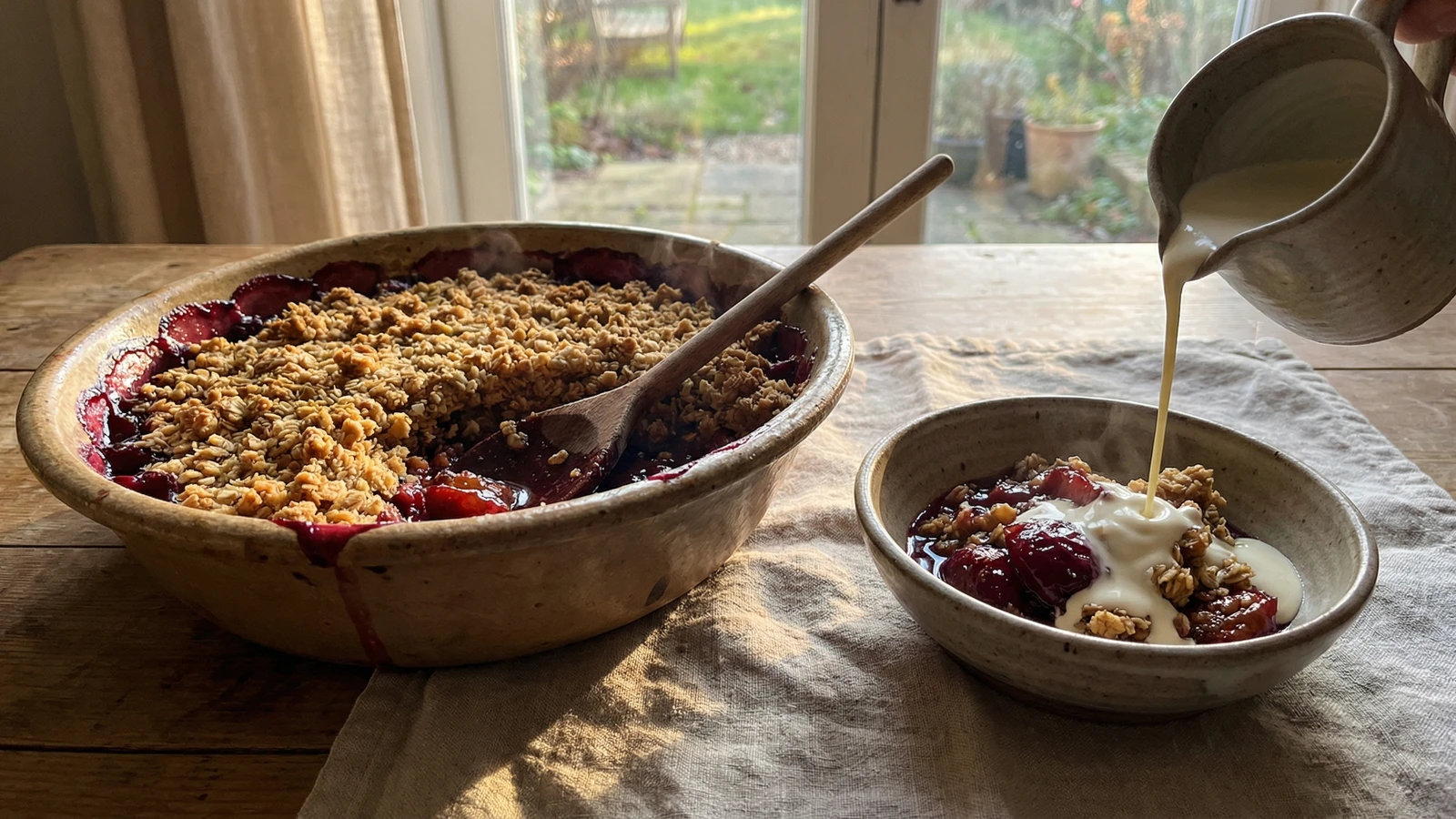
Victoria plums under a rubbly crumble of oats and demerara, baked until the juices bubble up dark and sticky through the golden topping. A late summer pudding that asks very little and gives back a great deal.
There's a week or two in late summer when the plum trees give up everything at once. The branches sag. The fruit starts dropping. You pick a bowl full and then another, and by the end of the day the kitchen table is covered in them, and you can't quite remember how it happened. This is the pudding for that week.
A crumble is the most forgiving thing you can make. It doesn't care about precise measurements or clever technique. You halve the fruit, rub butter into flour, scatter it over the top and put it in the oven. Forty minutes later the kitchen smells of warm plums and toasted oats, and you've made something that people will remember longer than anything you tried harder at. A recipe is a conversation, not a contract, and this one is practically a shrug.
The oats are what make it. Demerara sugar, rolled oats, a handful of ground almonds for richness. It bakes into a topping that is partly crisp, partly chewy, with those dark, caramelised edges where the plum juice has bubbled up through the crumble and set like jam. I wrote it down in the notebook years ago: plums, oats, August, rain. It still works.
Serve it with cold double cream from a jug, poured generously. Not ice cream, not custard, not unless that's what you have. Cold cream against hot fruit is one of the small, quiet pleasures of British cooking, and there's no improving on it.
Quantity
900g
halved and stoned
Quantity
80g
Quantity
1 tbsp
Quantity
from half a lemon
Quantity
150g
Quantity
100g
cubed
Quantity
75g
Quantity
75g
Quantity
50g
Quantity
pinch
Quantity
to serve
| Ingredient | Quantity |
|---|---|
| Victoria plumshalved and stoned | 900g |
| golden caster sugar (for the fruit) | 80g |
| plain flour (for the fruit) | 1 tbsp |
| lemon zest | from half a lemon |
| plain flour (for the topping) | 150g |
| cold unsalted buttercubed | 100g |
| rolled oats | 75g |
| demerara sugar | 75g |
| ground almonds | 50g |
| fine sea salt | pinch |
| double cream or vanilla ice cream (optional) | to serve |
Set the oven to 180C/160C fan. Find a baking dish that fits the plums snugly in one layer. Something earthenware, if you have it. Nothing too deep. The fruit wants to catch a bit of heat from above as well as below.
Halve the plums and prise out the stones with your thumb. Some will come away cleanly, some will fight you. Don't worry about it. Tip them into the baking dish, cut side up, and scatter over the caster sugar, the tablespoon of flour, and the lemon zest. Turn them gently with your hands until they're glossed all over. Arrange them cut side up again, tucked close together.
Tip the flour, butter, ground almonds and salt into a bowl. Rub the butter into the flour with your fingertips, lifting the mixture up and letting it fall back, until it looks like rough, uneven breadcrumbs. Some larger lumps are good. A crumble that's too fine bakes into a biscuit layer. You want rubble, not sand.
Stir the oats and demerara through the crumble with a spoon. The demerara is the important part here. Its big, honeyed crystals don't quite dissolve in the oven, so you get little pockets of caramel on top. Don't swap it for caster. It isn't the same.
Scatter the crumble over the plums in handfuls, letting it fall loosely rather than packing it down. Leave a few gaps here and there so the juices can bubble up through the topping. That's where the best bits are, the spots where the fruit meets the oats and goes sticky and dark.
Slide the dish into the oven and bake for thirty-five to forty minutes. You're looking for a topping that has gone a deep golden brown and juices that are bubbling up around the edges like slow, purple lava. The kitchen will smell of warm plums and toasted oats and something faintly almondy. That's when it's ready.
Take it out and leave it on the side for ten minutes before you serve it. This isn't optional. A crumble straight from the oven is molten at the bottom and will take the roof off your mouth. Ten minutes' rest lets the juices settle and gives you a pudding you can actually eat. Spoon it into bowls and pour cold cream over the top until it runs down into the fruit.
1 serving (about 240g)
Culinary guides, cultural storytelling, and the editorial depth that makes cooking meaningful.
Discover Culinary ExplorerChef Thomas
Buttered bread baked to a deep mahogany around a filling of spiced Bramley apples, turned out at the table in a small moment of drama, cold cream poured from a jug alongside.

Chef Thomas
Whole Bramley apples cored and stuffed with butter, brown sugar and plump dried fruit, baked until they collapse and the kitchen fills with the smell of autumn getting on with itself.

Chef Thomas
A proper baked rice pudding, slow-cooked in whole milk with butter and nutmeg until the top sets into a freckled golden skin. The kind of pudding that makes January feel like less of a long haul.

Chef Thomas
Wild blackberries and Bramley apples collapsed together under a thick, sandy crumble, the pudding that makes September feel like it's worth staying in for.