
Chef Fai
Dry Egg Noodles (Ba Mee Haeng)
The four pillars live at the bottom of the bowl before the noodles ever touch it: nam pla for salt, sugar for sweet, vinegar for sour, chili for heat. Every noodle cart in Bangkok runs on this principle.
A cooking platform built around craft, culture, and the stories behind what we eat.
Created by
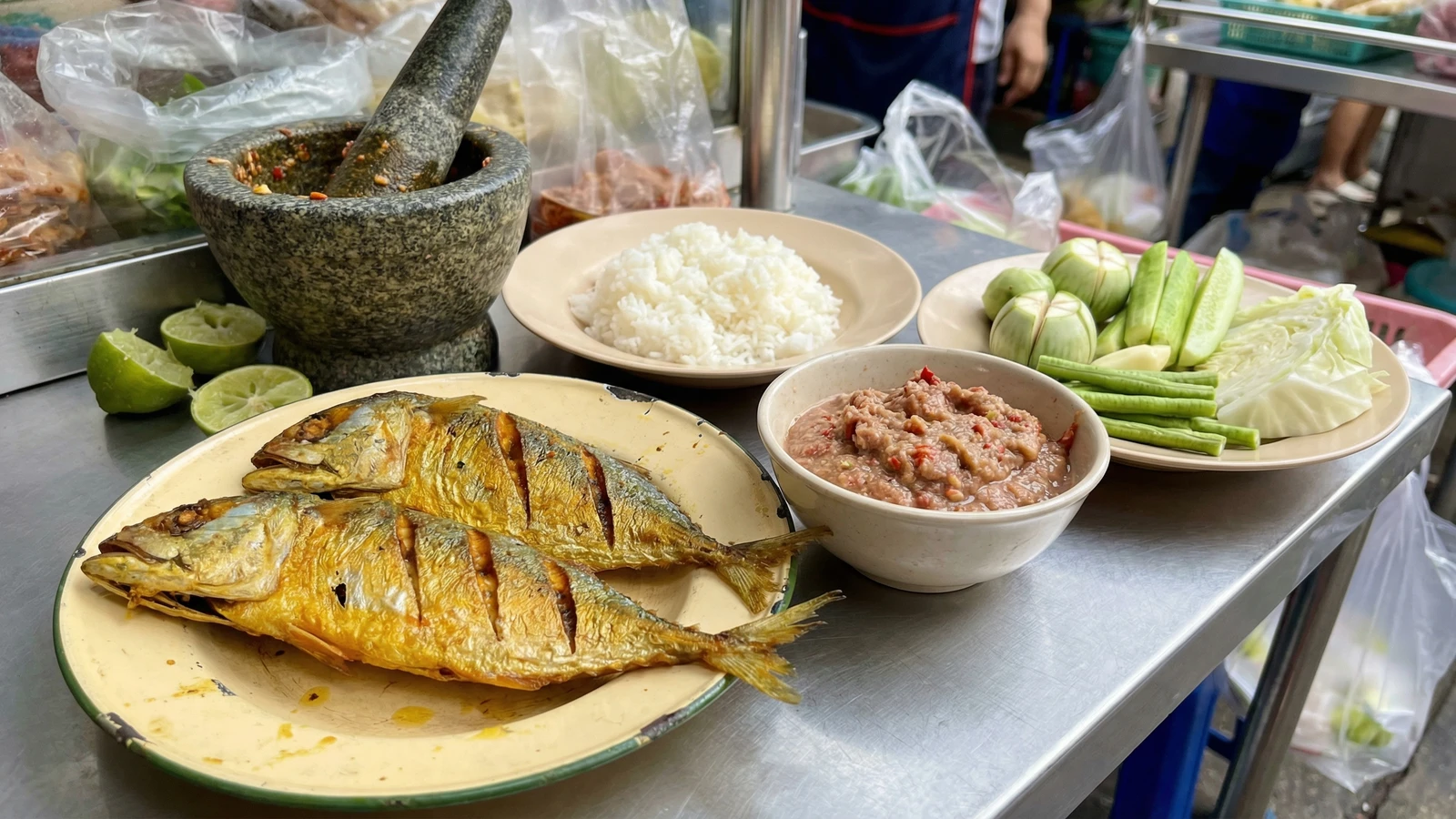
The fish that feeds the Gulf coast daily: short mackerel scored, rubbed with turmeric and salt, fried until the skin shatters. No ceremony. Just the four pillars working through the plate, not just the pan.
Not every dish needs a kreung tam. Sometimes the principle lives in the plate, not the pan.
Pla too tod is the most eaten fish dish in Thailand. Full stop. From street stalls in Hat Yai to family tables in Nakhon Si Thammarat, this is the fish that feeds the South. Short mackerel pulled from the Gulf that morning, scored, rubbed with kamin (turmeric) and salt, dropped into hot oil until the skin crackles and the flesh goes firm and sweet. It takes ten minutes. It costs almost nothing. And it's one of the best things you'll ever eat if you do it right.
Here's where the principle shows up. A fried fish by itself is just protein. But the Thai system never serves protein alone. Pla too tod arrives with nam prik kapi (shrimp paste chili dip), a mound of raw vegetables, and jasmine rice. That's the architecture. The fish gives you protein and the richness of hot oil. The nam prik gives you all four pillars in a single spoonful: nam pla for salt, manao for sour, prik khi nu for heat, and the faintest touch of nam tan pip for sweet. The raw vegetables give you crunch and freshness to cut through the fat. Rice ties everything together. Remove any one element and the meal is incomplete. Ajarn always said Thai food is a system, not a menu. This plate proves it.
In the South, turmeric is king. Not galangal, not lemongrass. Kamin. It stains everything golden: your cutting board, your fingers, the oil in the pan. Southern cooks rub it into fish before frying because the earthy bitterness of raw turmeric creates a crust that's different from anything you get in Central Thai cooking. It's not decoration. It's flavor architecture. The turmeric bonds with the fish oils under high heat, forming a shell that keeps the inside moist while the outside shatters. That's not tradition for tradition's sake. That's science.
Pla too (Rastrelliger brachysoma, short mackerel) is Thailand's most consumed fish species, caught in enormous quantities from the Gulf of Thailand and the Andaman Sea. The fish is so central to the Thai diet that the curved shape of steamed pla too in bamboo baskets became iconic in Thai markets. Southern Thai preparations distinguish themselves through the use of fresh turmeric root (kamin) as a marinade, reflecting the peninsula's proximity to Malay and Indian Ocean spice traditions. In provinces like Nakhon Si Thammarat, Songkhla, and Krabi, pla too tod with nam prik kapi is considered a default meal, the thing you eat when you don't plan anything else.
Quantity
4 whole (about 150g each)
gutted and cleaned, scored 3 times on each side
Quantity
1 tablespoon
grated or pounded
Quantity
1 teaspoon
Quantity
for deep-frying
Quantity
1 tablespoon
Quantity
8
stems removed
Quantity
4 cloves
Quantity
1 tablespoon
Quantity
2 tablespoons (about 2 limes)
Quantity
1 tablespoon
Quantity
4
quartered
Quantity
1
sliced into spears
Quantity
1 handful
trimmed
Quantity
4
cut into 3-inch pieces
Quantity
1/4 head
cut into wedges
Quantity
for serving
| Ingredient | Quantity |
|---|---|
| short mackerel (pla too)gutted and cleaned, scored 3 times on each side | 4 whole (about 150g each) |
| fresh turmeric root (kamin)grated or pounded | 1 tablespoon |
| sea salt | 1 teaspoon |
| vegetable oil | for deep-frying |
| shrimp paste (kapi) | 1 tablespoon |
| bird's eye chilies (prik khi nu)stems removed | 8 |
| garlic | 4 cloves |
| palm sugar (nam tan pip) | 1 tablespoon |
| lime juice (nam manao) | 2 tablespoons (about 2 limes) |
| fish sauce (nam pla) | 1 tablespoon |
| Thai eggplant (makhuea pro) (optional)quartered | 4 |
| cucumbersliced into spears | 1 |
| wing beans (thua phu) (optional)trimmed | 1 handful |
| long beans (thua fak yao)cut into 3-inch pieces | 4 |
| white cabbagecut into wedges | 1/4 head |
| steamed jasmine rice | for serving |
Lay the mackerel on your cutting board. With a sharp knife, score three diagonal slashes on each side, cutting down to the bone but not through it. The scores aren't decorative. They let the turmeric marinade penetrate the flesh and they let heat reach the thickest part of the fish evenly. No scores, no crispy skin, no seasoned meat. Mix the grated turmeric with the salt and rub it into the fish: into the scores, inside the cavity, over the skin. Every surface gets touched. Your fingers will be yellow. That's how you know you're doing it right. Let the fish sit for ten minutes. The salt draws moisture to the surface, and the turmeric bonds with the fish oils. When it hits the hot oil, that's what creates the crust.
While the fish marinates, make the nam prik. This is where the kreung tam principle enters the plate. In a granite mortar (krok hin), pound the garlic and chilies to a rough paste. Eight chilies is Southern standard. If that scares you, start with five, but know that Southern cooks would laugh. Add the kapi (shrimp paste) and pound it in. The smell will be aggressive. That's correct. Shrimp paste smells like the sea floor and tastes like concentrated ocean. Now add the palm sugar and pound until dissolved. Squeeze in the lime juice and fish sauce. Stir with the pestle. Taste. It should hit you in this order: salty and funky from the kapi and nam pla, then sour from the lime, then heat that builds, then a whisper of sweetness from the palm sugar. Southern food leans sour and spicy. The sugar is there to round edges, not to dominate.
Pour enough oil into a wok or deep pan to submerge the fish halfway. You're not shallow-frying. You need enough depth that the oil comes up the sides of the fish. Heat to 180°C (350°F). No thermometer? Drop a small piece of garlic skin into the oil. It should sizzle immediately and float to the surface within two seconds. If it sits there doing nothing, the oil isn't ready. If it burns instantly, it's too hot. Pat the fish dry with a paper towel before frying. Wet fish in hot oil spatters. Dangerously.
Gently lower the fish into the oil, sliding them away from you so any splash goes in the opposite direction. Don't crowd the wok. Two fish at a time maximum. The oil temperature will drop when the fish goes in, so keep the heat high for the first thirty seconds, then reduce to medium-high. Fry for 4 to 5 minutes on the first side. Don't touch it. Don't move it. Don't flip it early. The crust needs time to form. When the edges are deep gold and the turmeric has turned the skin a burnished amber, flip once with a slotted spatula. Another 3 to 4 minutes on the second side. The fish is done when the skin is crispy enough to shatter when you press it with the spatula and the flesh at the deepest score mark is opaque white, not translucent.
Lift the fish out and set them on a wire rack, not paper towels. A rack lets air circulate underneath so the bottom stays crispy. Paper towels trap moisture and steam the crust soft. Let the fish rest for two minutes. The residual heat finishes cooking the center, and the crust tightens as it cools slightly.
Set the fried mackerel on a plate. The nam prik kapi goes in a small bowl alongside. Arrange the raw vegetables on the plate or in a separate dish: Thai eggplant, cucumber spears, wing beans, long bean pieces, cabbage wedges. A mound of jasmine rice completes the plate. This is a Thai meal. Not the fish alone. Not the nam prik alone. The whole plate, eaten together. You tear a piece of fish, dip it in the nam prik, take a bite of raw vegetable, eat a spoonful of rice. Every bite is different. Every bite is balanced. That's the system at work.
1 serving (about 550g)
Culinary guides, cultural storytelling, and the editorial depth that makes cooking meaningful.
Discover Culinary ExplorerChef Fai
The four pillars live at the bottom of the bowl before the noodles ever touch it: nam pla for salt, sugar for sweet, vinegar for sour, chili for heat. Every noodle cart in Bangkok runs on this principle.

Chef Fai
The kreung tam fried in cracked coconut cream until the oil bleeds red. That's the technique. Concentrated, semi-dry, spooned thick over crispy fish. This is what happens when the four pillars meet restraint.

Chef Fai
Isan foraging in a bowl: wild taro stems stripped of their sting, simmered in padaek broth with a pounded chili paste and yanang leaf extract. The land feeds you if you know the rules.

Chef Fai
Lanna's kreung tam breaks from Central Thai rules: ginger over galangal, cumin and coriander from Burmese spice routes, tamarind for sour instead of lime. The North has its own system, and this curry is its crown.