
Chef Fai
Dry Egg Noodles (Ba Mee Haeng)
The four pillars live at the bottom of the bowl before the noodles ever touch it: nam pla for salt, sugar for sweet, vinegar for sour, chili for heat. Every noodle cart in Bangkok runs on this principle.
A cooking platform built around craft, culture, and the stories behind what we eat.
Created by
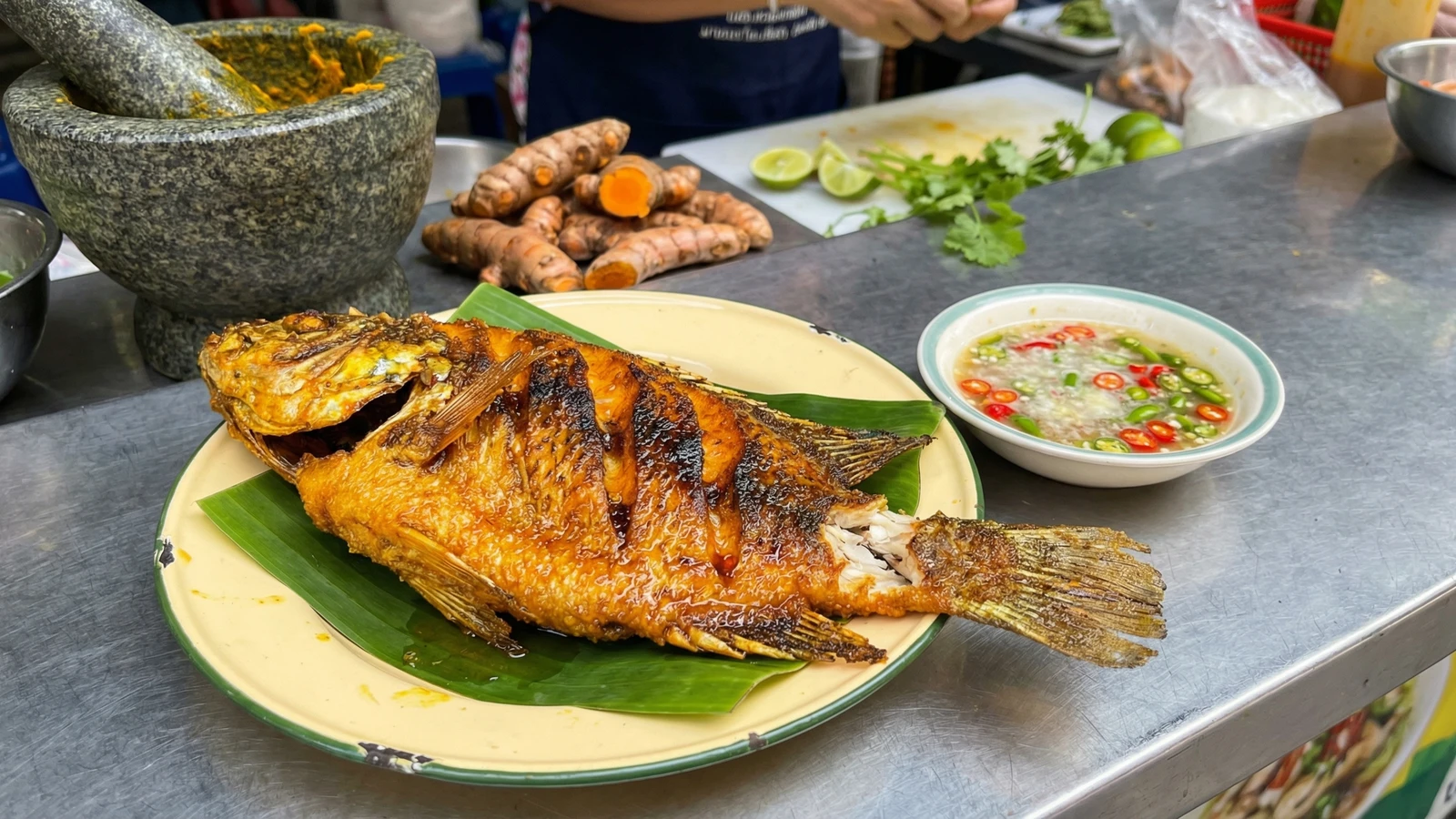
A two-ingredient kreung tam, turmeric and garlic, pounded and rubbed into fish, fried until the crust shatters gold. Southern Thai preservation science made permanent by flavor.
Two ingredients. That's all it takes to prove the kreung tam is everything.
Pla thod kamin is a kreung tam dish stripped to its bones: kamin (turmeric) and kratiam (garlic), pounded in the mortar, rubbed into scored fish, fried until the skin shatters golden. No curry paste with twelve aromatics. No elaborate spice blend. Just two ingredients doing what the kreung tam always does: transforming raw protein into something that smells like it belongs to a specific place on earth. In this case, the Southern Thai coast.
Ajarn always said the kreung tam is a delivery system. The pounding breaks cell walls, releases volatile oils, creates a paste that penetrates the flesh instead of sitting on top of it. When you rub pounded turmeric and garlic into scored fish, those compounds migrate into the cuts during the rest. The frying then locks everything in and creates a crust that is simultaneously crisp, aromatic, and stained the deep gold that marks Southern Thai cooking like a fingerprint. If you just sprinkle turmeric powder on fish, you get yellow fish. If you pound a kreung tam and rub it in, you get pla thod kamin. The difference is the mortar.
Down south, this dish is everywhere. Every market in Nakhon Si Thammarat, every beachside stall in Krabi, every Muslim food cart in Pattani. The fish changes depending on what the boats brought in that morning: pla kaphong (sea bass), pla insii (mackerel), pla chon (snakehead) in the freshwater towns. The kreung tam stays the same. Turmeric and garlic. That's the law. The nam jim (dipping sauce) that comes alongside, sour with lime, brutal with chilies, salty with nam pla, that's where the four pillars show up in full force. The fish provides the canvas. The sauce provides the balance.
Southern Thai food leans hard into sour and spicy. Palm sugar is barely a whisper. The nam jim seafood you serve with pla thod kamin should make your eyes water from the lime and the chilies before the fish sauce rounds it out. That's the Southern identity on a plate. Fire, acid, salt, and the smell of turmeric-stained oil in a wok by the sea.
Turmeric's use as a fish marinade in Southern Thailand predates refrigeration, where the rhizome's curcumin compounds served as both antimicrobial preservative and flavor agent in the tropical heat of the Malay Peninsula. The technique is shared across the Southern Thai-Malay culinary corridor, appearing in similar forms in Kelantan and Terengganu. In Thailand's deep south provinces (Pattani, Yala, Narathiwat), Muslim vendors fry turmeric fish as a halal protein staple, and the dish's golden color has become a visual signature of Southern Thai market stalls from Chumphon to Songkhla.
Quantity
1 fish, about 500-600g
scaled, gutted, scored on both sides
Quantity
3 tablespoons
peeled and sliced
Quantity
8 cloves
Quantity
1 teaspoon
Quantity
1 teaspoon
Quantity
for deep frying
Quantity
1 tablespoon
Quantity
3 tablespoons
for dusting
Quantity
for serving
Quantity
10
finely sliced
Quantity
4 cloves
minced
Quantity
3 tablespoons (about 3 limes)
Quantity
2 tablespoons
Quantity
1 teaspoon
| Ingredient | Quantity |
|---|---|
| whole sea bass or snapper (pla kaphong)scaled, gutted, scored on both sides | 1 fish, about 500-600g |
| fresh turmeric root (kamin)peeled and sliced | 3 tablespoons |
| garlic (kratiam) | 8 cloves |
| white peppercorns (prik thai khao) | 1 teaspoon |
| salt | 1 teaspoon |
| vegetable oil | for deep frying |
| fish sauce (nam pla) | 1 tablespoon |
| rice flour or tapioca starchfor dusting | 3 tablespoons |
| steamed jasmine rice | for serving |
| bird's eye chilies (prik khi nu)finely sliced | 10 |
| garlic (kratiam)minced | 4 cloves |
| lime juice (nam manao) | 3 tablespoons (about 3 limes) |
| fish sauce (nam pla) | 2 tablespoons |
| palm sugar (nam tan pip) | 1 teaspoon |
Rinse the fish and pat it completely dry. Use paper towels. Every drop of surface water is an enemy of crisp skin. Score the fish on both sides with deep diagonal cuts, about an inch apart, cutting almost to the bone. These aren't decorative. They're access points. The kreung tam needs channels to penetrate the flesh. Three or four cuts per side. Rub the fish sauce into the scores and over the skin. Set aside.
In your granite mortar (krok hin), start with the white peppercorns. Crack them first because they're the hardest. Add the salt and garlic. Pound to a rough paste. Now add the turmeric slices and pound until everything is a thick, vivid orange-gold paste. The color should stain your mortar, your pestle, your hands, everything. That's the curcumin releasing. If your paste is pale, you didn't pound long enough. The aroma should be sharp, earthy, almost medicinal. That's kamin doing its job.
Rub the kreung tam all over the fish, pressing it into every score, into the cavity, over every surface. The paste should coat the fish like paint. Don't be delicate. Push it into the cuts with your fingers. Let the fish rest for 15 minutes. This isn't optional. During the rest, the curcumin and allicin from the garlic migrate into the flesh. Chemistry needs time. Fifteen minutes minimum. You can go up to an hour in the fridge if you're planning ahead.
After the rest, dust the entire fish lightly with rice flour or tapioca starch. Shake off the excess. This layer sits between the wet paste and the hot oil, creating a barrier that fries into an extra-crisp shell. The starch also prevents the turmeric paste from burning and turning bitter in the oil. It's a thin coat. You're not battering. You're insulating.
Heat enough oil in a wok to submerge the fish, or at least come halfway up. The oil needs to be at 180°C (350°F). Test with a small piece of garlic: it should sizzle immediately and float. Slide the fish in gently, away from you. Don't drop it. Hot oil splashes will teach you that lesson once. Fry for 6 to 7 minutes on the first side without touching it. The crust forms from patience, not from poking. When the edges are deep gold and the skin has visibly tightened, carefully flip with two spatulas. Another 5 to 6 minutes. The fish is done when the crust is a dark, burnished gold and the flesh at the thickest score pulls apart easily with a fork.
While the fish fries, make the dipping sauce. Combine the sliced chilies, minced garlic, lime juice, fish sauce, and palm sugar in a bowl. Stir until the sugar dissolves. Taste. It should hit you in this order: sour, then salty, then heat that builds and builds. The palm sugar is barely there, just enough to round the acid. This is Southern Thai. It leans sour and spicy, not sweet. If you can't feel the lime on the back of your teeth, add more.
Lift the fish from the oil and drain on a wire rack, not paper towels. A rack lets air circulate under the fish and keeps the bottom crust from going soggy in its own oil. Let it rest for two minutes. The residual heat finishes the flesh inside. Serve whole on a plate with the nam jim seafood alongside and jasmine rice. Eat with your hands if you're doing it right, tearing pieces of crisp-skinned, turmeric-gold fish and dragging them through the sauce. That's pla thod kamin.
1 serving (about 240g)
Culinary guides, cultural storytelling, and the editorial depth that makes cooking meaningful.
Discover Culinary ExplorerChef Fai
The four pillars live at the bottom of the bowl before the noodles ever touch it: nam pla for salt, sugar for sweet, vinegar for sour, chili for heat. Every noodle cart in Bangkok runs on this principle.

Chef Fai
The kreung tam fried in cracked coconut cream until the oil bleeds red. That's the technique. Concentrated, semi-dry, spooned thick over crispy fish. This is what happens when the four pillars meet restraint.

Chef Fai
Isan foraging in a bowl: wild taro stems stripped of their sting, simmered in padaek broth with a pounded chili paste and yanang leaf extract. The land feeds you if you know the rules.

Chef Fai
Lanna's kreung tam breaks from Central Thai rules: ginger over galangal, cumin and coriander from Burmese spice routes, tamarind for sour instead of lime. The North has its own system, and this curry is its crown.