
Chef Fai
Dry Egg Noodles (Ba Mee Haeng)
The four pillars live at the bottom of the bowl before the noodles ever touch it: nam pla for salt, sugar for sweet, vinegar for sour, chili for heat. Every noodle cart in Bangkok runs on this principle.
A cooking platform built around craft, culture, and the stories behind what we eat.
Created by
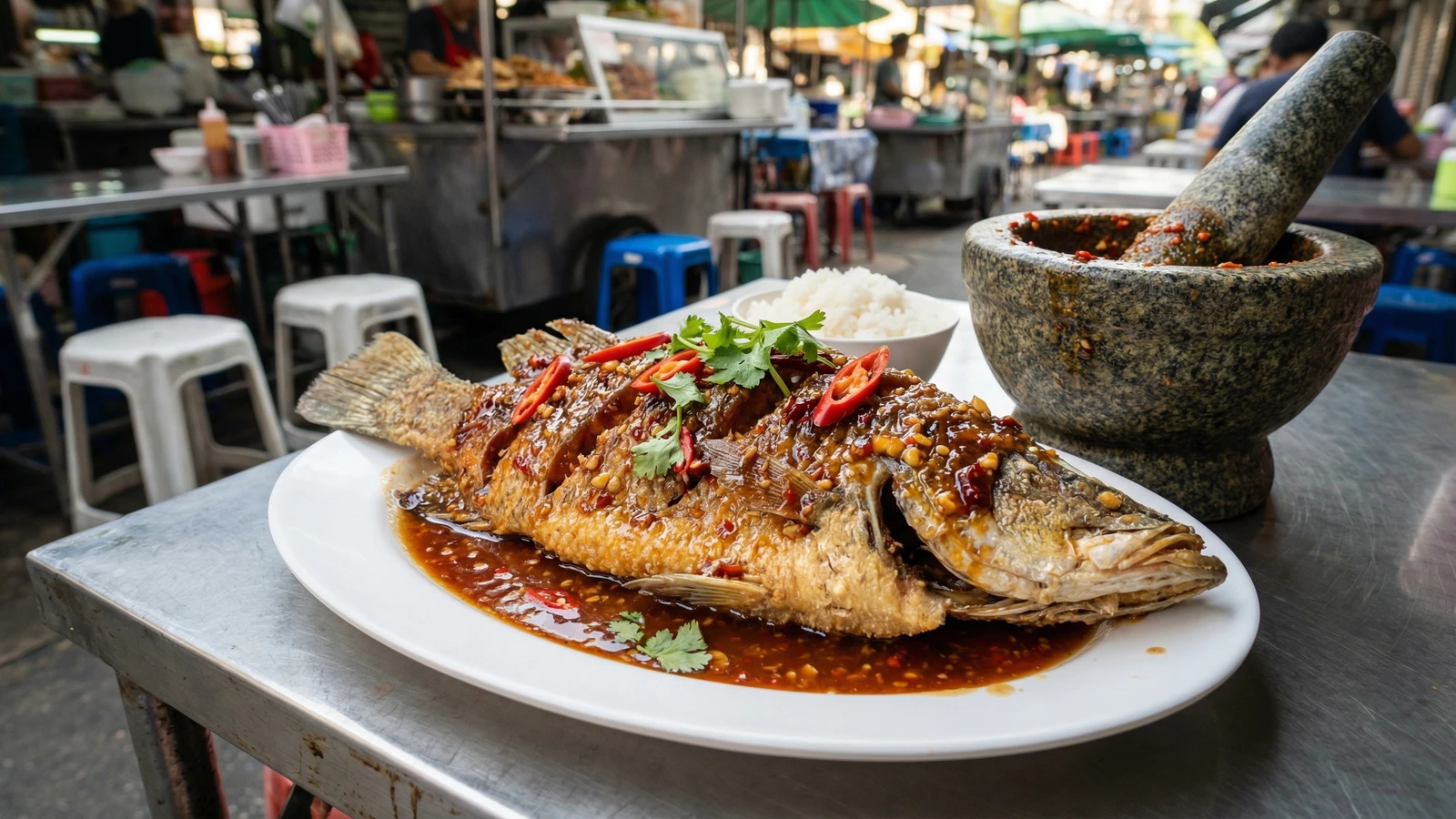
A whole fish fried until the skin shatters, then drowned in a sauce born from the kreung tam: dried chilies, garlic, shallots, and kapi pounded in the krok, cooked out with tamarind, nam pla, and palm sugar. The four pillars, poured hot.
Pla rad prik is the kreung tam served as a sauce. That's the principle. You pound a paste of dried chilies, garlic, shallots, and shrimp paste in the mortar, then you cook it out in oil until the raw edge disappears and the aromatics bloom. Add tamarind water for sour, fish sauce for salt, palm sugar for sweet. Pour it over a whole fish fried so hard the skin cracks when you breathe on it. That's the dish. That's the system at work.
Ajarn always said: if you understand the kreung tam, you understand Thai food. Pla rad prik proves it. The paste here isn't hidden inside a curry or buried under coconut milk. It's right there on top, naked, exposed. You can taste every decision you made in the mortar. Pounded too fine? The sauce is muddy. Too coarse? Chunks of raw garlic floating in tamarind. The krok teaches you control. There's no hiding behind other flavors.
I learned this dish from a vendor near Khlong Toei who fried pla nin (tilapia) in a blackened wok the size of a satellite dish. She'd pull the fish out, golden and blistered, set it on a steel plate, then ladle on a sauce so thick and red it looked like lava. The fish crackled under the weight of it. She made the paste fresh every morning. Same mortar, same order, same rhythm. Twenty years of the same dish, and she never once looked bored. That's what mastery looks like.
The four pillars are explicit here. Nam pla for salt. Nam tan pip for sweet. Makham (tamarind) for sour, the tropical acid doing what lime does in som tam but with more depth, more darkness, more body. Prik haeng (dried chilies) for heat. No pillar is hidden. No pillar is optional. You taste all four in every spoonful of that sauce. Fish sauce for salt. Palm sugar for sweet. Tamarind for sour. That's the law.
Pla rad prik is a Central Thai preparation with deep roots in Bangkok's street food culture, where whole fried fish has been a market staple for over a century. The dish demonstrates the kreung tam principle applied as a cooked sauce rather than a curry base: the same pounded paste foundation, different application. The use of makham (tamarind) rather than manao (lime) as the sour element reflects Central Thai cooking's preference for cooked tropical acids in hot sauces, reserving fresh lime for cold dishes and table condiments.
Quantity
1 fish (about 500-600g)
cleaned, scaled, scored 3-4 diagonal cuts on each side
Quantity
1 teaspoon
Quantity
2 tablespoons
Quantity
enough to submerge the fish
Quantity
10
soaked in warm water 15 minutes, drained, roughly chopped
Quantity
8 cloves
Quantity
4
roughly sliced
Quantity
1 teaspoon
Quantity
3 tablespoons
dissolved in 1/2 cup warm water, strained
Quantity
3 tablespoons
Quantity
3 tablespoons
shaved or chopped
Quantity
2 tablespoons
Quantity
3
sliced on the bias
Quantity
for finishing
Quantity
for serving
| Ingredient | Quantity |
|---|---|
| whole sea bass or snappercleaned, scaled, scored 3-4 diagonal cuts on each side | 1 fish (about 500-600g) |
| salt | 1 teaspoon |
| rice flour or tapioca starch | 2 tablespoons |
| vegetable oil for deep-frying | enough to submerge the fish |
| dried red chilies (prik haeng)soaked in warm water 15 minutes, drained, roughly chopped | 10 |
| garlic | 8 cloves |
| shallots (hom daeng)roughly sliced | 4 |
| shrimp paste (kapi) | 1 teaspoon |
| tamarind paste (makham piak)dissolved in 1/2 cup warm water, strained | 3 tablespoons |
| fish sauce (nam pla) | 3 tablespoons |
| palm sugar (nam tan pip)shaved or chopped | 3 tablespoons |
| vegetable oil for sauce | 2 tablespoons |
| fresh red spur chilies (prik chi fa)sliced on the bias | 3 |
| fresh cilantro sprigs | for finishing |
| steamed jasmine rice | for serving |
Start with the dried chilies in the granite mortar. They're the hardest ingredient, so they go first. Pound them to rough flakes, not powder. You want texture in this sauce. Add the garlic cloves and pound until they break down and merge with the chili. Then the shallots. They have the most moisture, so they go last among the hard ingredients. Pound until you have a rough, fragrant paste with visible bits of chili skin. Now add the kapi (shrimp paste) and pound it in until fully incorporated. The kapi is the binder. It pulls everything together and adds that deep, funky umami backbone. Your paste should be coarse, wet, and smell like it could strip paint. That's exactly right.
Rinse the fish and pat it completely dry with paper towels. This is not optional. Water plus hot oil equals a trip to the burn unit. Score three or four diagonal slashes on each side, cutting down to the bone. The scores serve two purposes: they let the oil penetrate so the flesh cooks evenly, and they create ridges that fry into crispy edges. Rub the fish inside and out with salt, then dust it lightly with rice flour or tapioca starch. Shake off the excess. The starch creates a shell that fries into armor.
Heat the oil in a deep wok or pot to 180°C (350°F). The oil needs to be deep enough to submerge at least two-thirds of the fish. Test it: drop a small piece of batter or starch in. If it sizzles and floats immediately, you're ready. Carefully lower the fish into the oil using a spider or slotted spatula. Do not move it for the first 3 minutes. Let the crust set. If you nudge it too early, the skin tears and sticks to the wok. After 3 minutes, gently loosen it. Fry for 12 to 15 minutes total, turning once, until the entire surface is deep golden-brown and the skin is blistered and rigid. The skin should sound hollow when you tap it with the spatula. That's your sign. Lift the fish out, let it drain on a wire rack, and set it on your serving plate.
In a clean wok or saucepan, heat 2 tablespoons of oil over medium heat. Add the pounded paste and fry it, stirring constantly, for about 2 minutes. You're cooking out the raw garlic edge and blooming the dried chili. The paste will darken slightly and the oil will turn red. The smell shifts from sharp and aggressive to round and aromatic. That's the transformation. That's what the kreung tam does when it meets heat.
Pour in the strained tamarind water. It will sizzle and deglaze the paste from the wok. Add the fish sauce and palm sugar. Stir until the sugar dissolves completely. Bring the sauce to a gentle boil and let it reduce for 3 to 4 minutes until it thickens slightly and coats the back of a spoon. Taste. This is where the four pillars reveal themselves. Salty from the nam pla. Sweet from the nam tan pip. Sour from the makham. Heat from the prik haeng already in the paste. All four should be present and none should dominate. Adjust: more fish sauce if it's flat, more palm sugar if the tamarind is too aggressive, more tamarind water if it's too sweet. Pound, taste, adjust. Same method, different stage.
Toss the sliced prik chi fa into the sauce for a flash of color and fresh heat. One quick stir. Pour the sauce over the fried fish while both are still hot. The sauce should cascade over the crispy skin, pooling around the fish on the plate. You'll hear the sizzle. That's the sound of the crust drinking in the sauce while still holding its crunch. Scatter cilantro over the top. Bring the whole plate to the table with jasmine rice. This is a sharing dish. You don't plate pla rad prik for one. You set it in the center and let people pull the meat apart with a spoon, spooning that sauce over their rice. That's how it's done.
1 serving (about 150g)
Culinary guides, cultural storytelling, and the editorial depth that makes cooking meaningful.
Discover Culinary ExplorerChef Fai
The four pillars live at the bottom of the bowl before the noodles ever touch it: nam pla for salt, sugar for sweet, vinegar for sour, chili for heat. Every noodle cart in Bangkok runs on this principle.

Chef Fai
The kreung tam fried in cracked coconut cream until the oil bleeds red. That's the technique. Concentrated, semi-dry, spooned thick over crispy fish. This is what happens when the four pillars meet restraint.

Chef Fai
Isan foraging in a bowl: wild taro stems stripped of their sting, simmered in padaek broth with a pounded chili paste and yanang leaf extract. The land feeds you if you know the rules.

Chef Fai
Lanna's kreung tam breaks from Central Thai rules: ginger over galangal, cumin and coriander from Burmese spice routes, tamarind for sour instead of lime. The North has its own system, and this curry is its crown.