
Chef Fai
Southern Cucumber Relish (Ajad)
The one Thai condiment where vinegar replaces lime as the sour pillar, and the system still holds. Palm sugar for sweet, nam pla for salt, prik for heat. Ajad is the four pillars in a jar.
A cooking platform built around craft, culture, and the stories behind what we eat.

Created by
Pla ra is fish sauce before civilization polished it. Six months in a clay jar, salt-tolerant bacteria breaking protein into pure umami, then simmered into coconut cream. This is Isan's soul in a dipping bowl.
Pla ra is the principle before the principle. Ajarn always said fish sauce provides salinity through protein fermentation. Nam pla is the refined, filtered, commercially bottled version. Pla ra is the source. The unfiltered, unpasteurized, six-month-old ancestor sitting in a clay jar in every Isan kitchen. If you understand pla ra, you understand why fish sauce exists at all.
Here's what's happening in that jar. You take freshwater fish, usually pla chon (snakehead) or pla soi, pack them in salt and roasted rice bran, and seal them in an earthenware pot. Salt-tolerant bacteria (primarily Lactobacillus and Bacillus species) go to work. The salt concentration, around 20-25%, kills everything except the organisms tough enough to survive it. Those bacteria break down protein into amino acids. That's where the umami comes from. The roasted rice bran feeds the fermentation and adds a toasty depth. Six months minimum. Twelve is better. Time is the ingredient you can't shortcut.
Lon is a Central Thai technique: aromatics simmered gently in coconut cream until the fat softens everything into a thick, spoonable dip. When you marry Isan's pla ra with Central Thai's coconut cream method, you get lon pla ra. The funk meets the fat. The sharp, briny fermentation collides with the richness of hua kathi (coconut cream head), and the shallots and galangal mediate between them. Palm sugar rounds the edges. Kaffir lime leaves cut through with citrus.
This dish follows the four pillars, but the balance is different from anything else in Thai cooking. The pla ra itself delivers salt and umami so deep that you barely need extra nam pla. Palm sugar provides the sweet. The kaffir lime leaves and the natural acidity of the ferment handle sour. Chilies bring heat. But the star is the ferment. Remove the pla ra and you have coconut cream with vegetables. Keep the pla ra and you have Isan identity in a bowl. The ferment is the dish.
Pla ra (ปลาร้า) is the foundational ferment of Thailand's Isan (northeastern) region and Laos, predating commercial fish sauce (nam pla) by centuries. The fermentation relies on salt-tolerant bacteria (halophilic Bacillus and Lactobacillus species) working over 6-12 months in sealed earthenware jars, converting fish protein into amino acids and creating the intense umami that defines Isan cooking. Lon, by contrast, is a Central Thai palace-kitchen technique of simmering aromatics in coconut cream. Pla ra lon represents the cultural intersection of Isan's fermentation heritage with Central Thai coconut cookery, a dish that gained national popularity as Isan workers brought their food traditions to Bangkok in the mid-20th century.
Quantity
200ml
strained through muslin cloth
Quantity
50g
picked clean of bones and shredded
Quantity
400ml
thick first pressing
Quantity
100ml
Quantity
5
thinly sliced
Quantity
3 stalks
tender inner part only, thinly sliced
Quantity
5 slices
1/4 inch thick, finely julienned
Quantity
5
central vein removed, very finely shredded
Quantity
5
lightly bruised
Quantity
2 tablespoons
Quantity
generous platter
white cabbage wedges, Thai eggplant, cucumber, long beans, wing beans, blanched morning glory stems
| Ingredient | Quantity |
|---|---|
| pla ra liquid (nam pla ra)strained through muslin cloth | 200ml |
| pla ra fish flesh (optional)picked clean of bones and shredded | 50g |
| coconut cream (hua kathi)thick first pressing | 400ml |
| thin coconut milk (hang kathi) | 100ml |
| shallots (hom daeng)thinly sliced | 5 |
| lemongrass (takhrai)tender inner part only, thinly sliced | 3 stalks |
| galangal (kha)1/4 inch thick, finely julienned | 5 slices |
| kaffir lime leaves (bai makrut)central vein removed, very finely shredded | 5 |
| bird's eye chilies (prik khi nu)lightly bruised | 5 |
| palm sugar (nam tan pip) | 2 tablespoons |
| mixed fresh vegetables for dippingwhite cabbage wedges, Thai eggplant, cucumber, long beans, wing beans, blanched morning glory stems | generous platter |
This is the most important step and the one people rush through. Take your pla ra liquid and strain it through muslin or a fine-weave cloth into a bowl. You're removing bone fragments, rice bran sediment, and any grit. What passes through should be a murky, amber-brown liquid that smells intensely funky: sharp, briny, with a deep savory backbone. If it smells rotten or makes you gag, the ferment has gone wrong. Good pla ra smells strong but clean underneath the funk. If you're using pla ra fish flesh, pick through it carefully with your fingers, removing every bone and scale. Shred it into small pieces. The flesh adds body and textural interest to the lon.
Pour the thick coconut cream into a heavy-bottomed pot or deep pan over medium heat. Stir it gently and continuously. You're waiting for the cream to break: the fat separates from the liquid, and you'll see clear, fragrant coconut oil pooling on the surface. This takes 8-10 minutes. Don't rush it. The cream will go from smooth and white to slightly grainy with visible oil slicks. That split is what gives lon its rich, glossy body. If you skip this step, the dip tastes flat and watery. Cracking the cream is non-negotiable.
Once the coconut oil has separated, add the sliced shallots and lemongrass to the cracked cream. Stir and let them soften in the coconut fat for 3-4 minutes. They should turn translucent and fragrant, not browned. Add the julienned galangal. Another minute. The kitchen should smell like a Thai grandmother's house: coconut, shallot, lemongrass, the warm bite of galangal. These aromatics aren't a kreung tam in the pounded sense, but they're doing the same work. Building a flavor foundation.
Pour in the strained pla ra liquid. If you're using the shredded fish flesh, add it now too. Stir everything together. The coconut cream will darken to a warm caramel-brown. The smell will shift: the sharp funk of the ferment meeting the sweet fat of the coconut. This is the collision that makes the dish. Add the thin coconut milk to adjust the consistency. You want something between a thick soup and a dip, spoonable but not runny. Bring it to a gentle simmer. Not a boil. Gentle. Let it cook for 8-10 minutes, stirring occasionally. The flavors need time to merge.
Add the palm sugar and stir until dissolved. Taste. The pla ra brings all the salt you need, maybe more than you need. The palm sugar is there to balance, not to sweeten. You should taste: deep umami first, coconut richness second, a gentle sweetness rounding the edges, and the aromatic backbone of the herbs. If it's too salty, more palm sugar. If it's too flat, it needs more time on the heat. The four pillars are at work: the pla ra handles salt and then some, palm sugar handles sweet, the natural acidity of the ferment provides a subtle sour note, and the chilies are coming next.
Remove from heat. Add the finely shredded kaffir lime leaves and bruised chilies. Stir them through. The lime leaves should hit the warm dip and release their citrus oil immediately. You'll smell it. That bright, floral sharpness cutting through the funky richness is exactly right. The chilies add heat that builds slowly. Transfer to a serving bowl. The lon should be warm, not hot. It's a dip, not a soup. Serve it surrounded by raw and blanched vegetables: cabbage wedges for crunch, Thai eggplant for bitter contrast, cucumber for coolness, blanched morning glory stems for something green and tender. The vegetables aren't a side dish. They're the delivery system.
1 serving (about 290g)
Culinary guides, cultural storytelling, and the editorial depth that makes cooking meaningful.
Discover Culinary ExplorerChef Fai
The one Thai condiment where vinegar replaces lime as the sour pillar, and the system still holds. Palm sugar for sweet, nam pla for salt, prik for heat. Ajad is the four pillars in a jar.

Chef Fai
Every grilled dish in Isan answers to this dip. Roasted dried chilies, nam pla, manao, khao khua, and shallots: the four pillars in a condiment that's structural, not optional.
Chef Fai
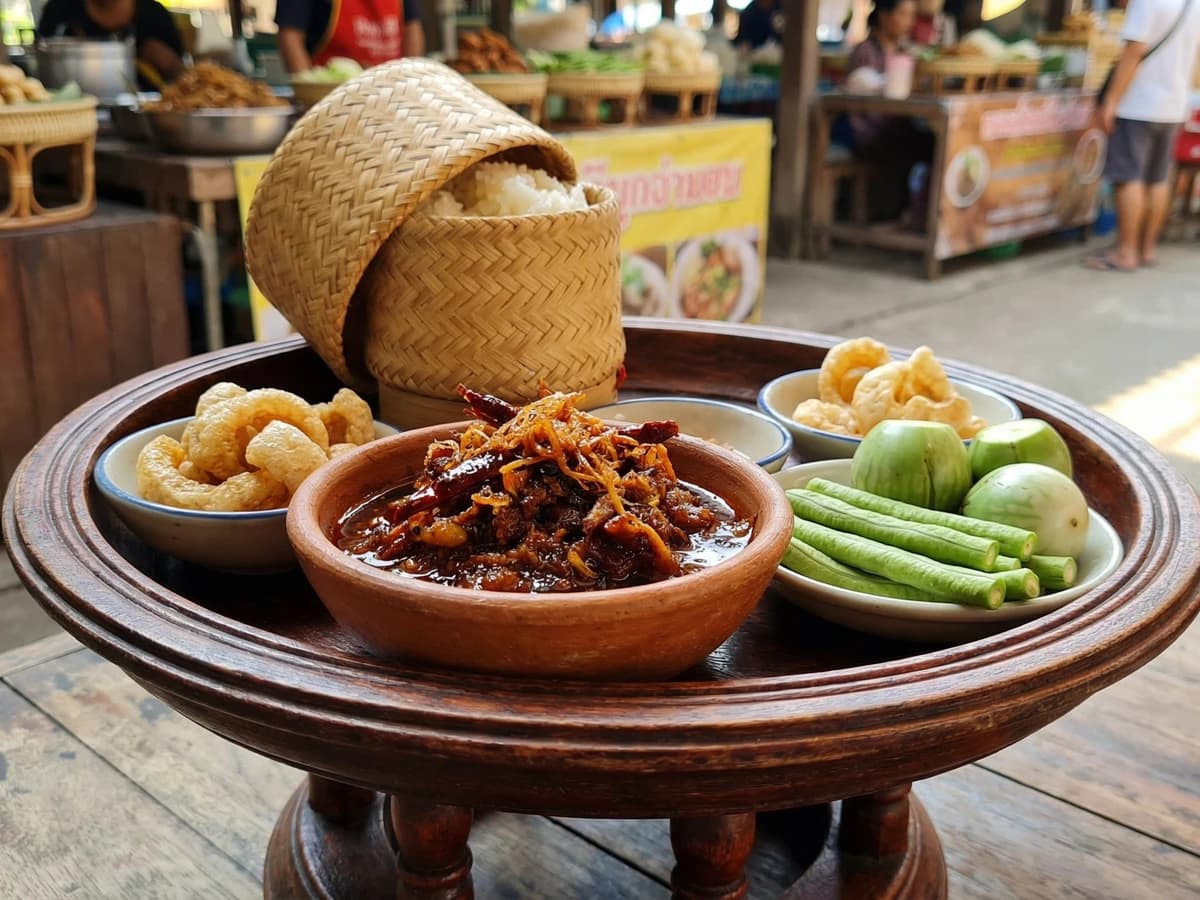
Roasted dried chilies and galangal pounded to a rough paste, folded with shredded pork skin and palm sugar until it becomes something sweet, smoky, and chewy that belongs on every khantoke tray in Chiang Mai.
Chef Fai
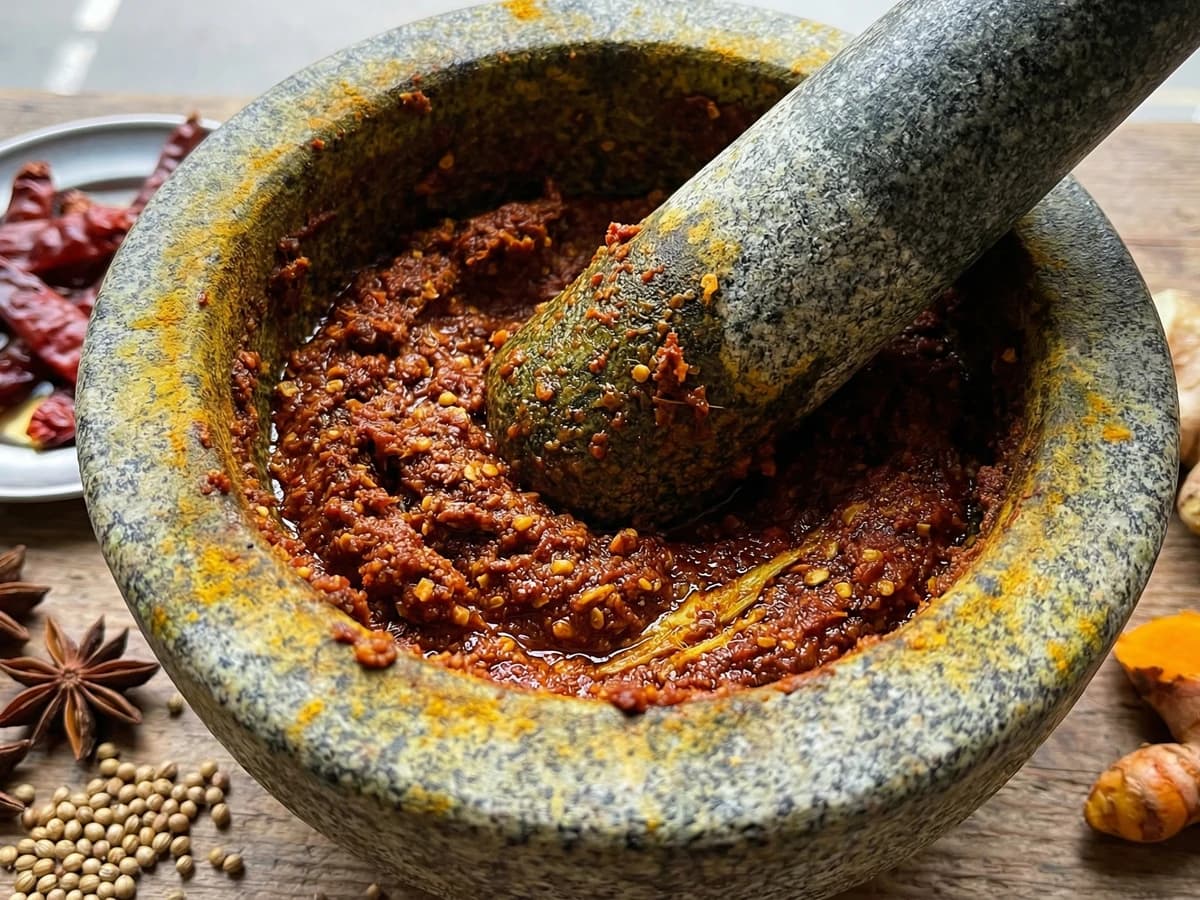
The kreung tam that proves the system adapts. Ginger instead of galangal, cumin and star anise alongside lemongrass. Lanna's mortar holds the whole Burma-to-Chiang Mai trade route in a single paste.