
Chef Fai
Dry Egg Noodles (Ba Mee Haeng)
The four pillars live at the bottom of the bowl before the noodles ever touch it: nam pla for salt, sugar for sweet, vinegar for sour, chili for heat. Every noodle cart in Bangkok runs on this principle.
A cooking platform built around craft, culture, and the stories behind what we eat.
Created by
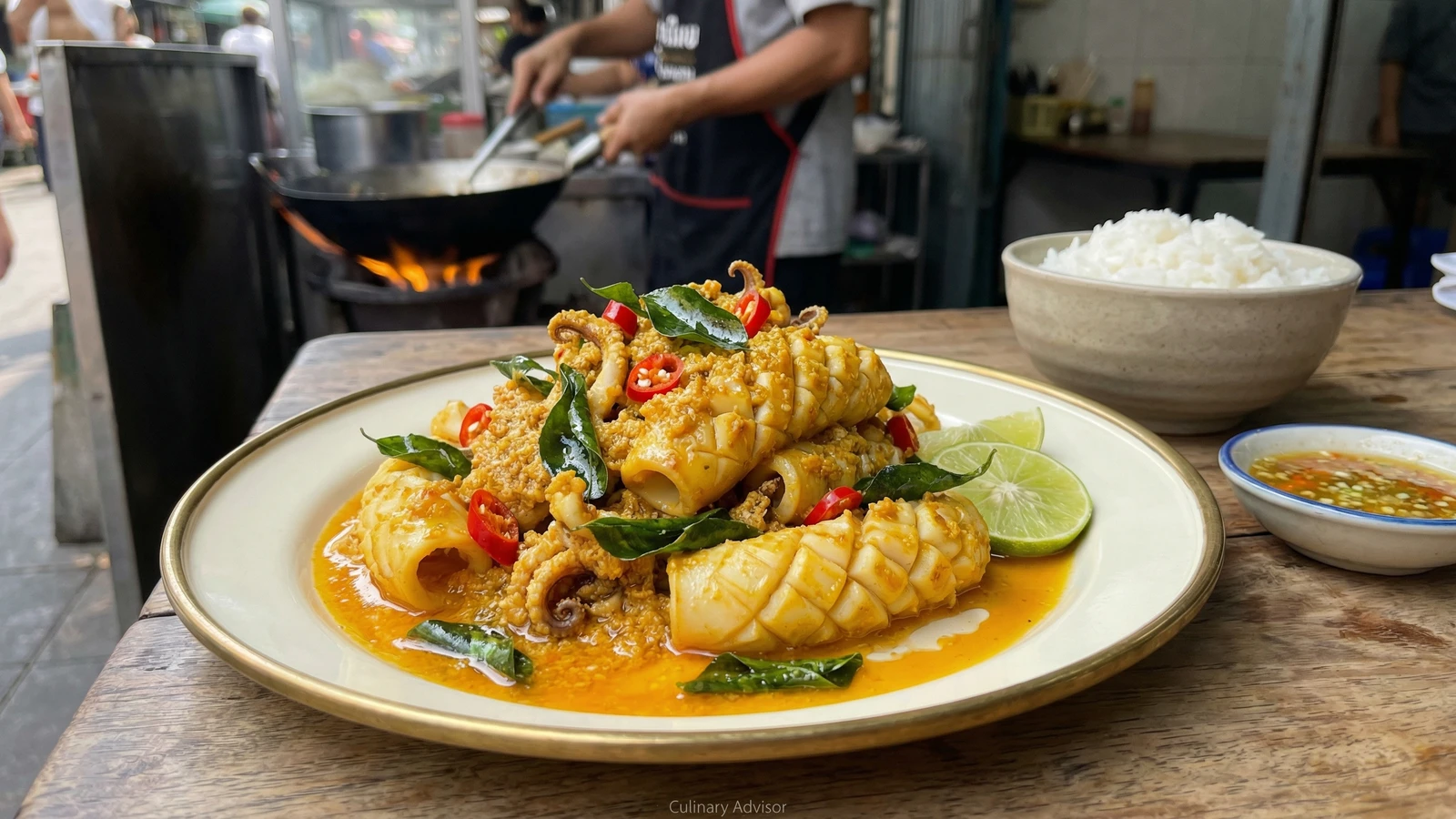
Salted duck egg yolk melted into butter, foamed until golden, tossed with flash-fried squid and curry leaves. Thai-Chinese wok cooking from the Southern coast, where the sea sets the menu and the salt pillar comes from the egg itself.
This dish breaks a rule and teaches you why the rule exists in the first place.
In most Thai cooking, nam pla (fish sauce) is your salt pillar. That's the law. But pla muk pad khai khem gets its salinity from somewhere older: salted duck eggs, cured for weeks in a salt-ash brine until the yolks turn dense, orange, and granular. The yolk IS the seasoning. It melts into hot butter, foams, and coats everything it touches in a layer of concentrated salt and fat. Fish sauce still shows up, but as a supporting player. The salted egg runs the show. That's the principle at work: understand where your salt comes from, and you understand the dish.
Ajarn always said the four pillars are a framework, not a cage. Salt, sweet, sour, heat. In Southern Thai cooking, the balance tips hard toward salt and heat, with sweet barely registering. This dish follows that Southern instinct. A pinch of sugar, maybe. A squeeze of lime at the table. But the dominant note is that rich, saline, almost cheese-like intensity of cured egg yolk hitting hot fat. If you've never cooked with salted egg yolks before, the moment they start foaming in butter is the moment you understand why Chinese and Thai cooks have been curing duck eggs for centuries.
The curry leaves (bai karee) are the Southern Thai signature here. Not basil, not kaffir lime leaf. Curry leaves. They crackle in hot oil and release a fragrance that's part citrus, part earth, part something you can't name. In Nakhon Si Thammarat and down through Songkhla, curry leaves show up in stir-fries the way horapha shows up in Central Thai cooking. They tell you where you are on the map.
The squid gets a light coat of rice flour and kamin (turmeric) before it hits the oil. That's Southern batter logic: turmeric is the dominant rhizome below the peninsula, not galangal. The coating gives the squid something for the egg yolk sauce to grip. Without it, the sauce slides off. With it, every piece comes out golden, crunchy at the edges, and coated in that salted egg yolk glaze that sticks to your fingers. That's the design.
Salted duck eggs (khai khem) arrived in Thailand through Chinese immigration, particularly the Teochew communities who settled along the Gulf coast. The technique of curing eggs in salted charcoal ash or brine is centuries old in southern China. Pad khai khem as a stir-fry style became a Thai-Chinese restaurant staple in the 1990s and 2000s, with the Southern coastal version distinguishing itself through the addition of curry leaves (bai karee), a Malay-Indian influenced aromatic common below the Chumphon isthmus. The dish represents the intersection of Chinese preservation technique and Thai wok culture, adapted to whatever comes off the boat that morning.
Quantity
400g
cleaned, scored in crosshatch, cut into bite-sized pieces
Quantity
4
whites discarded
Quantity
3 tablespoons
Quantity
1 tablespoon, plus 2 cups for frying
Quantity
6 cloves
roughly smashed
Quantity
5
sliced
Quantity
2 sprigs, about 20 leaves
stripped from stems
Quantity
3 tablespoons
Quantity
1 teaspoon
Quantity
1 tablespoon
Quantity
1 teaspoon
Quantity
1/4 teaspoon
Quantity
1
Quantity
for serving
| Ingredient | Quantity |
|---|---|
| fresh squid (pla muk)cleaned, scored in crosshatch, cut into bite-sized pieces | 400g |
| salted duck egg yolks (khai khem)whites discarded | 4 |
| unsalted butter | 3 tablespoons |
| vegetable oil | 1 tablespoon, plus 2 cups for frying |
| garlic (kratiam)roughly smashed | 6 cloves |
| bird's eye chilies (prik khi nu)sliced | 5 |
| fresh curry leaves (bai karee)stripped from stems | 2 sprigs, about 20 leaves |
| rice flour (paeng khao jao) | 3 tablespoons |
| turmeric powder (kamin) | 1 teaspoon |
| fish sauce (nam pla) | 1 tablespoon |
| granulated sugar | 1 teaspoon |
| white pepper | 1/4 teaspoon |
| egg white | 1 |
| lime wedges (optional) | for serving |
Lay each squid tube flat, inside facing up. Score it in a crosshatch pattern with your knife held at a 45-degree angle, spacing cuts about 5mm apart. Don't cut all the way through. You want to go about two-thirds deep. This does two things: it tenderizes the squid so it doesn't turn to rubber, and it creates surface area for the salted egg yolk sauce to grip. Cut the scored tubes into pieces about 5cm wide. Tentacles stay whole. Pat everything bone dry with paper towels. Moisture is the enemy of a crisp coating.
In a bowl, whisk the egg white until slightly frothy. Toss the squid pieces in the egg white. In a separate bowl, mix the rice flour, kamin (turmeric), and white pepper. Lift the squid out of the egg white, shake off the excess, and dredge through the flour mixture. The coating should be thin. Paper-thin. You're not making tempura. You're giving the squid just enough texture to hold the sauce and just enough turmeric to stain everything gold. That golden color is the Southern Thai signature. Below the peninsula, kamin replaces galangal as the dominant rhizome. It colors the batter, it flavors the oil, it tells you this is coastal food.
Heat 2 cups of oil in a wok to 180°C (355°F). If you don't have a thermometer, drop a small piece of coated squid in. It should sizzle immediately and float within a few seconds. Fry the squid in two batches. Don't crowd the wok. Each batch takes about 90 seconds. The squid should curl, turn golden from the turmeric, and feel crisp at the edges when you lift a piece with a spider. Pull them out and drain on a wire rack, not paper towels. Paper towels trap moisture on the bottom and kill the crunch you just built.
While the oil heats, mash the salted duck egg yolks with a fork. They should be dense, bright orange, and slightly crumbly. Work them into a rough paste. Some granularity is fine. You don't want a smooth puree. Those little granules of cured yolk are what give the finished sauce its texture: creamy but with grit. That's the character of khai khem.
Pour out the frying oil. Wipe the wok. Set it back over medium heat. Add the butter and 1 tablespoon of vegetable oil. When the butter melts and starts to foam, add the mashed egg yolks. Stir constantly. Within 30 seconds, something remarkable happens: the yolks dissolve into the butter and start to foam. The mixture will bubble and expand, turning into a golden, frothy sauce that looks almost like scrambled egg foam. That foam is the sign. It means the salt and fat have emulsified. The yolk proteins are releasing. This is the sauce. Keep stirring for another 20 seconds until the foam is even and fragrant.
The moment the yolk sauce is foaming, throw in the smashed garlic, sliced chilies, and curry leaves. All at once. The curry leaves will crackle and spit in the hot butter. That's the aromatic oils releasing. The smell should hit you instantly: sharp, citrusy, with something green and almost smoky underneath. That's bai karee. That's Southern Thailand in a single leaf. Stir for 10 seconds. The garlic should be fragrant but not browned.
Add the fried squid to the wok. Toss everything together with a wok spatula, working quickly. Every piece of squid needs to be coated in that golden egg yolk sauce. The foam clings to the turmeric-stained coating like paint. Add the fish sauce and sugar. Toss twice more. Taste. The salted egg yolks provide most of the salt, so go easy on the nam pla. A tablespoon is a starting point, not a mandate. The sugar is barely a whisper. This is Southern Thai: salty, spicy, rich. Sweet takes a back seat. Total time in the wok from adding the squid: 30 seconds. That's it. Any longer and the coating goes soggy and the squid overcooks.
Turn the squid out onto a plate immediately. It should be golden, glistening, flecked with green curry leaf and red chili. Serve with lime wedges on the side and steamed jasmine rice. The lime is the sour pillar showing up at the table, not in the wok. A squeeze of manao over the top cuts through the richness of the egg yolk and butter. It's not optional. It's the balance. Without it, the dish is one-dimensional. With it, all four pillars are present: salt from the egg yolk and nam pla, sweet barely there, sour from the lime, heat from the prik khi nu.
1 serving (about 200g)
Culinary guides, cultural storytelling, and the editorial depth that makes cooking meaningful.
Discover Culinary ExplorerChef Fai
The four pillars live at the bottom of the bowl before the noodles ever touch it: nam pla for salt, sugar for sweet, vinegar for sour, chili for heat. Every noodle cart in Bangkok runs on this principle.

Chef Fai
The kreung tam fried in cracked coconut cream until the oil bleeds red. That's the technique. Concentrated, semi-dry, spooned thick over crispy fish. This is what happens when the four pillars meet restraint.

Chef Fai
Isan foraging in a bowl: wild taro stems stripped of their sting, simmered in padaek broth with a pounded chili paste and yanang leaf extract. The land feeds you if you know the rules.

Chef Fai
Lanna's kreung tam breaks from Central Thai rules: ginger over galangal, cumin and coriander from Burmese spice routes, tamarind for sour instead of lime. The North has its own system, and this curry is its crown.