
Chef Lupita
Acambaritas de Acámbaro
Guanajuato's daily bread from Acámbaro, a small glazed roll built on pata, enriched with manteca de cerdo, and baked until the top shines lightly for merienda.
A cooking platform built around craft, culture, and the stories behind what we eat.
Created by
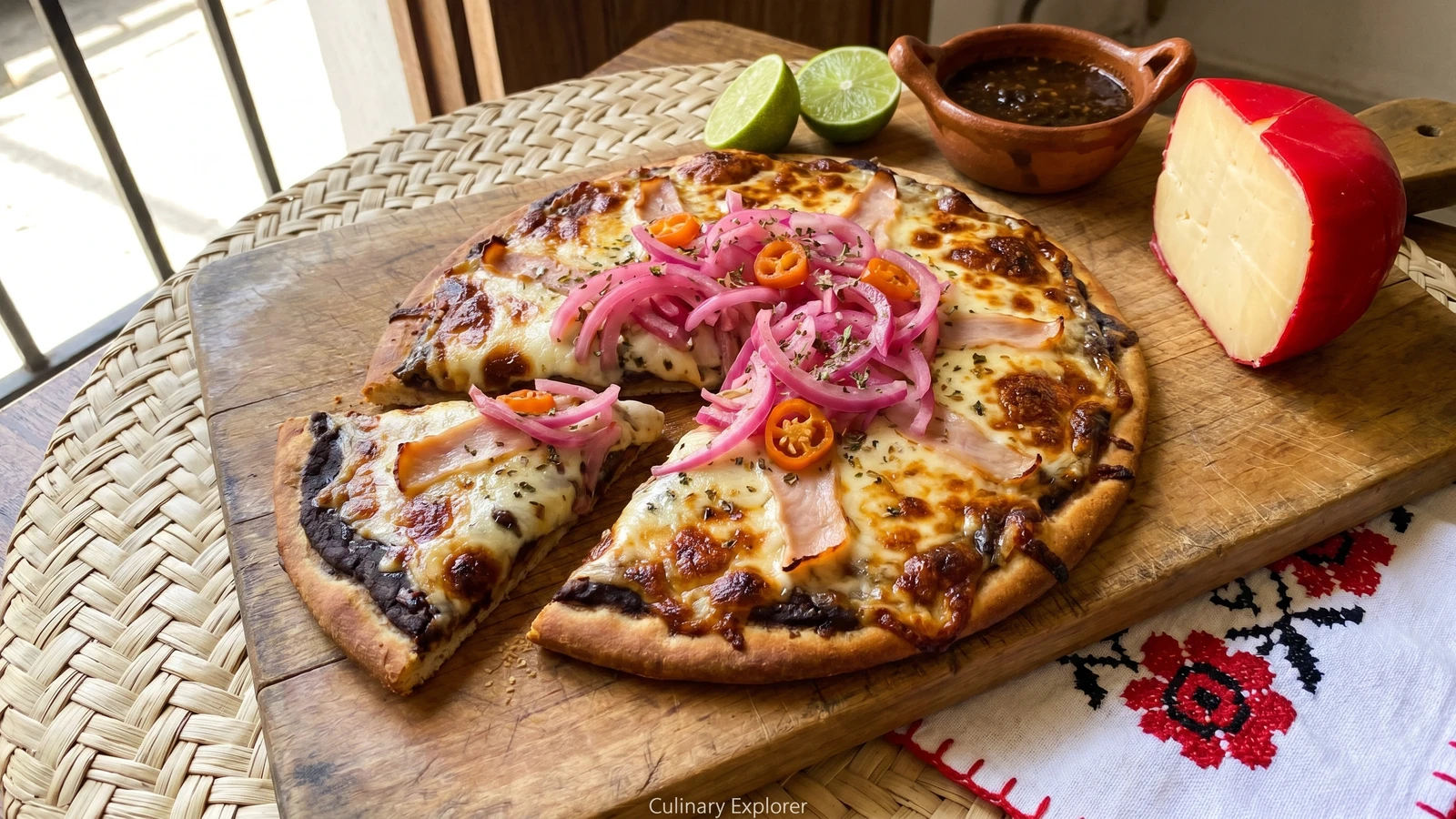
Mérida's 1979 invention by pizzero José Luis Marrero: a lard-enriched pizza base layered with refried black beans, smoked turkey, queso de bola, and the cebolla morada that defines Yucatecan cooking. Pizza meets panucho, and Yucatán wins.
This is from Mérida, Yucatán. Not from Mexico. From Mérida, and you have to understand that distinction before you understand the dish.
The Peninsula sits apart. For most of its history it was easier to get to Cuba or New Orleans from Mérida than to Mexico City, and the food carries that isolation: sour orange instead of lime, achiote where the rest of the country uses guajillo, queso de bola in its red wax rind brought in through the port of Sisal, smoked turkey from the milpa, habanero so hot it has its own dialect. Yucatecan cooks do not apologize for any of this. They built their own cuisine and they are correct to defend it.
The pizzanucho was invented in 1979 by a pizzero named José Luis Marrero, who looked at a panucho, the fried tortilla stuffed with refried black beans and topped with turkey and pickled red onion that anyone from Mérida eats by the half-dozen, and asked the obvious question: what if the base was a pizza. The answer is what you are about to make. Refried black beans cooked with epazote, smoked pavo, melted queso de bola, and a mountain of cebolla morada pickled in naranja agria. Every layer is panucho. The base is pizza. It should not work and it does, and Mérida has been eating it for almost fifty years.
My mother was from Jalisco. She did not cook Yucatecan food. I learned this dish in 2011 from a woman named Doña Reyna who ran a small pizzeria on Calle 62 in Mérida and who told me, while she pulled the wax off a queso de bola the size of a softball, that the secret was respecting both halves. You cannot cheat the pizza, you cannot cheat the panucho. Cada estado, su propia cocina, and Yucatán's kitchen is one of the most particular of them all.
The pizzanucho was created in 1979 by José Luis Marrero, a Meridano pizzero who fused the Italian-American pizza format with the panucho, one of Yucatán's signature antojitos. The panucho itself dates to the late 19th or early 20th century in Mérida, traditionally a fried corn tortilla split open and stuffed with refried black beans, then topped with cochinita pibil or turkey, pickled red onion, and habanero. Queso de bola, the wax-coated Edam cheese central to many Yucatecan dishes including the pizzanucho and queso relleno, entered the regional kitchen through Dutch trade routes via the ports of Sisal and Progreso during the henequen boom of the 19th century, when Yucatán's commercial ties to Europe and the Caribbean were stronger than its overland connections to the Mexican interior. The cebolla morada en escabeche, pickled in sour orange juice with oregano yucateco and allspice, is the Peninsula's universal table condiment and predates the pizzanucho by centuries.
Quantity
3 1/2 cups (about 450 grams)
plus more for shaping
Quantity
1 teaspoon
Quantity
2 teaspoons
Quantity
1 1/4 cups
Quantity
2 tablespoons
melted, plus more for the pans
Quantity
1 pound dry (or 4 cups cooked with their broth)
cooked until very soft, broth reserved
Quantity
3 tablespoons
Quantity
1/2
finely diced
Quantity
2
minced
Quantity
1 sprig
Quantity
1 1/2 pounds
thinly sliced or pulled into ribbons
Quantity
12 ounces
rind peeled, grated on the large holes
Quantity
1 large
sliced into thin half-moons
Quantity
1/2 cup
or 1/3 cup orange juice with 3 tablespoons lime and 1 tablespoon white vinegar
Quantity
1 teaspoon
crumbled
Quantity
1/2 teaspoon
toasted and ground
Quantity
1 teaspoon
Quantity
2
stemmed and finely sliced, one for the onions and one for the table
Quantity
for serving
Quantity
for serving
| Ingredient | Quantity |
|---|---|
| bread flourplus more for shaping | 3 1/2 cups (about 450 grams) |
| instant yeast | 1 teaspoon |
| fine sea salt | 2 teaspoons |
| warm water | 1 1/4 cups |
| manteca de cerdo (for the dough and pans)melted, plus more for the pans | 2 tablespoons |
| black beans, cooked from dry with epazote and onioncooked until very soft, broth reserved | 1 pound dry (or 4 cups cooked with their broth) |
| manteca de cerdo (for refrying the beans) | 3 tablespoons |
| white onionfinely diced | 1/2 |
| garlic clovesminced | 2 |
| fresh epazote | 1 sprig |
| smoked turkey breast (pavo ahumado)thinly sliced or pulled into ribbons | 1 1/2 pounds |
| queso de bola (Edam)rind peeled, grated on the large holes | 12 ounces |
| red onionsliced into thin half-moons | 1 large |
| fresh sour orange juice (naranja agria)or 1/3 cup orange juice with 3 tablespoons lime and 1 tablespoon white vinegar | 1/2 cup |
| dried oregano yucatecocrumbled | 1 teaspoon |
| allspice berries (pimienta gorda)toasted and ground | 1/2 teaspoon |
| fine sea salt (for the onions) | 1 teaspoon |
| fresh chile habanerostemmed and finely sliced, one for the onions and one for the table | 2 |
| salsa de chile habanero tatemado (optional) | for serving |
| lime wedges (optional) | for serving |
In a large bowl, whisk together the bread flour, instant yeast, and sea salt. Pour in the warm water and the melted manteca. Stir with a wooden spoon until a shaggy dough forms, then turn it out onto a lightly floured counter and knead for about 8 minutes. The dough should pull together into a smooth ball, tacky but not sticky. The manteca in the dough is what gives this base its tenderness. It is closer to a pan francés than to a Neapolitan pizza, and that is on purpose. This is Mérida, not Naples.
Place the dough in a lightly greased bowl, cover with a damp cotton servilleta, and let it rise at warm room temperature for about 1 hour and 30 minutes, or until nearly doubled. In the heat of a Peninsula kitchen this happens fast. In a cold kitchen it takes longer. Trust the dough, not the clock.
While the dough rises, place the sliced red onion in a heatproof bowl. Pour boiling water over it and let it sit for 10 seconds, then drain. This takes the raw bite off without cooking the onion. Return the onion to the bowl and add the sour orange juice, the oregano yucateco, the ground allspice, the teaspoon of salt, and the slices of one habanero. Toss with your hands. Let it sit for at least 30 minutes. The onion should turn bright fuchsia. If yours stays pale, your sour orange is weak and you need more acid. This is the cebolla morada that defines Yucatecan food. Without it, no panucho, no cochinita, no pizzanucho.
In a heavy skillet, melt the 3 tablespoons of manteca over medium heat. Add the diced white onion and cook for 4 minutes until translucent. Add the garlic and cook 30 seconds more. Add the cooked black beans with a ladleful of their broth and the sprig of fresh epazote. Mash with a bean masher or the back of a wooden spoon. You want a thick paste, not a soup, but not dry either. It should spread like a soft butter. Taste and salt. Remove the epazote sprig. The beans are the layer that holds everything together on the pizzanucho the way they hold together a panucho. They are not a garnish. They are structure.
Heat the oven to 475F with a heavy sheet pan or baking steel on the middle rack. Punch down the dough and divide it in two. On a lightly floured surface, press and stretch each piece into a 12-inch round. Mérida pizzanucho is not the airy Neapolitan style with a puffed cornicione. It is flatter, sturdier, almost the thickness of a pan francés split open. Brush both rounds lightly with melted manteca on top and bottom. Lay each on a piece of parchment.
Slide one round on its parchment onto the hot sheet pan and bake for 6 minutes. The base should be set, pale gold, with no raw flour smell. Pull it out and repeat with the second. This par-bake is what makes the structure work. If you build the toppings on raw dough, the beans soak in and you get a soggy disaster. The base has to be cooked enough to hold the bean layer like a panucho holds its filling. No me vengas con atajos.
Spread half the refried black beans evenly over each par-baked base, leaving a half-inch border around the edge. Be generous. The beans should be a real layer, about a quarter-inch thick, the way they fill a panucho. Distribute the smoked turkey over the beans, draping the ribbons so every slice will catch some. Scatter the grated queso de bola evenly over the top. The queso de bola is non-negotiable. It is the Edam in red wax that came to Yucatán through the port of Sisal in the 19th century and stayed. Mozzarella is not a substitute. Cheddar is not a substitute. If you cannot find queso de bola, find a Yucatecan grocery or wait until you can.
Return each pizzanucho on its parchment to the hot sheet pan and bake for 8 to 10 minutes. The cheese should melt into a pale golden pool, the edges of the base should darken to a deep brown, and the bean layer should bubble at the rim. Queso de bola does not stretch like mozzarella. It melts into a smoother, denser layer with little spots of amber where the milk fat caramelizes. That is what you want. That is what tells you the cheese is right.
Pull the pizzanuchos onto a wooden board. Pile the pickled red onion generously over the top of each one while still hot. The onion should cover most of the surface. This is the moment the dish becomes a panucho on a pizza base instead of a pizza with weird toppings. Cut into wedges with a sharp knife. Serve with the salsa de habanero tatemado, lime wedges, and the second sliced habanero on the side for those who want more heat. Eat with your hands. Así se hace y punto.
1 serving (about 410g)
Culinary guides, cultural storytelling, and the editorial depth that makes cooking meaningful.
Discover Culinary ExplorerChef Lupita
Guanajuato's daily bread from Acámbaro, a small glazed roll built on pata, enriched with manteca de cerdo, and baked until the top shines lightly for merienda.

Chef Lupita
Michoacan's Tinguindin aguacatas are flat, leaf-scored sweet breads made with harina de trigo, piloncillo, anise, and manteca de cerdo, shaped by hand for the wood oven.

Chef Lupita
From Ajijic on Lake Chapala, Pan Tachihual is a lightly sweet wedding loaf built with harina de trigo, harina de maiz, piloncillo, manteca, anise, and the old Guadalajara pata.

Chef Lupita
Comitán's pan de yema shaped into little pigs, birds, and rabbits, a Chiapas bakery bread rich with egg yolks, manteca de cerdo, and anís, baked golden on hoja de plátano.