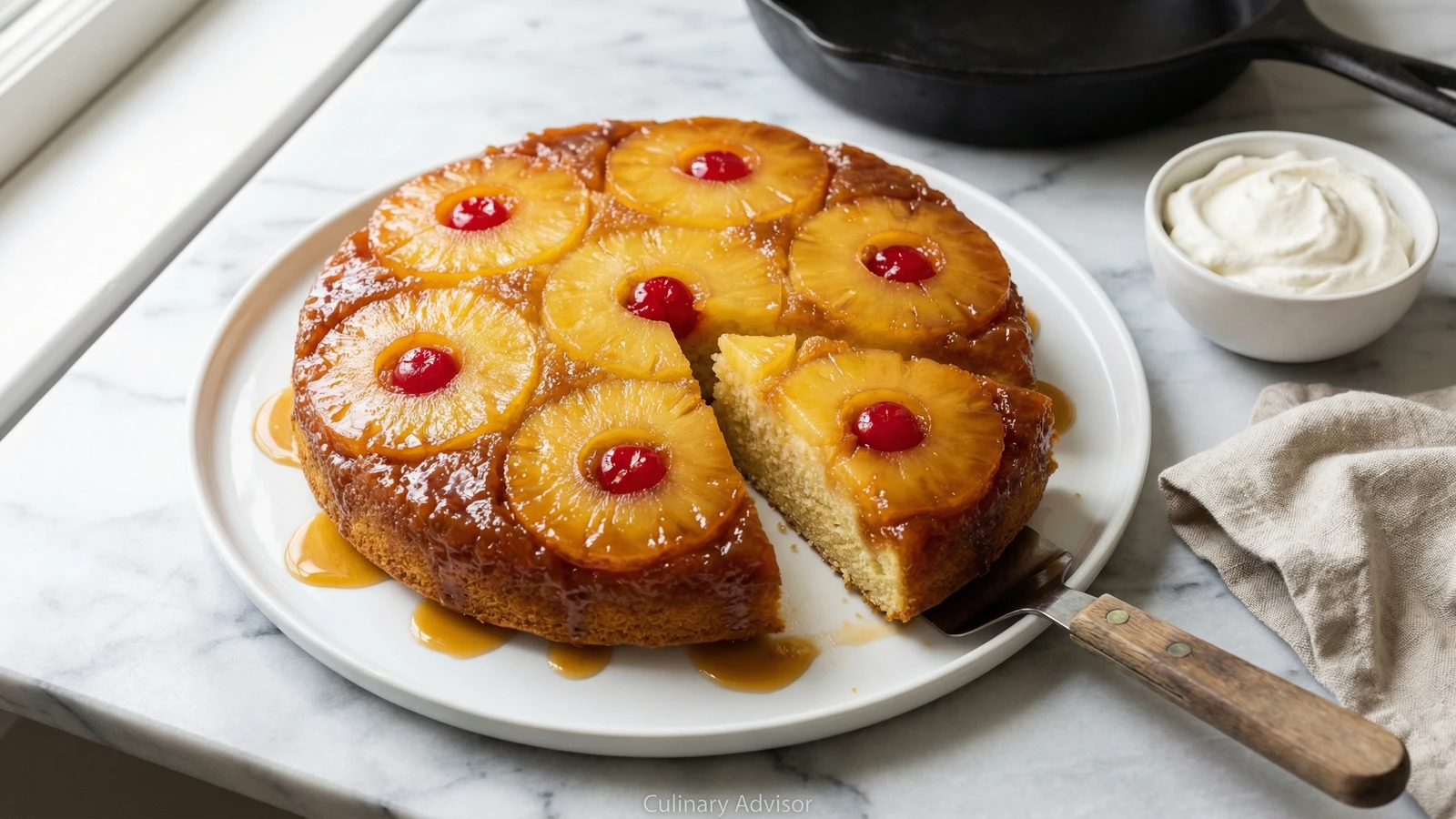
A buttery golden cake crowned with caramelized pineapple rings, jewel-bright cherries, and a lacquered brown sugar glaze that pools into sticky amber rivers when you flip it onto the plate.
Desserts
American
Potluck
Comfort Food
25 min
Active Time
50 min cook•1 hr 15 min total
Yield8 servings
This cake arrived in American kitchens alongside a revolution in canned goods. When James Dole began shipping Hawaiian pineapple to the mainland in the early 1900s, home bakers discovered they could create something extraordinary with ingredients that kept in the pantry. By the 1920s, pineapple upside-down cake had become a national obsession.
The genius lives in the inversion. You build the topping first, arranging pineapple rings and cherries in a pool of melted butter and brown sugar. The batter goes on top. During baking, that sugar mixture transforms into a sticky caramel that penetrates the cake's surface while the fruit softens and concentrates. When you flip the pan onto a serving plate, the whole thing emerges gloriously bronzed, glistening, and utterly irresistible.
I insist on cast iron for this cake. The heavy pan distributes heat evenly, the caramel cooks without burning, and the drama of inverting a skillet at the table is worth the slight effort. This is a cake that demands to be served warm, with the caramel still slightly flowing, to people you genuinely like.
The technique, the tradition, and the story behind every dish.
•Serving plate larger than skillet (at least 12 inches)
•Oven mitts
Instructions
1
Preheat and prepare
Position a rack in the center of your oven and preheat to 350°F. Place your 10-inch cast iron skillet in the oven while it heats. A warm pan helps the butter and sugar melt evenly when you build the topping. While the oven heats, pat your pineapple rings and cherries thoroughly dry with paper towels. Moisture is the enemy of good caramelization.
2
Create the caramel base
Carefully remove the hot skillet from the oven and add the 6 tablespoons of butter. It will sizzle and begin melting immediately. Swirl the pan until the butter coats the bottom evenly. Sprinkle the dark brown sugar over the melted butter in an even layer. Do not stir. The butter and sugar will meld together as the cake bakes, creating a proper caramel without any fussy stovetop work.
Dark brown sugar produces a deeper, more molasses-rich caramel than light brown. This is worth seeking out.
3
Arrange the fruit
Arrange the pineapple rings in a single layer over the brown sugar, fitting as many as possible. A 10-inch skillet typically holds one ring in the center surrounded by six rings around the perimeter. You may need to trim a ring or two to fill gaps. Press a maraschino cherry, cut side down, into the center of each pineapple ring. The cherries should nestle snugly so they stay put when you invert the cake. Set the prepared skillet aside.
4
Mix the dry ingredients
In a medium bowl, whisk together the flour, baking powder, and salt. Whisking aerates the flour and ensures the leavening distributes evenly. Set aside.
5
Cream the butter and sugar
In a large bowl, beat the softened butter with an electric mixer on medium speed until creamy, about one minute. Add the granulated sugar and beat for three to four minutes until the mixture turns pale and fluffy. Scrape down the sides of the bowl halfway through. This step builds the cake's structure; a properly creamed butter traps air that expands during baking.
Your butter should hold a gentle fingerprint but not feel greasy or slick. If it's too cold, the cake will be dense; if too soft, it won't hold air.
6
Add eggs and vanilla
Add the eggs one at a time, beating well after each addition until fully incorporated. The batter may look slightly curdled after the first egg. This is normal. Add the vanilla with the second egg. Beat until the mixture is smooth, light, and uniformly creamy.
7
Alternate dry and wet ingredients
Add the flour mixture in three additions, alternating with the buttermilk in two additions, beginning and ending with flour. Mix on low speed after each addition just until incorporated. The batter should be thick, smooth, and hold soft peaks. Overmixing develops gluten and toughens the crumb.
8
Spread batter over fruit
Spoon the batter over the arranged pineapple rings in large dollops. Using an offset spatula or the back of a spoon, gently spread the batter into an even layer, taking care not to disturb the fruit beneath. The batter should just cover the pineapple, coming about three-quarters up the sides of the skillet.
9
Bake until golden
Bake for 45 to 50 minutes until the cake is deeply golden on top and a toothpick inserted into the center comes out clean. The cake will dome slightly in the middle and pull away from the edges of the pan. You'll smell butter, caramel, and that unmistakable tropical sweetness. The edges will bubble with amber syrup.
Rotate the skillet halfway through baking if your oven heats unevenly. Watch the edges; if they're darkening too quickly, tent loosely with foil for the final fifteen minutes.
10
Cool briefly before inverting
Remove the skillet from the oven and let it rest for exactly five minutes. No more, no less. Too short and the caramel will be too liquid to hold the fruit in place. Too long and it will set like candy and stick to the pan. The five-minute window is critical.
11
Perform the inversion
Run a thin knife around the edge of the cake to release any stuck bits. Place a serving plate larger than the skillet face-down over the pan. Using oven mitts on both hands, grip the plate and skillet together and flip decisively in one confident motion. Set the plate on the counter, then lift the skillet straight up. The cake should release cleanly, revealing its caramelized crown. If any pineapple or cherries stuck to the pan, simply retrieve them with a spatula and press them back into place. The caramel will forgive you.
Confidence matters here. A hesitant flip invites disaster. Commit to the motion and trust the cake.
12
Serve warm
Serve the cake warm or at room temperature, cut into wedges. The caramel should glisten, the pineapple rings hold their shape, and each cherry should sit proudly in its golden halo. A cloud of lightly sweetened whipped cream is traditional. Vanilla ice cream is not traditional but is absolutely permissible.
Chef Tips
•Canned pineapple in juice produces better results than pineapple in heavy syrup, which can make the caramel too sweet and prone to burning. Save the juice for cocktails or smoothies.
•If you lack a cast iron skillet, a 10-inch round cake pan works, but you'll need to melt the butter and sugar together on the stovetop first, then pour into the pan before arranging the fruit.
•This cake is best within four hours of baking. The caramel gradually soaks into the cake and softens the crust. This is not a flaw, but it does change the texture.
•For those who object to maraschino cherries, fresh sweet cherries, pitted and halved, make a beautiful substitution when in season. So do pecan halves, placed flat side up.
•No buttermilk? Stir one teaspoon of white vinegar or lemon juice into regular milk and let it sit for five minutes. It won't be identical, but it will work.
Advance Preparation
•The dry ingredients can be whisked together and stored in an airtight container for up to one week.
•Butter can be softened and portioned ahead, then returned to room temperature before baking.
•The baked cake should not be made more than four to six hours ahead. The caramel will gradually soften the crust and make inversion more difficult.
•Leftovers can be covered and stored at room temperature for one day, or refrigerated for up to three days. Reheat gently in a 300°F oven for ten minutes to restore some of the caramel's stickiness.
Frequently Asked Questions
Nutrition Information
1 serving (about 145g)
Calories
485 calories
Total Fat
23 g
Saturated Fat
14 g
Trans Fat
0 g
Unsaturated Fat
8 g
Cholesterol
47 mg
Sodium
156 mg
Total Carbohydrates
65 g
Dietary Fiber
0 g
Sugars
28 g
Protein
5 g
Where cooking meets culture.
Culinary guides, cultural storytelling, and the editorial depth that makes cooking meaningful.