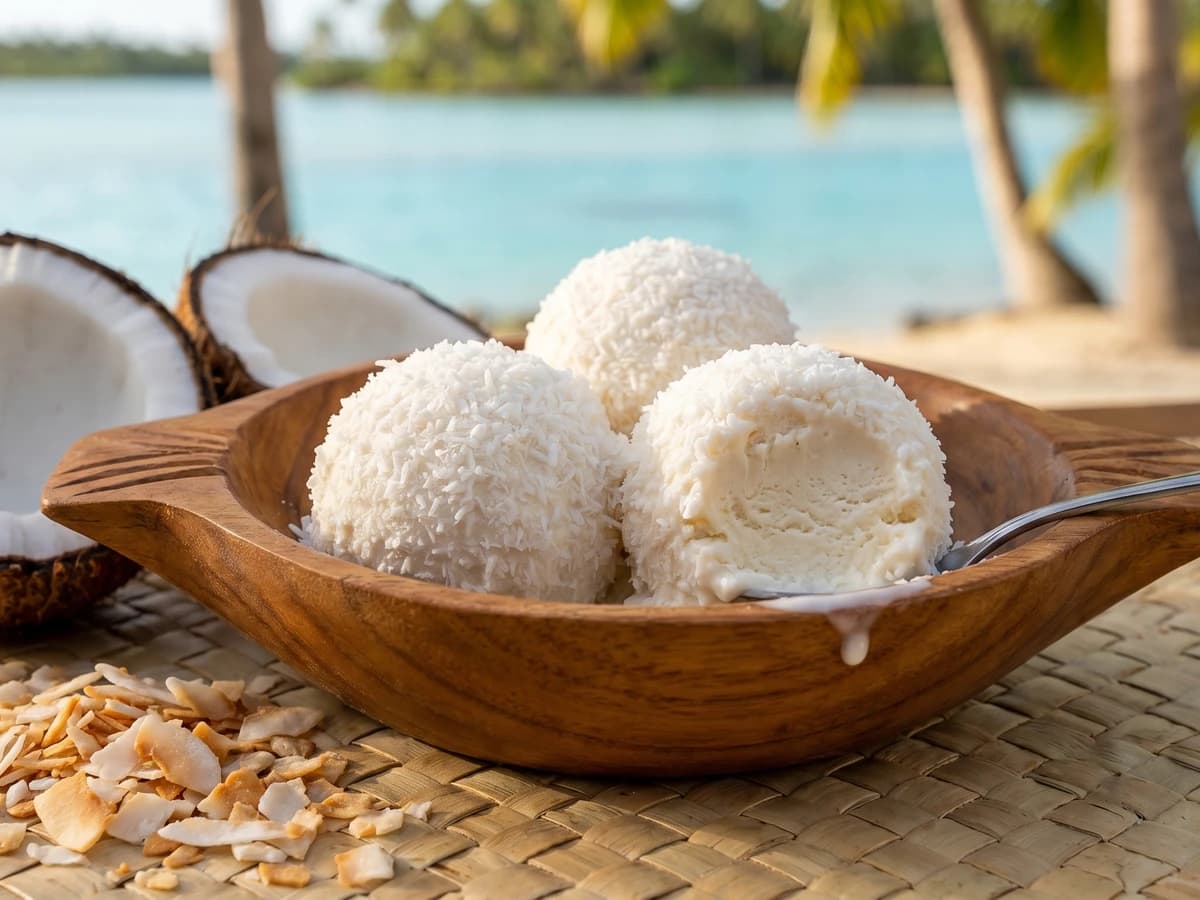
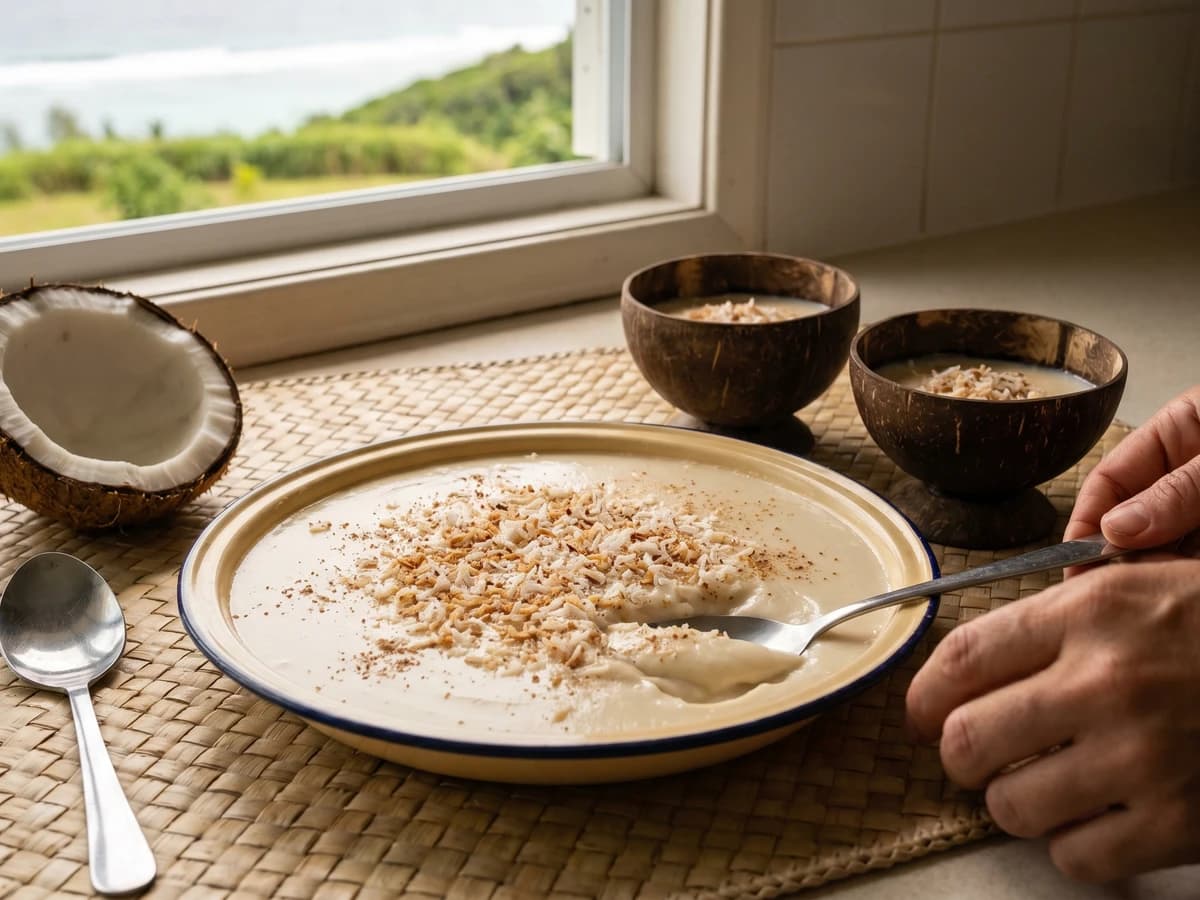
Cook Islands pia is the plain arrowroot pudding before the fruit poke, cooked low with coconut cream until it turns glossy and clear, then chilled soft for the whole table.
Desserts
Polynesian, Cook Islands
Comfort Food
Make Ahead
Budget Friendly
15 min
Active Time
15 min cook•2 hr 30 min total
Yield6 to 8 servings
The canoe carried the quiet starches too, the ones you don't notice until the table needs holding together. In Kūki ʻĀirani, the Cook Islands, pia means the arrowroot starch and the plain pudding it becomes, soft and clear under coconut cream. This is Cook Islands food, not a nameless Polynesian sweet, and I cook it open-handed because my home seat is Hawaiʻi. For the family stories that sit deepest in it, go sit with a Cook Islands mama or papa who carries that table from the inside.
First time a Cook Islands auntie set pia in front of me, I almost waited for the banana, because back home I knew poke as fish and in the Cooks many people know poke as fruit pudding, poke meika, banana poke. She laughed at me, fair enough. Plain pia comes before all that: root starch, coconut, sugar if you have it, no more noise than that. Same ocean, different bowl. Hawaiian haupia, coconut pudding, once leaned on pia starch too; Tahitian poʻe, fruit pudding, carries fruit through the same pudding thinking; and our Hawaiian poi and paʻiʻai, pounded taro, remember the same law of root and patience.
The work is small, but don't get careless. Whisk the starch cold so it wakes evenly, then cook it low and steady until the cloudy white turns glossy and pearl-clear, and the spoon pulls heavy folds from the pot. If it lumps, no blame the pia. You rushed the pour or let the fire bully it. Slow hand, clean source, enough coconut cream, and the pudding will settle soft, humble, and ready for one more person at the table.
Cook Islands pia reaches back to the old starch work of washing and settling arrowroot from the pia plant, Tacca leontopetaloides, one of the useful canoe plants carried and tended through East Polynesia. In the Cooks, that clean starch became plain pia pudding and also the binder for poke meika, banana poke, while later kitchens made room for maniota, cassava, and store-bought tapioca or arrowroot. That shift tells the deep food and mission-trade story in one bowl: root, coconut, and patient hands still at the center, even when the pantry changes.
The technique, the tradition, and the story behind every dish.
or arrowroot starch; tapioca starch from maniota (cassava) gives a chewier set
cool water
Quantity
1 1/2 cups
thick coconut cream
Quantity
2 cups
fresh-squeezed if possible, divided
sugar
Quantity
1/3 to 1/2 cup
to taste
sea salt
Quantity
1/4 teaspoon
banana leaf or neutral oil
Quantity
as needed
for lining the dish
fresh grated coconut (optional)
Quantity
2 tablespoons
Ingredient
Quantity
Cook Islands pia starch (Polynesian arrowroot)or arrowroot starch; tapioca starch from maniota (cassava) gives a chewier set
3/4 cup
cool water
1 1/2 cups
thick coconut creamfresh-squeezed if possible, divided
2 cups
sugarto taste
1/3 to 1/2 cup
sea salt
1/4 teaspoon
banana leaf or neutral oilfor lining the dish
as needed
fresh grated coconut (optional)
2 tablespoons
Equipment Needed
•Heavy 2-quart saucepan
•Flat wooden spoon or heatproof silicone spatula
•8-inch square dish
•Fine-mesh sieve for the starch
Instructions
1
Line the dish
Line an 8-inch square dish with a softened banana leaf, or oil it lightly if that is what your kitchen has. The leaf gives a little green breath to the pudding and helps the pia lift out clean, but no need make it precious. Eat what you have.
2
Make the slurry
Put the pia starch in a bowl and whisk in the cool water until it looks smooth and milky, with no dry pockets hiding at the bottom. Let it sit one minute, then stir again because starch settles heavy, like sand in a tide pool.
If the starch has been sitting in the bag a long time, rub it through a fine-mesh sieve first. Lumps in the bowl become lumps in the pudding.
3
Warm the coconut
In a heavy saucepan, warm 1 1/2 cups of the coconut cream with the sugar and salt over low heat, just until the sugar dissolves and the surface turns glossy. Keep the fire gentle. Coconut cream can split when bullied, and pia does not need that kind of heat.
4
Cook it clear
Stir the starch slurry one more time, then pour it into the warm coconut cream in a slow stream while stirring with a flat spoon. Cook over medium-low heat, scraping the bottom and corners the whole time. It will go from thin, to cloudy, to thick all at once. Keep stirring until the chalky white turns pearl-clear and glossy, the spoon leaves a path, and the pudding folds back on itself in heavy, silky waves, 8 to 10 minutes.
If it still tastes chalky, give it another minute. If you boil it hard for too long, it can thin out or turn gluey. No blame the pia. The fire got ahead of your hand.
5
Set it soft
Scrape the pudding into the lined dish and smooth the top with a wet spoon. Let it cool until the heat leaves, then cover and chill for at least 2 hours. It should set with a soft wobble, firm enough to cut but still tender under the spoon.
6
Cut and share
Cut the pia into squares or spoon it in soft slabs, then finish with the remaining 1/2 cup coconut cream and a little fresh grated coconut if you like. Serve it chilled or cool-room temperature, plain and generous. This is comfort food from the Cook Islands table, quiet, glossy, and enough for one more.
Chef Tips
•If you can find Cook Islands pia starch or true Polynesian arrowroot, buy that. Tapioca starch from maniota, cassava, is a fair pantry cousin, bouncier and clearer. Eat what you have, no shame.
•Fresh coconut cream gives the cleanest flavor. A thick can does the weeknight job, but stir it well first so the cream and water come back together.
•The heat is the whole trick. Arrowroot sets clear when handled gently, but hard boiling can make it lose its body. Low fire, steady spoon, eyes on the pot.
•Pia is not Hawaiian poke. In the Cook Islands, poke is a fruit pudding family, often banana, pumpkin, or pawpaw bound with starch. Plain pia teaches the base before the fruit goes in.
•Store leftovers covered in the fridge for up to 3 days. Let them sit a few minutes before serving so the texture softens and the coconut cream tastes full again.
Advance Preparation
•Make the pia up to 1 day ahead and keep it covered in the refrigerator. Add the finishing coconut cream right before serving.
•Squeeze fresh coconut cream the morning you cook if you can; it separates and sours if it sits too long.
•Do not mix the starch slurry hours ahead. Whisk it right before cooking, because the starch settles hard at the bottom.
Frequently Asked Questions
Nutrition Information
1 serving (about 145g)
Calories
345 calories
Total Fat
25 g
Saturated Fat
22 g
Trans Fat
0 g
Unsaturated Fat
3 g
Cholesterol
0 mg
Sodium
85 mg
Total Carbohydrates
31 g
Dietary Fiber
2 g
Sugars
17 g
Protein
3 g
Where cooking meets culture.
Culinary guides, cultural storytelling, and the editorial depth that makes cooking meaningful.