
Chef Klaus
Ähzezupp (Kölsche Erbsensuppe)
The Cologne pea pot earns its depth from soaked peas and cured pork bone, simmered slowly until the soup thickens itself and the meat falls clean from the knuckle.
A cooking platform built around craft, culture, and the stories behind what we eat.
Created by
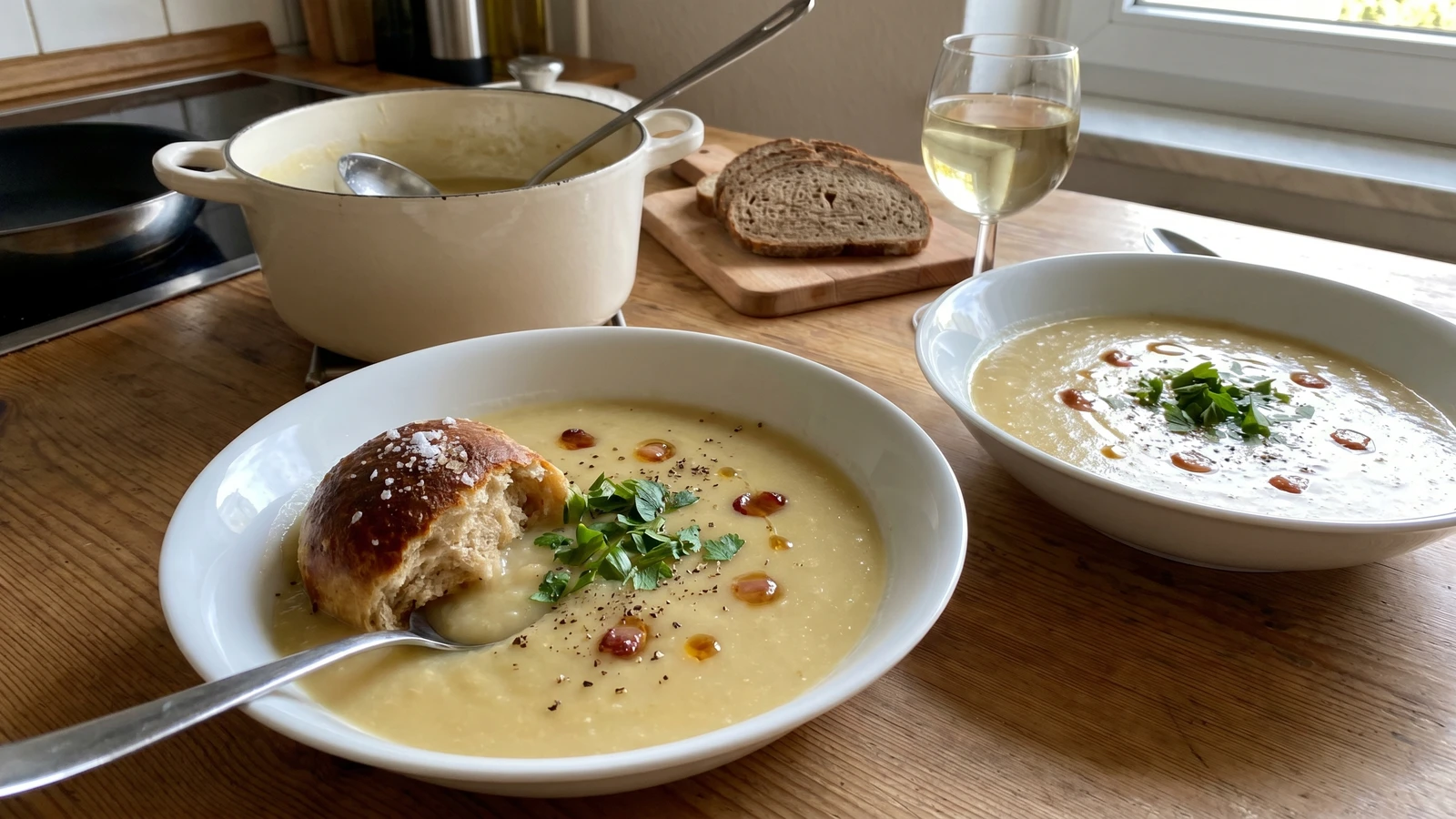
A Palatinate potato soup from cheap roots and good fat, thickened by the potato itself, with a salty Dampfnudel ready to drink up the broth.
Pfälzer Grumbeersupp belongs to the Palatinate, where Grumbeere means potatoes, and the soup sits in the part of the German table that knows how to feed people from a cellar basket. Potato, leek, carrot, celeriac, a little smoked bacon if the larder has it, and enough time for the roots to give themselves up. This is autumn and winter cooking, but it doesn't need a Sunday to justify itself.
The Palatinate argues about the partner more than the pot. Some houses serve it with Quetschekuche, plum cake, in late summer. Others put a salt-crusted Dampfnudel, a steamed yeast dumpling, right into the bowl so the crust goes savoury and the middle stays soft. Across the border in Saarland you meet close cousins with more sausage; further south the soup may be smoother and richer. Im Norden anders, im Süden anders. German food has no one version, and this one is Pfälzer.
The step that decides it is the sweating at the beginning and the mashing at the end. Cook the leek, onion, carrot, and celeriac slowly in bacon fat or butter before the water goes in, because raw roots boiled in plain water taste thin no matter how long you stare at them. Then simmer, don't thrash it, until the floury potatoes fall apart and thicken the soup themselves. Not flour. Not a packet. Nicht aus dem Glas.
I leave some pieces whole and crush the rest against the side of the pot. That gives you body without making baby food. Taste at the end, because potatoes drink salt like a thirsty man drinks beer. Würzen, Fett, Salz zum Schluss.
The potato became a German staple only after the eighteenth century, when rulers such as Frederick II of Prussia pushed cultivation through repeated potato orders, most famously in the 1750s and 1760s after crop failures and war had made grain unreliable. In the Palatinate, the dialect word Grumbeere comes from Grundbirne, earth pear, one of many regional German names that shows how locally the potato was adopted. The pairing of potato soup with Quetschekuche or a salty Dampfnudel is a Palatinate table habit, a sweet-savoury or bread-and-soup meal built from cheap fields, stored roots, and orchard fruit.
Quantity
1kg
peeled and cut into 2cm chunks
Quantity
1 large
cleaned and sliced
Quantity
1
finely diced
Quantity
2
diced
Quantity
200g
peeled and diced
Quantity
80g
diced
Quantity
2 tablespoons
Quantity
1.2 litres
Quantity
1
Quantity
1 teaspoon
Quantity
1/4 teaspoon
Quantity
to taste
Quantity
2 tablespoons
chopped
Quantity
4 to 6
to serve
| Ingredient | Quantity |
|---|---|
| floury potatoespeeled and cut into 2cm chunks | 1kg |
| leekcleaned and sliced | 1 large |
| onionfinely diced | 1 |
| carrotsdiced | 2 |
| celeriacpeeled and diced | 200g |
| smoked bacon (optional)diced | 80g |
| butter or lard | 2 tablespoons |
| light pork stock, vegetable stock, or water | 1.2 litres |
| bay leaf | 1 |
| dried marjoram | 1 teaspoon |
| freshly grated nutmeg | 1/4 teaspoon |
| salt and black pepper | to taste |
| flat-leaf parsleychopped | 2 tablespoons |
| salt-crusted Dampfnudeln (optional)to serve | 4 to 6 |
Put the bacon in a heavy pot with the butter or lard and cook it over medium-low heat until the fat runs and the bacon edges colour. Don't rush this. The fat is carrying the smoke through the whole soup, and browned bacon dropped in later tastes separate, like an afterthought.
Add the onion, leek, carrot, and celeriac with a good pinch of salt and cook gently for 10 to 12 minutes, stirring often, until the leek softens and the roots smell sweet. Keep the colour pale. This slow sweating pulls flavour into the fat before the liquid dilutes it, which is why the soup tastes cooked instead of boiled.
Stir in the potatoes, bay leaf, marjoram, and nutmeg, then pour in enough stock or water to just cover the vegetables. Use floury potatoes, the kind that fall apart when boiled, because their starch is the thickener. Waxy potatoes stay neat in the pot and leave you with broth and cubes.
Bring the pot just to a boil, then turn it down to a steady simmer for 25 to 30 minutes, until the potatoes break when pressed against the side. Runter mit der Temperatur. A hard boil knocks the vegetables ragged and throws the starch around harshly; a simmer lets the potatoes soften and cloud the broth properly.
Remove the bay leaf, then crush about half the soup with a potato masher right in the pot, leaving enough pieces to remind you what you cooked. If you use a blender, pulse only briefly. The potato should thicken the soup, not turn elastic and glossy from being beaten to death.
Taste hard now and season with salt and black pepper, because potatoes hide salt until the end. Stir in the parsley off the heat so it stays green and sharp. Ladle into warm bowls and set a salt-crusted Dampfnudel into each one if you're serving it the Palatinate way; the crust takes the soup, the soft middle stays tender, and Weggeworfen wird nichts.
1 serving (about 650g)
Culinary guides, cultural storytelling, and the editorial depth that makes cooking meaningful.
Discover Culinary ExplorerChef Klaus
The Cologne pea pot earns its depth from soaked peas and cured pork bone, simmered slowly until the soup thickens itself and the meat falls clean from the knuckle.

Chef Klaus
The Allgäu's Alpine cheese soup works only if the Bergkäse melts gently off the heat, where it turns smooth instead of stringy.

Chef Klaus
A firm egg dough, grated into tiny crumbs and cooked in clear broth: Allgäu kitchen thrift, warm in the bowl, and finished only when the Riebele keep their bite.

Chef Klaus
The Altmark wedding broth is a clear soup with no tricks: bones for depth, patient skimming for clarity, and small semolina dumplings that make it festive.