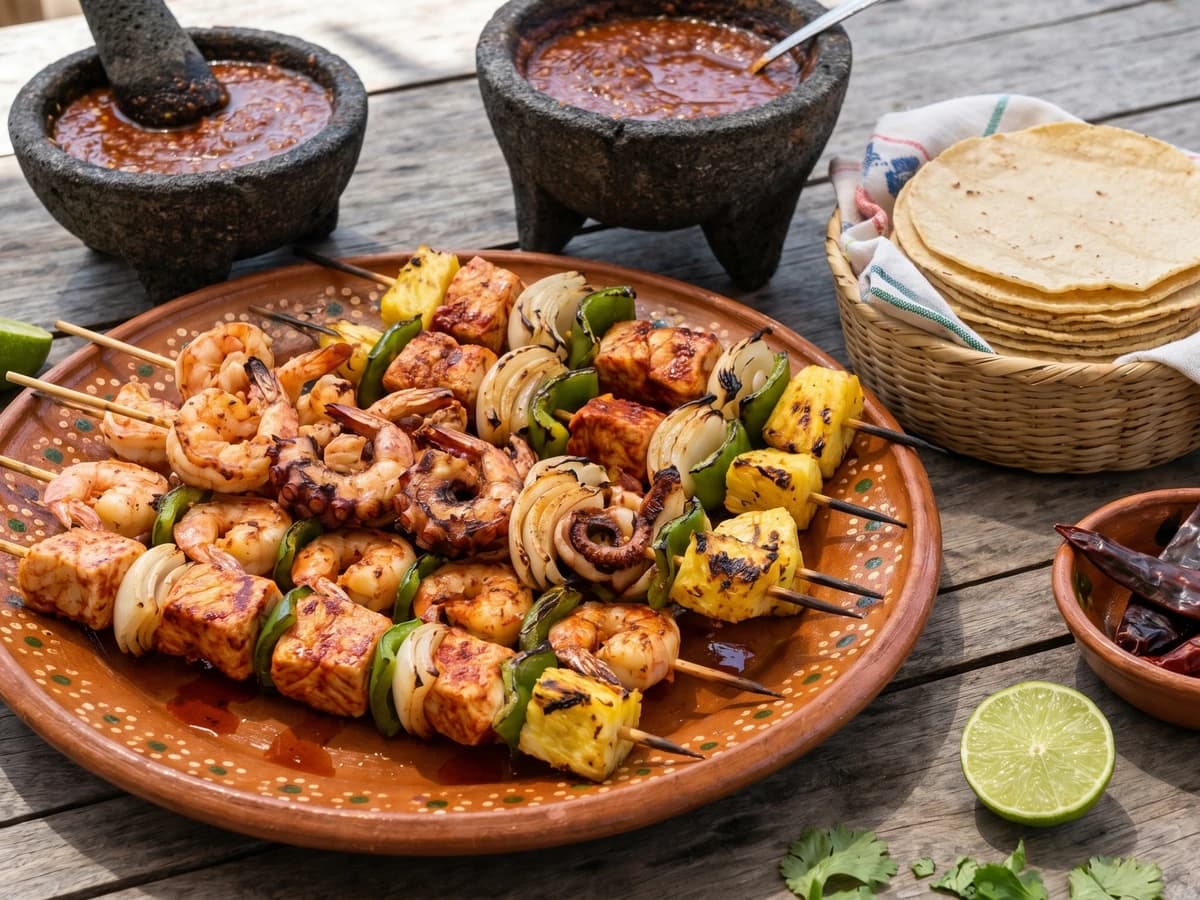
Jalisco's Bahía de Banderas skewer, fish and shrimp threaded on wooden varas, lacquered with guajillo, achiote, garlic, and butter, then grilled fast over charcoal.
Appetizers & Snacks
Mexican
BBQ
Outdoor Dining
Picnic
35 min
Active Time
10 min cook•45 min total
Yield8 skewers
Jalisco, specifically Puerto Vallarta and the Bahía de Banderas, is where pescado embarazado lives. Not in a hotel dining room. On the beach, under a palapa, with wooden varas leaning over charcoal and the smell of guajillo, garlic, and butter moving through the salt air.
The name is a joke, but the cooking is serious: pescado en vara asado, fish on a stick and roasted, becomes pescado embarazado in the mouth. Vallarta people know the joke. Tourists think it means pregnant fish. Let them laugh, then feed them properly.
The adobo does the work. Chile guajillo for clean red fruit, chile de árbol for a little bite, achiote for earth and color, garlic because the coast demands it, and butter brushed again and again until the fish shines and the shrimp curl tight. I learned this from señoras along Playa Los Muertos who did not measure because their hands already knew. I measured so you can learn, then stop measuring.
Use firm Pacific fish, dorado, pargo, robalo, or good local snapper. Soft fish falls apart and embarrasses you before the coals do. Soak the varas. Keep the fire medium-hot. Baste, turn, baste again. This is beach food, yes, but la cocina no es decoración, es trabajo. Cada estado, su propia cocina.
Pescado embarazado is a 20th-century beach-vendor specialty tied to Puerto Vallarta's rise as a coastal food destination after the city opened to wider tourism in the 1960s. Its name comes from the spoken pun pescado en vara asado, fish roasted on a stick, which compresses into embarazado in Mexican Spanish. The guajillo-achiote butter reflects Pacific coastal botana cooking, where local seafood, citrus, chile pastes, and grill smoke became the practical language of palapa kitchens from Jalisco into Nayarit.
The technique, the tradition, and the story behind every dish.
firm white fish such as dorado, pargo, robalo, or snapper
Quantity
1 pound
cut into 1 1/2-inch chunks
large shrimp
Quantity
1 pound
peeled and deveined, tails left on
long wooden skewers or thin wooden varas
Quantity
8
soaked in water for 30 minutes
dried chile guajillo
Quantity
6
stemmed and seeded
dried chile de árbol
Quantity
2
stemmed
garlic cloves
Quantity
3
peeled
achiote paste
Quantity
2 tablespoons
unsalted butter
Quantity
1/2 cup
melted
fresh lime juice
Quantity
1/4 cup
fresh orange juice
Quantity
2 tablespoons
dried Mexican oregano
Quantity
1 teaspoon
kosher salt
Quantity
1 teaspoon, plus more to taste
freshly ground black pepper
Quantity
1/2 teaspoon
Salsa Huichol or another Jalisco-Nayarit style bottled chile sauce (optional)
Quantity
1 tablespoon
lime halves (optional)
Quantity
for serving
salsa de chile de árbol (optional)
Quantity
for serving
warm corn tortillas or tostadas (optional)
Quantity
for serving
Ingredient
Quantity
firm white fish such as dorado, pargo, robalo, or snappercut into 1 1/2-inch chunks
1 pound
large shrimppeeled and deveined, tails left on
1 pound
long wooden skewers or thin wooden varassoaked in water for 30 minutes
8
dried chile guajillostemmed and seeded
6
dried chile de árbolstemmed
2
garlic clovespeeled
3
achiote paste
2 tablespoons
unsalted buttermelted
1/2 cup
fresh lime juice
1/4 cup
fresh orange juice
2 tablespoons
dried Mexican oregano
1 teaspoon
kosher salt
1 teaspoon, plus more to taste
freshly ground black pepper
1/2 teaspoon
Salsa Huichol or another Jalisco-Nayarit style bottled chile sauce (optional)
1 tablespoon
lime halves (optional)
for serving
salsa de chile de árbol (optional)
for serving
warm corn tortillas or tostadas (optional)
for serving
Equipment Needed
•Dry comal or heavy skillet for toasting chiles
•Blender
•8 long wooden skewers or thin wooden varas
•Charcoal grill or cast iron grill pan
•Pastry brush for basting
Instructions
1
Soak the varas
Put the wooden skewers or thin varas in water for 30 minutes. The beach vendors in Vallarta use long sticks because they can lean them over the fire and turn them quickly. At home, skewers work. Dry wood burns before the fish cooks, and then you are fighting your tools instead of cooking.
2
Toast the chiles
Heat a dry comal or heavy skillet over medium. Toast the chile guajillo for about 20 to 30 seconds per side, just until the skin darkens slightly and smells fruity. Toast the chile de árbol for only a few seconds. It is thin and burns fast. Burned chile makes a bitter adobo, and no amount of butter will save it.
If a chile turns black in spots, throw it out and toast another. No me vengas con atajos. The adobo starts here.
3
Soften and blend
Cover the toasted chiles with hot water and let them sit for 15 minutes. Drain them. Put the softened chiles in a blender with the garlic, achiote paste, lime juice, orange juice, Mexican oregano, salt, black pepper, and Salsa Huichol if using. Blend until smooth and deep red. If the blender struggles, add one tablespoon of water, not half a cup. You want a paste, not soup.
4
Finish the adobo
Pour the chile paste into a small bowl and whisk in the melted butter. Taste it. It should be salty, garlicky, a little sour, and red from chile, not from food coloring. Achiote gives color and earth. Guajillo gives body. Butter carries both onto the fish. Así se hace y punto.
5
Thread the skewers
Pat the fish and shrimp very dry. Thread the fish chunks and shrimp onto the soaked skewers, alternating them so the shrimp protects some of the fish edges from drying out. Leave a little space between pieces so the heat can move through. Brush all sides generously with the guajillo-achiote butter.
6
Grill over coals
Prepare a medium-hot charcoal grill. Oil the grate lightly. Lay the skewers over the fire and cook for 2 to 3 minutes on the first side, until the shrimp starts to curl and the fish releases from the grate. Turn carefully, brush again with adobo, and cook 2 to 3 minutes more. The fish should flake at the edge but stay juicy in the center.
7
Baste and finish
Brush once more during the last minute so the surface turns glossy and red, with small charred spots where the butter met the coals. Do not walk away. Fish goes from perfect to dry while you are looking for a plate. Pull the skewers off as soon as the shrimp are opaque and the fish flakes cleanly.
8
Serve beach style
Serve the skewers immediately with lime halves, salsa de chile de árbol, warm corn tortillas or tostadas, and nothing that belongs on a Tex-Mex plate. Squeeze lime over the fish at the table. Eat with your hands if you have sense. Recetas probadas y garantizadas.
Chef Tips
•Start with the fish, not the stove. Ask for dorado, pargo, robalo, or another firm white Pacific fish. If the fish smells tired, buy shrimp instead. Si no conoces el mercado, no conoces la cocina.
•The butter is not decoration. It carries the chile and achiote onto the seafood and helps the edges brown over charcoal. Olive oil gives you a different dish. Good, maybe, but not the Vallarta skewer.
•Salsa Huichol is a real coastal table sauce from Nayarit and common around Bahía de Banderas. Use it if you have it. If not, leave it out and let the guajillo and achiote stand on their own. A substitution is a compromise, not an upgrade.
•If you cook indoors, use a ridged cast iron grill pan and open the windows. You will get a decent skewer, but you will miss the charcoal. That smoke is part of why this botana belongs to the beach.
•Do not marinate the fish for hours in lime. The acid will tighten the flesh before it reaches the grill. Brush the adobo on right before cooking and again while grilling.
Advance Preparation
•The guajillo-achiote adobo can be blended up to two days ahead and refrigerated without the butter. Warm it gently and whisk in melted butter before grilling.
•The skewers can be threaded up to four hours ahead, covered, and refrigerated. Do not brush with lime-heavy adobo until just before they hit the fire.
•Soak wooden skewers in the morning and leave them submerged until cooking time. A waterlogged skewer gives you one less problem over the coals.
Frequently Asked Questions
Nutrition Information
1 serving (about 160g)
Calories
310 calories
Total Fat
14 g
Saturated Fat
8 g
Trans Fat
0 g
Unsaturated Fat
5 g
Cholesterol
145 mg
Sodium
670 mg
Total Carbohydrates
20 g
Dietary Fiber
4 g
Sugars
3 g
Protein
26 g
Where cooking meets culture.
Culinary guides, cultural storytelling, and the editorial depth that makes cooking meaningful.