
Chef Juliana
Ambrosia Baiana
You think curdled milk means you ruined dessert. Good. Tonight you'll do it on purpose, with lemon, yolks, cravo, and sugar, until the pot turns into golden gruminhos.
A cooking platform built around craft, culture, and the stories behind what we eat.
Created by
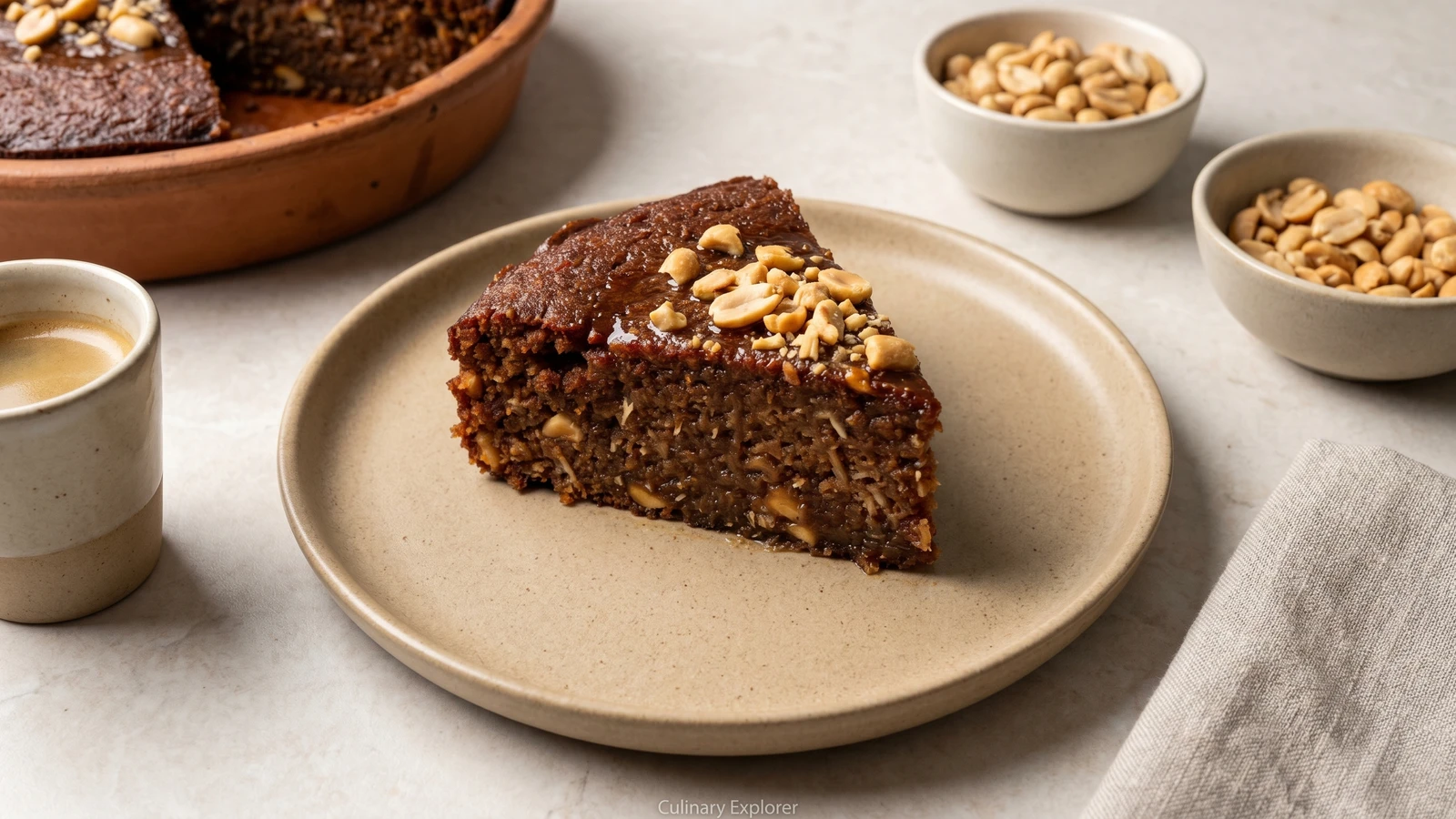
You don't need a clay oven or family secrets. Cassava dough, cane syrup, peanuts, coconut, and spices make a dark festa cake a careful home cook can actually repeat.
Your head may already be saying isso não é pra mim, because this cake is dark, spiced, Pernambucano, and probably came to you wrapped in someone else's family memory. Good. That's exactly the kind of myth a gente can take apart. Cozinhar não é dom, é um aprendizado, and a cake is just a set of steps that tell the truth.
The everyday Brazilian plate, the pê-efe, does the daily work: rice, beans, something from the pan, something green. But the same home kitchen that resolves dinner also makes festa. Here the comida de verdade is cassava dough, peanuts, coconut, cane syrup, clove, and cinnamon, all ordinary ingredients once you strip the drama away. Not the Bahian peanut brittle. Not a packet pretending to be a Pernambuco memory. A cake.
The method matters because cassava is honest and a little bossy. You loosen the massa de mandioca so it doesn't bake in lumps. You cool the spiced syrup before it meets the eggs so the eggs don't scramble into little yellow flecks. You bake until the center is set but still moist, because cassava cake goes from tender to stubborn if you dry it out.
I teach this as a home version, with respect to the Pernambucano cooks who carry the festa version in their hands. Use the clay form if you have one. Use a metal pan if that's what you have. The point is receitas que funcionam: a dark, fragrant slice you can serve tonight and make again without crossing yourself at the oven door.
Across Brazil, pé de moleque usually means a hard peanut candy served around festas juninas, while in Pernambuco the name also belongs to a dark cassava cake made with massa de mandioca or massa puba, peanuts, coconut milk, cane syrup, and spices. The Pernambuco cake is linked to June celebrations and to the cassava kitchens of the Northeast, where clay forms and banana leaves were practical baking tools before they became memory markers. The broader sweet table in Bahia and Pernambuco carries Portuguese convent sugar-and-yolk habits, including the old use of egg whites to starch religious robes, but African and Afro-Brazilian cooks in the casas-grandes and in home kitchens, along with New World coconut and cassava, changed those sweets into Brazilian ones.
Quantity
1 tablespoon
for greasing
Quantity
1 large piece
softened and trimmed to fit the pan
Quantity
4 cups (about 650 g)
thawed if frozen; squeezed only if dripping wet
Quantity
1 1/2 cups
skins rubbed off; divided
Quantity
1/2 cup
or frozen unsweetened coconut, thawed
Quantity
1 cup
at room temperature
Quantity
3 large
at room temperature
Quantity
6 tablespoons
melted and cooled
Quantity
1 cup
Quantity
1/2 cup
finely grated, or use packed dark brown sugar
Quantity
1/2 cup
cooled
Quantity
1 teaspoon
Quantity
1/2 teaspoon
lightly crushed
Quantity
1/4 teaspoon
Quantity
1/2 teaspoon
| Ingredient | Quantity |
|---|---|
| softened butterfor greasing | 1 tablespoon |
| banana leaf (optional)softened and trimmed to fit the pan | 1 large piece |
| fresh cassava dough (massa de mandioca or massa puba)thawed if frozen; squeezed only if dripping wet | 4 cups (about 650 g) |
| roasted unsalted peanutsskins rubbed off; divided | 1 1/2 cups |
| freshly grated coconutor frozen unsweetened coconut, thawed | 1/2 cup |
| unsweetened coconut milkat room temperature | 1 cup |
| eggsat room temperature | 3 large |
| unsalted buttermelted and cooled | 6 tablespoons |
| mel de engenho or dark cane syrup | 1 cup |
| rapadurafinely grated, or use packed dark brown sugar | 1/2 cup |
| strong brewed coffeecooled | 1/2 cup |
| ground cinnamon | 1 teaspoon |
| fennel seeds (erva-doce)lightly crushed | 1/2 teaspoon |
| ground cloves | 1/4 teaspoon |
| fine salt | 1/2 teaspoon |
For a metal 9-inch round pan or 8-inch square pan, heat the oven to 180°C (350°F). Grease the pan with butter and line the bottom with parchment or a softened banana leaf, smooth side up. The lining is not decoration; this is a sticky cassava cake, and the leaf, when you have it, gives a quiet green aroma and lets the slice lift cleanly. If you're using an oven-safe clay form, don't preheat the oven; fill the form later, put it in cold, then set the heat to 180°C and expect 10 to 15 extra minutes.
Set aside 2 tablespoons of peanuts for the top. Pulse the rest in a food processor, or crush them in a mortar, until you have a coarse meal with a few small nubs left. Stop before they turn oily. You want peanut flavor and texture in the cake, not peanut paste, and warm peanuts cross that line fast.
Put the mel de engenho, rapadura, coffee, cinnamon, fennel, cloves, and salt in a small saucepan over low heat. Stir until the rapadura dissolves and the kitchen smells like cane and spice, about 3 to 5 minutes. Don't boil it hard. You're dissolving and perfuming, not making candy. Take it off the heat and let it cool until the pan feels warm, not hot, about 15 to 20 minutes.
Put the massa de mandioca in a large sturdy bowl and crumble it with your fingers until it looks like damp, loose crumbs. Pull out any tough fibers you find. If water puddles in the bowl, wrap the massa in a clean towel and squeeze just until damp, not dry. Cassava lumps bake into heavy pockets, and too much water leaves the middle gummy.
Whisk the eggs until smooth, then whisk in the room-temperature coconut milk and the melted, cooled butter. Pour in the cooled spiced syrup slowly, whisking as you go. The leite de coco needs to be at room temperature so the butter doesn't set into little beads, and the syrup needs to be cool so the eggs stay silky instead of scrambling. A scrambled egg cake is a betrayal nobody needs.
Pour the liquids over the cassava and stir with a wooden spoon until every pale crumb turns dark and there are no dry pockets. Fold in the ground peanuts and grated coconut. The batter should be thick and heavy, like spoonable porridge, and smell like cane, peanut, and spice. Let it rest for 10 minutes so the cassava drinks the liquid; skipping the rest leaves dry specks in a cake that should be dense and even.
Scrape the batter into the prepared pan, smooth the top, and scatter over the reserved peanuts. For metal, bake in the preheated oven for 70 to 85 minutes. For clay, put the filled form in a cold oven, set it to 180°C (350°F), and start checking around 85 minutes. The cake is done when the top is deep mahogany, the edges pull from the pan, the center no longer sloshes, and a skewer comes out with moist crumbs, not wet paste. Cassava needs time to cook through; pull it early and the middle is gummy, bake it until dry and it turns stubborn.
Cool the cake in the pan for at least 45 minutes before slicing. I know. Annoying. But hot cassava cake tears and looks raw even when it's cooked; resting lets the starch set. Slice with a small knife wiped between cuts and serve at room temperature, or wrap it and eat it the next day when the spice tastes deeper.
1 serving (about 155g)
Culinary guides, cultural storytelling, and the editorial depth that makes cooking meaningful.
Discover Culinary ExplorerChef Juliana
You think curdled milk means you ruined dessert. Good. Tonight you'll do it on purpose, with lemon, yolks, cravo, and sugar, until the pot turns into golden gruminhos.

Chef Juliana
You are not ruining the milk. You're curdling it on purpose, slowly, until sugar, eggs, cinnamon, and patience turn cheap ingredients into dessert.

Chef Juliana
You think curdled milk means failure. Not here. Milk, yolks, sugar, and lemon cook into golden curds in amber whey, a Minas sweet where the ponto teaches the whole recipe.

Chef Juliana
You already trust rice for dinner. Trust it for dessert: cook it gently with milk, coconut, and canela until each grain turns soft, creamy, and impossible to blame on lack of talent.