
Chef Fai
Fried Banana Fritters (Kluay Tod)
Rice flour, not wheat. Nam wa banana, not Cavendish. Coconut and sesame in the batter, not on top. Every ingredient in a street vendor's kluay tod is a decision, and every decision follows a rule.
A cooking platform built around craft, culture, and the stories behind what we eat.

Created by
Chinese dough, Thai table. Patongo is proof the system absorbs everything: pair it with sangkhaya sweetened with palm sugar, tear it into jok laced with fish sauce, and a Chinese import becomes Bangkok breakfast.
Not every Thai dish announces the four pillars in its ingredient list. Patongo is flour, water, salt, sugar, and leavening. Nothing Thai about it on paper. But Thai food is a system, not a menu. The system doesn't stop at the edge of the plate. It includes what you dip into, what you tear it apart over, what time of morning you eat it, and what's sitting next to it on that plastic table.
Patongo came from China. Teochew and Hokkien immigrants brought you tiao to Bangkok generations ago, frying dough in the same woks they'd used back home. But the moment a Thai vendor set a bowl of sangkhaya next to it (pandan-coconut custard, sweetened with palm sugar, the aroma of bai toei filling the stall), it stopped being Chinese. The moment someone tore a patongo stick apart and dropped it into their jok, seasoned with fish sauce and white pepper and a scatter of cilantro, it was Thai. That's how the system works. It absorbs. It adapts. It makes things its own.
The dough itself is an exercise in patience. Mix, knead, rest. The rest is everything. Four hours minimum, overnight if you can manage it. The gluten relaxes. The leavening does its work. When you come back to that dough, it's pillowy and alive. You roll it flat, cut strips, press two together (that's the signature shape, the pull-apart center), stretch them out, and drop them into oil at 170°C. The outside crisps golden. The inside stays airy and chewy. A patongo vendor in Yaowarat has been doing this same stretch at 4 AM for thirty years. Single-dish mastery. That's street food.
Make the sangkhaya. That's where you'll taste the Thai identity of this dish. Coconut cream, eggs, palm sugar (nam tan pip, not granulated, that's the law), and pandan leaves knotted and steeped until the custard smells like a Bangkok morning. Steam it gently. Serve it warm. Tear the patongo, dip, eat. Ajarn always said the principles show up everywhere if you know where to look. In patongo, they're in the sangkhaya.
Patongo (ปาท่องโก๋) descends from the Chinese you tiao (油條), brought to Thailand by Teochew and Hokkien immigrants who settled in Bangkok's Chinatown (Yaowarat) and along the Gulf coast from the 18th century onward. The Thai name likely derives from a southern Chinese dialect pronunciation of a fried dough variant, though the exact etymology is debated. While the dough itself remains close to its Chinese ancestor, the Thai morning market system transformed it: paired with sangkhaya (pandan-coconut custard) sweetened with palm sugar, or torn into pieces and dropped into jok (rice congee) seasoned with fish sauce and white pepper, patongo became inseparable from Thai breakfast culture by the mid-20th century.
Patongo is Thailand's fried dough stick: a light, crisp leavened dough fried golden and sold at morning markets, adapted from the Chinese youtiao. Thais eat patongo dipped in sangkhaya (pandan custard) or hot soy milk, and often tear it into rice porridge (jok) as part of breakfast.
Quantity
300g
Quantity
2 teaspoons
Quantity
1/2 teaspoon
Quantity
1/2 teaspoon
Quantity
1 tablespoon
Quantity
1 tablespoon, plus more for coating
Quantity
160ml (about 40°C)
Quantity
about 1 liter
Quantity
200ml
Quantity
3 large
Quantity
100g
shaved or finely chopped
Quantity
3
knotted
| Ingredient | Quantity |
|---|---|
| all-purpose flour | 300g |
| baking powder | 2 teaspoons |
| baking soda | 1/2 teaspoon |
| salt | 1/2 teaspoon |
| granulated sugar | 1 tablespoon |
| vegetable oil | 1 tablespoon, plus more for coating |
| warm water | 160ml (about 40°C) |
| vegetable oil for deep-frying | about 1 liter |
| coconut cream (hua kati) | 200ml |
| eggs | 3 large |
| palm sugar (nam tan pip)shaved or finely chopped | 100g |
| pandan leaves (bai toei)knotted | 3 |
Combine the flour, baking powder, baking soda, salt, and sugar in a large bowl. Make a well in the center. Pour in the warm water and vegetable oil. Mix with your hands until a shaggy mass forms, then turn it out onto a clean surface and knead for 8-10 minutes. The dough should become smooth, soft, and slightly elastic. It'll feel oily and a little sticky. That's correct. Don't add more flour. You're not making bread. You're building a dough that needs to stretch, not resist. After 10 minutes of kneading, it should spring back gently when you poke it.
Coat the dough ball generously with vegetable oil. Place it back in the bowl, cover tightly with plastic wrap, and let it rest at room temperature for at least 4 hours. Overnight in the refrigerator is even better. This isn't optional. This is where patongo is made or ruined. The gluten relaxes completely so the dough stretches without snapping back. The leavening agents create tiny air pockets throughout. When you come back to it, the dough should feel pillowy, slack, and almost alive under your hands. If it's still tight and springy, it hasn't rested long enough. Give it more time.
While the dough rests (or the morning you plan to fry), make the sangkhaya. Whisk the eggs and palm sugar together in a bowl until the sugar dissolves. The palm sugar takes longer to dissolve than white sugar because of its crystalline structure. Be patient. Add the coconut cream and whisk until smooth. Strain the mixture through a fine mesh strainer into a heatproof bowl. You want silk, not scrambled bits. Tuck the knotted pandan leaves into the custard. Set the bowl in a steamer over medium heat. Steam gently for 20-25 minutes. The edges should be set and the center should have a soft wobble. Not liquid, not stiff. A gentle, custard wobble. Remove the pandan leaves. The sangkhaya will be warm caramel-colored from the palm sugar and smell like every Bangkok morning market you've ever walked through.
Turn the rested dough onto a lightly oiled surface. Not floured. Oiled. Flour will create dry spots and uneven frying. Press the dough flat with your hands into a rectangle roughly 10cm wide and 1cm thick. Cut crosswise into strips about 2cm wide. Now the critical step: take two strips and stack them on top of each other. Press down firmly along the center with a chopstick or the back of a knife handle. The two strips should bond at that center line. This creates the signature patongo shape. When they hit the oil, the bonded middle holds while the free edges puff apart. Two textures in one stick: dense chewy center, crispy airy ends.
Heat the oil in a wok or deep heavy pot to 170°C. Not higher. This is important. Patongo needs time to puff and cook through. Too hot and the outside browns while the inside stays raw and doughy. Pick up a shaped pair of strips, hold both ends, and gently stretch them to about 20cm long. The dough should stretch willingly. If it resists, it didn't rest enough. Lower the stretched dough into the oil. Fry 2-3 sticks at a time, no more. Overcrowding drops the oil temperature. Turn them constantly with chopsticks, rolling them in the oil so they puff evenly on all sides. 3-4 minutes until deep golden brown all over. Lift them out and drain on a wire rack. They should feel surprisingly light for their size. The surface should be crispy with fine bubbles. Tear one open: the inside should be airy, layered, and slightly chewy. If it's dense, your oil was too hot. If it's greasy, your oil was too cool.
Bring the patongo to the table the moment they're drained. This is market-opening food. It doesn't wait. Serve with the warm sangkhaya in a bowl for dipping. Tear a stick apart at the center seam, dip the airy end into the custard, eat. That's breakfast. If you've got hot soy milk (nam tao hu), pour a cup and dunk the patongo into it, the way every kid in Yaowarat does on the way to school. If you've made jok, tear the patongo into pieces and drop them right into the congee. They soak up the fish sauce-laced broth and go soft and rich. One dough, three ways to eat it, all of them Thai. Fai Thai, baby.
1 serving (about 220g)
Culinary guides, cultural storytelling, and the editorial depth that makes cooking meaningful.
Discover Culinary ExplorerChef Fai
Rice flour, not wheat. Nam wa banana, not Cavendish. Coconut and sesame in the batter, not on top. Every ingredient in a street vendor's kluay tod is a decision, and every decision follows a rule.

Chef Juliette
A pale short-paste shell holds silken, lightly sweet carrot purée beneath neat glazed half-discs, their butter syrup catching the light: a classical tart poised between vegetable course and sweet.
Chef Juliette
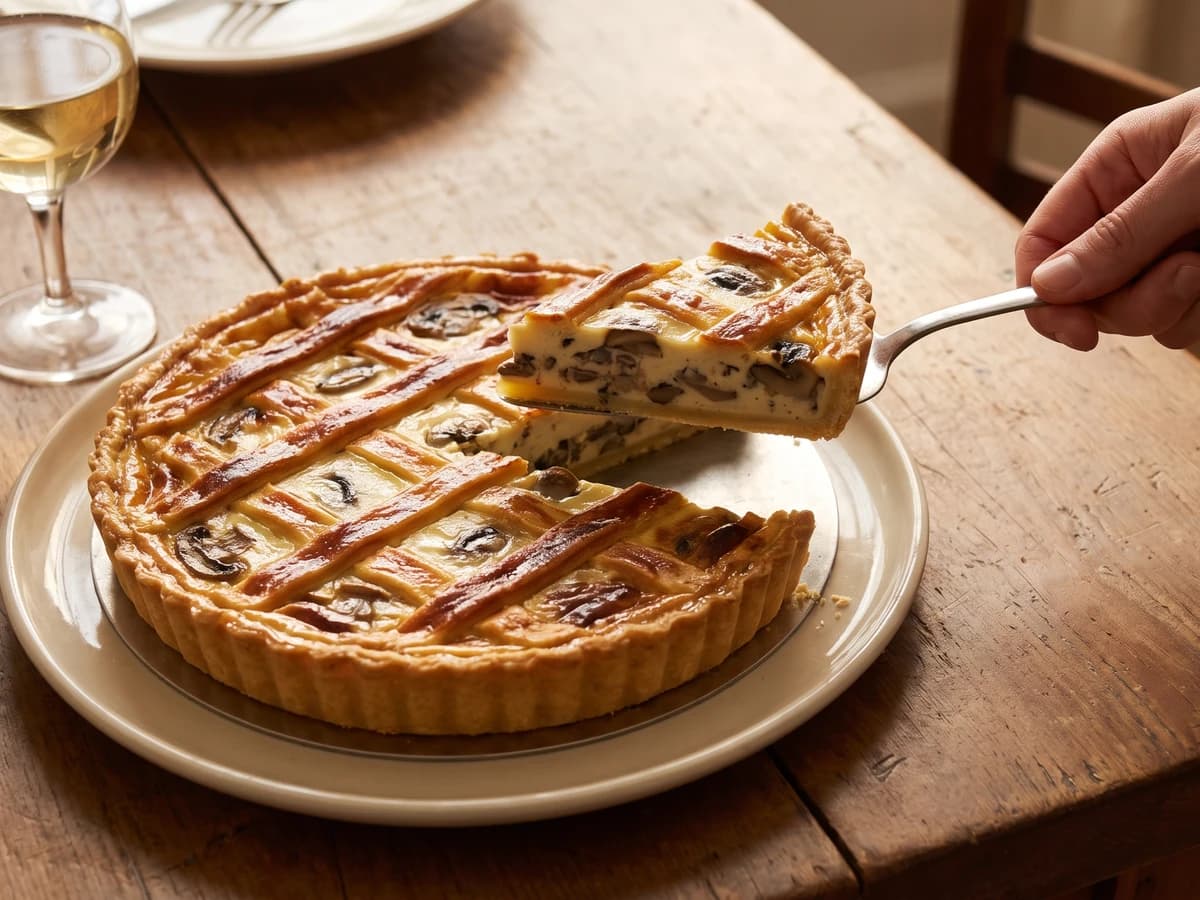
A hot mushroom flan under a butter-gold lattice, with cream reduced close around barely opened caps and a crisp short-paste base protected by one discipline: cool the filling completely.

Chef Juliette
Four little mushroom flans, latticed and gilded, baked hard and fast until butter-gold: a classical garnish scaled to the meat it accompanies and served before its crispness has time to fade.