
Chef Lupita
Almendrados Conventuales Poblanos
Puebla's convent almond cookies, made from blanched almonds, sugar syrup, egg yolks, canela, and patient hands, the kind of sweet that belongs beside coffee in talavera, not in a plastic bakery box.
A cooking platform built around craft, culture, and the stories behind what we eat.
Created by
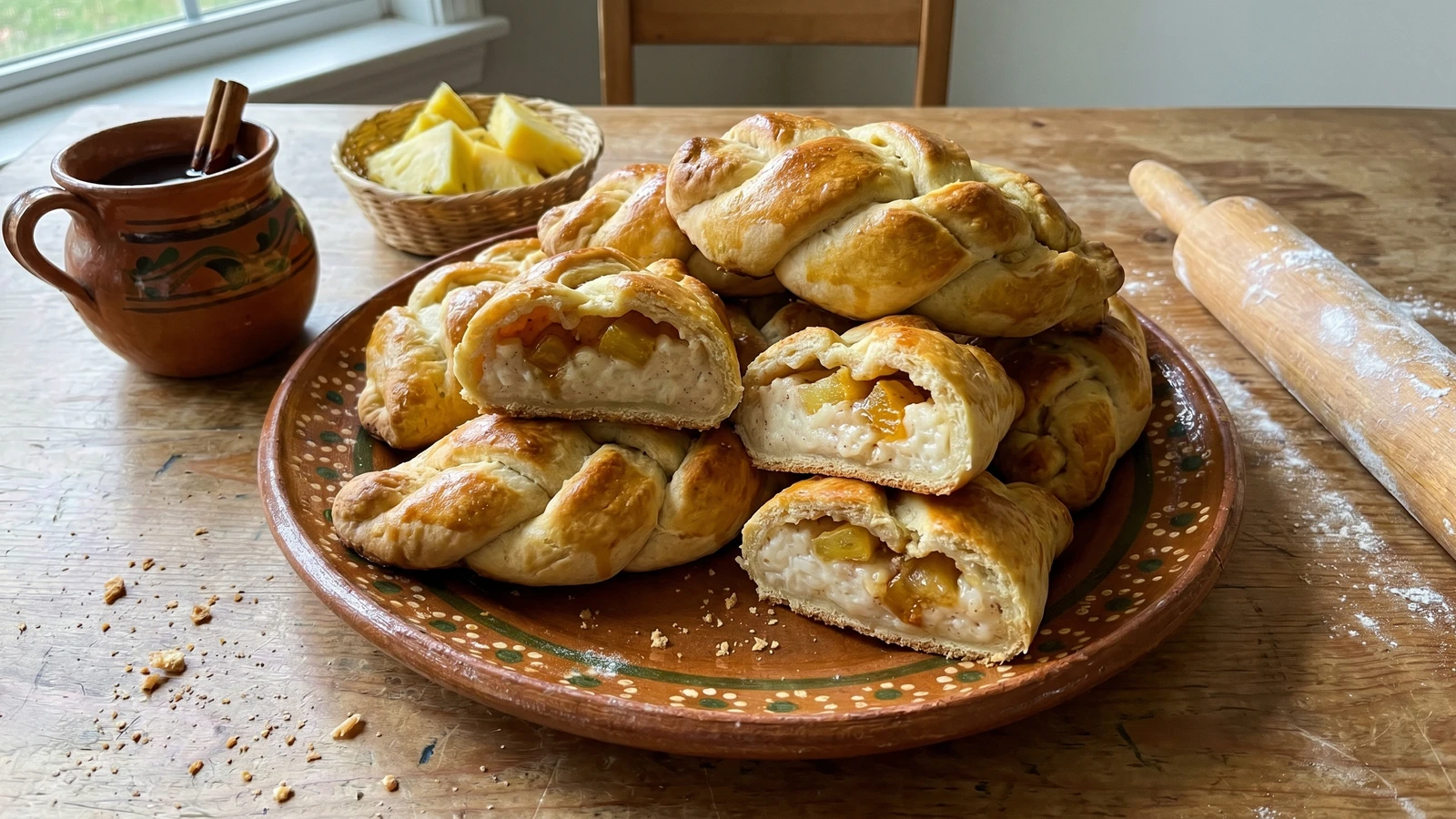
Hidalgo's sweet side of Real del Monte pastes, hand pies with a firm lard crust, braided edge, and fillings of cinnamon rice pudding or thick pineapple.
Hidalgo, especially Real del Monte and Pachuca, owns the paste in Mexico. This is mining food from the cold sierra, wheat dough folded over a filling that could travel in a lunch pail and survive a long workday underground. The sweet versions, arroz con leche and pina, came later, after the paste had already become hidalguense, no longer only Cornish and not a generic empanada either.
The dough is the first lesson. It needs wheat flour and manteca de cerdo for a firm, short crust that holds its braided edge. Butter alone makes it too delicate. Oil makes it wrong. La manteca es el sabor, even in pastry. The edge, the repulgue, is not decoration. It seals the filling and tells you the cook knows her hands.
For arroz con leche, use Mexican canela and cook the rice until it is thick enough to mound, not run. For pina, cook the fruit down with piloncillo until it is glossy and sticky, because watery pineapple will burst the paste open in the oven. I learned that from a woman in Real del Monte who sold them before noon and had none left by two. She looked at my first batch and said, 'muy bonito, pero esta llorando.' Pretty, but leaking. She was right. La cocina no es decoración, es trabajo.
Cada estado, su propia cocina. Hidalgo took a miner's hand pie, gave it Mexican fillings, and made it part of its own table. Saber cocinar es saber vivir.
Pastes arrived in Hidalgo in the 1820s and 1830s with Cornish miners recruited to work the silver mines of Real del Monte and Pachuca after Mexico's independence. The original Cornish pasty was a durable meal for miners, but in Hidalgo it adapted to local households, bakeries, and market stalls with fillings such as papa con carne, frijol, mole, arroz con leche, and pina. Real del Monte now holds an annual Festival Internacional del Paste, a sign of how completely the dish became part of Hidalgo's regional identity.
Quantity
4 cups
plus more for rolling
Quantity
1 teaspoon
Quantity
1 tablespoon
Quantity
3/4 cup
cut into small pieces
Quantity
1/2 cup
cut into small pieces
Quantity
3/4 cup, plus 2 tablespoons if needed
Quantity
1
beaten with 1 tablespoon milk for brushing
Quantity
1 cup
rinsed
Quantity
2 cups
Quantity
1 cup
Quantity
1/2 cup
Quantity
1
Quantity
1 strip
Quantity
1/4 teaspoon
Quantity
1 teaspoon
Quantity
2 tablespoons
only if the arroz con leche needs it
Quantity
3 cups
finely diced
Quantity
3/4 cup
grated
Quantity
1
Quantity
1 tablespoon
Quantity
1 tablespoon
mixed with 1 tablespoon cold water
| Ingredient | Quantity |
|---|---|
| all-purpose wheat flourplus more for rolling | 4 cups |
| fine sea salt | 1 teaspoon |
| granulated sugar | 1 tablespoon |
| cold manteca de cerdo (pork lard)cut into small pieces | 3/4 cup |
| cold unsalted buttercut into small pieces | 1/2 cup |
| ice water | 3/4 cup, plus 2 tablespoons if needed |
| eggbeaten with 1 tablespoon milk for brushing | 1 |
| short-grain white ricerinsed | 1 cup |
| whole milk | 2 cups |
| evaporated milk | 1 cup |
| sweetened condensed milk | 1/2 cup |
| Mexican canela stick | 1 |
| lime peel | 1 strip |
| fine sea salt | 1/4 teaspoon |
| vanilla extract | 1 teaspoon |
| granulated sugar (optional)only if the arroz con leche needs it | 2 tablespoons |
| fresh pineapplefinely diced | 3 cups |
| piloncillo or dark brown sugargrated | 3/4 cup |
| Mexican canela stick | 1 |
| fresh lime juice | 1 tablespoon |
| cornstarchmixed with 1 tablespoon cold water | 1 tablespoon |
Whisk the flour, salt, and sugar in a large bowl. Rub in the cold manteca de cerdo and butter with your fingertips until the mixture looks like coarse sand with some pea-size pieces left. Add the ice water little by little, mixing only until the dough holds together when pressed. Do not knead it like bread. A paste needs a sturdy short crust, not a tough one.
Divide the dough into 12 equal balls, flatten each into a disk, wrap, and refrigerate for at least 45 minutes. Cold fat is what gives the crust its bite. If the dough warms up, the lard smears into the flour and the paste bakes heavy.
Combine the rinsed rice, whole milk, evaporated milk, condensed milk, canela stick, lime peel, and salt in a heavy saucepan. Cook over medium-low heat, stirring often, for 30 to 35 minutes, until the rice is tender and the mixture is thick enough to mound on a spoon. Remove the canela and lime peel, then stir in the vanilla. Taste it. Add the extra sugar only if the milk needs it. Cool completely.
Put the diced pineapple, piloncillo, canela stick, and lime juice in a wide skillet. Cook over medium heat for 20 to 25 minutes, stirring often, until the pineapple turns glossy and the syrup thickens. Stir in the cornstarch slurry and cook 2 minutes more, until the filling looks jammy, not loose. Remove the canela and cool completely. Watery pina breaks the paste. No me vengas con atajos.
Heat the oven to 375F. Roll each chilled dough disk on a lightly floured table into a 6-inch round, about 1/8 inch thick. Keep the other disks cold while you work. If the edges crack, let the dough sit for two minutes and roll again. If it gets sticky, it is too warm.
Place 2 heaping tablespoons of arroz con leche on half of 6 rounds and 2 heaping tablespoons of pina on half of the other 6 rounds, leaving a clean border. Fold the dough over into a half-moon. Press the edges firmly, then braid the edge by folding small sections over themselves from one end to the other. That repulgue is Hidalgo's signature on the table. It seals the filling and gives the paste its shape.
Set the pastes on parchment-lined baking sheets. Brush lightly with the beaten egg and milk. Cut one tiny slit near the top of each paste so pressure can escape. Do not slash them wide open. You are making pastes, not showing off the filling.
Bake for 28 to 32 minutes, rotating the pans halfway through, until the crust is firm, golden at the edges, and lightly browned over the braid. A little filling may bubble at the vent. That is fine. Filling leaking from the seam means it was too wet or the braid was careless. Now you know.
Let the pastes cool on the baking sheet for 10 minutes, then move them to a rack. The fillings are hotter than they look and need time to settle. Serve warm or at room temperature with cafe de olla. Recetas probadas y garantizadas.
1 serving (about 190g)
Culinary guides, cultural storytelling, and the editorial depth that makes cooking meaningful.
Discover Culinary ExplorerChef Lupita
Puebla's convent almond cookies, made from blanched almonds, sugar syrup, egg yolks, canela, and patient hands, the kind of sweet that belongs beside coffee in talavera, not in a plastic bakery box.

Chef Lupita
Ciudad de Mexico's panaderia banderillas are long sticks of hojaldre pressed with sugar, baked until amber, and finished with a hard glaze for coffee at the kitchen table.

Chef Lupita
Mérida's pale egg-yolk-and-vanilla kisses, tiny cookies built on eight yolks and a perfume of orange blossom, sandwiched with guava paste and dusted heavy with powdered sugar.

Chef Lupita
Hidalgo's bisquet de nata carries Pachuca's mining history into the breakfast table: a Cornish-style bread softened by Mexican nata, split warm and eaten with café de olla.