
Chef Elsa
Eiersalat (Austrian Egg Salad)
Cool, creamy Austrian egg salad with sour gherkins and tart apple in a mustard-yogurt dressing, the kind of honest Jause food that tastes like an Austrian Easter table and works beautifully all year round.
A cooking platform built around craft, culture, and the stories behind what we eat.
Created by
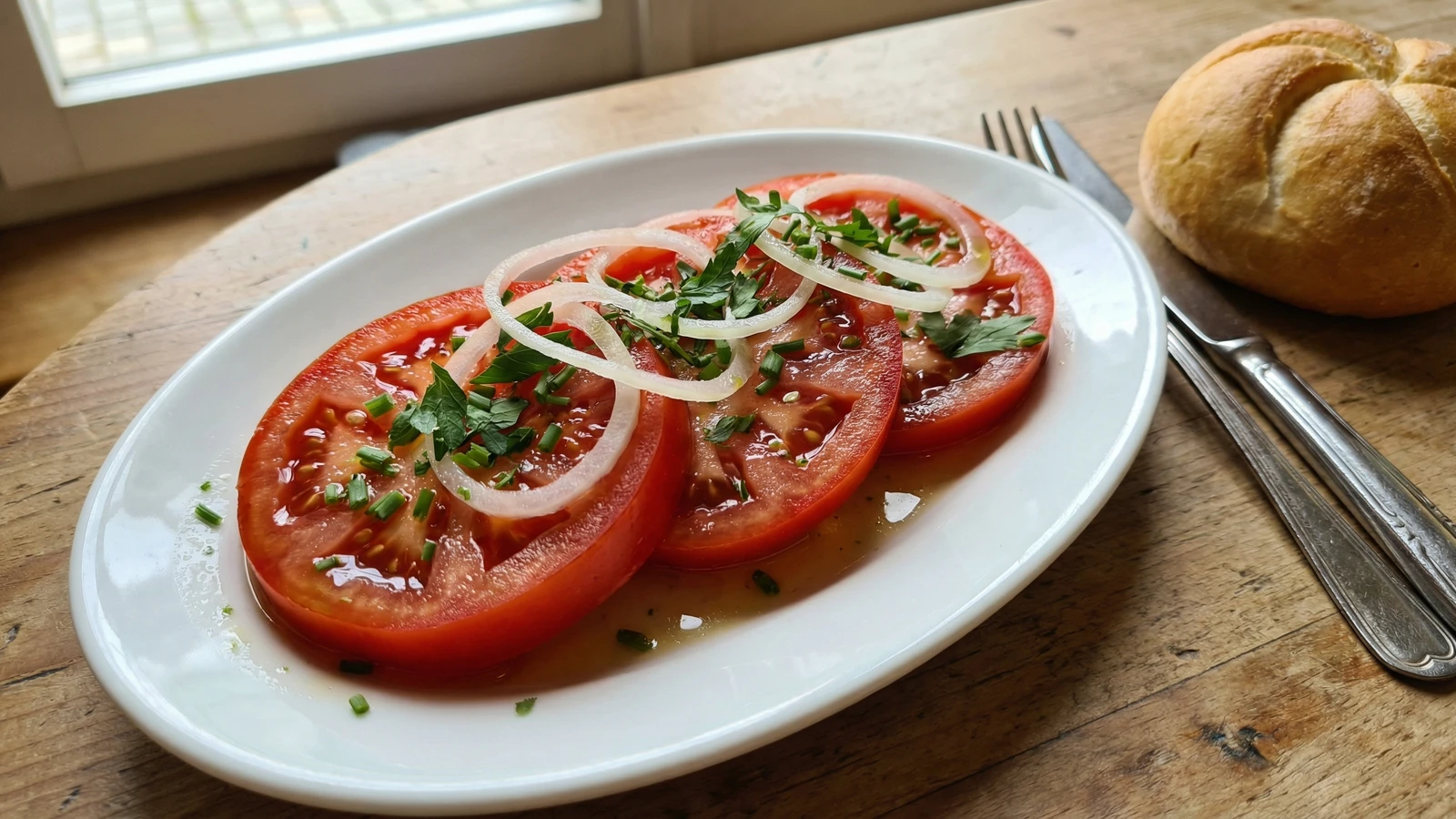
Thick-sliced summer Paradeiser with sharp onion rings and a vinegar-forward Marinade, the side salad that shows up on every Austrian Gasthaus table from July through September.
Austrians don't call them tomatoes. They call them Paradeiser, from the old word Paradiesapfel, the apple of paradise. And in July and August, when the markets in Salzburg are piled with them still warm from the field, that name makes perfect sense.
Gretel always said you can tell someone's kitchen by their salad. Not the complicated ones with fifteen ingredients and a dressing that takes longer than the main course. The simple ones. A plate of Paradeisersalat tells you whether the cook understands timing, seasoning, and when to leave things alone. The tomatoes must be ripe. Not supermarket-firm, not pale pink, not mealy. Ripe. The kind that smell like summer before you cut them and give slightly when you press your thumb against the skin. If you can't find those tomatoes, don't make this salad. Make something else and wait.
The Marinade is vinegar-forward, as all Austrian salad dressings should be. A good Hesperidenessig or Apfelessig, a neutral oil, salt, a pinch of sugar to balance the acid, and that's nearly all. You dress the tomatoes while they're still at room temperature so the Marinade can soak into the flesh instead of sliding off a cold surface. The onion rings go raw and thin, sharp enough to cut through the sweetness of a perfect tomato. A scattering of fresh chives, maybe some parsley. Nothing else. This is good Austrian home cooking at its most honest: three or four ingredients that depend entirely on quality and timing.
The word Paradeiser derives from Paradiesapfel, the Austrian term for tomato that dates to the fruit's arrival in Central Europe from the New World in the 16th century. While Germany adopted the Italian-derived 'Tomate,' Austria kept its own name, one of many culinary vocabulary differences that mark Austrian German as distinct. Paradeisersalat appears as a staple Beilagensalat in Viennese cookbooks from the 19th century onward, always dressed with a vinegar-forward Marinade rather than the oil-heavy dressings found further south.
Quantity
600g
mixed varieties if available
Quantity
1 medium
peeled
Quantity
3 tablespoons
Quantity
2 tablespoons
Quantity
1/2 teaspoon
Quantity
to taste
Quantity
to taste
Quantity
1 small bunch
finely cut
Quantity
a few leaves
torn
| Ingredient | Quantity |
|---|---|
| ripe tomatoes (Paradeiser)mixed varieties if available | 600g |
| white onionpeeled | 1 medium |
| Hesperidenessig or Apfelessig (apple cider vinegar) | 3 tablespoons |
| neutral sunflower oil or mild olive oil | 2 tablespoons |
| granulated sugar | 1/2 teaspoon |
| fine salt | to taste |
| freshly ground black pepper | to taste |
| fresh chivesfinely cut | 1 small bunch |
| fresh flat-leaf parsley (optional)torn | a few leaves |
Wash and dry the tomatoes. Cut them into thick slices, about half a centimeter. Not thin. You want slices with enough body to hold the Marinade without collapsing into mush on the plate. If you're using smaller tomatoes, halve or quarter them instead. Remove any hard core at the stem end, but leave the seeds and juice. That juice is flavor.
Slice the onion into thin rings, as thin as you can manage. Separate them with your fingers. The onion is raw in this salad and it's meant to be sharp, but thin rings mellow faster in the Marinade and distribute more evenly across the plate. If your onion is very strong, soak the rings in cold water for five minutes, then drain and pat dry. This takes the edge off without killing the flavor entirely.
In a small bowl, whisk together the vinegar, oil, sugar, a generous pinch of salt, and a few grinds of black pepper. Taste it. The Marinade should be noticeably vinegar-forward, sharper than you think a dressing should be. The tomato juice will dilute it on the plate, so it needs to start with backbone. The sugar is not there to make it sweet. It rounds off the acid just enough that the vinegar doesn't overwhelm the fruit.
Lay the tomato slices across a serving plate, overlapping slightly. Scatter the onion rings over the top. Spoon the Marinade evenly across everything. Don't toss it like a green salad. You want the slices to stay intact and the dressing to pool around and under them, soaking in slowly. Let it sit at room temperature for ten minutes. The tomatoes will release some of their own juice into the Marinade, and the onion will soften just slightly. This resting time is where the salad becomes itself.
Scatter the chives generously over the top. Tear a few parsley leaves across if you have them. Give it one final pinch of flaky salt. Serve at room temperature, never cold. A tomato straight from the fridge tastes like nothing. The flavor lives at room temperature, which is why every Austrian grandmother leaves her Paradeiser on the kitchen counter, not in the refrigerator. Mahlzeit!
1 serving (about 210g)
Culinary guides, cultural storytelling, and the editorial depth that makes cooking meaningful.
Discover Culinary ExplorerChef Elsa
Cool, creamy Austrian egg salad with sour gherkins and tart apple in a mustard-yogurt dressing, the kind of honest Jause food that tastes like an Austrian Easter table and works beautifully all year round.

Chef Elsa
Bitter curly endive wilted just so by a warm dressing of rendered Speck, sharp vinegar, and a touch of mustard, the kind of salad that makes a roast pork dinner feel complete.

Chef Elsa
Warm broth-soaked potatoes and crispy Speck over tender Vogerlsalat, finished with a drizzle of dark Steirisches Kürbiskernöl and a soft-boiled egg that ties the whole bowl together.

Chef Elsa
Tender Austrian green beans dressed in warm Marinade the moment they leave the pot, absorbing every drop of vinegar and oil while they cool into something far greater than the sum of their parts.