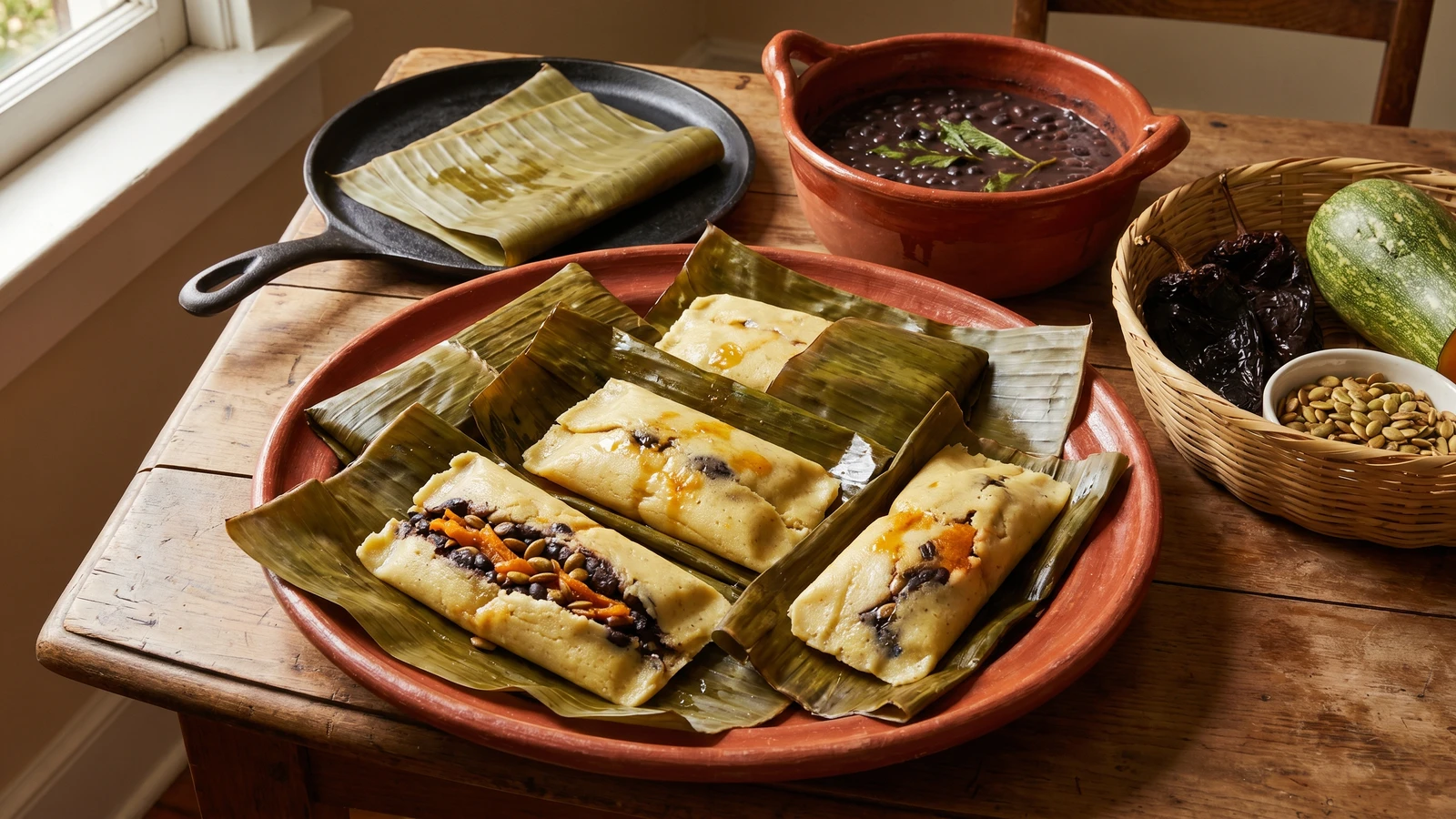
Veracruz's Totonacapan tamalitos, small banana leaf packets of soft corn masa wrapped around black beans, tender squash, epazote, and toasted pepita, made for fiesta tables beside a tray of zacahuil.
Appetizers & Snacks
Mexican
Celebration
Holiday
Make Ahead
1 hr 10 min
Active Time
2 hr 20 min cook•11 hr 30 min total
Yield24 small tamalitos, 8 servings
Veracruz, the Totonacapan around Papantla, is where these pulacles live. Not the Veracruz of the port alone, and not a generic tamal from a national buffet. Papantla sits in that humid northern stretch where vanilla vines climb, corn grows with beans and squash, and leaf-wrapped food belongs on the fiesta table beside zacahuil.
The filling tells you the geography: black beans, calabaza criolla, chile ancho, epazote, toasted pepita, and ajonjoli ground into a thick pipian. The chile ancho gives fruit and color, not a punishment of heat. Not all Mexican food is hot. The pepita gives body. The epazote keeps the beans honest. If the filling is loose, the tamal breaks. The women who taught this dish know that before they touch the masa.
I learned a Papantla version from a señora who folded the packets so flat and tight they looked measured, though she never measured anything. She used hoja de papatla when she had it and banana leaf when the market was being stubborn. She tapped the spoon against the filling and told me, seco, Lupita. Dry enough to hold. That is the instruction.
This is a 32-state cuisine. Pulacles are Veracruz, Totonacapan, Papantla. Saber cocinar es saber vivir.
Papantla belongs to Totonacapan in northern Veracruz, near El Tajin, the major Gulf Coast ceremonial city that flourished roughly between 600 and 1200 CE. Pulacles preserve the milpa base of corn, black beans, squash, chile, and squash seed, ingredients cultivated in Mesoamerica long before Spanish rule; sesame arrived after the conquest and settled into regional pipianes. In Veracruz fiesta cooking, pulacles are often made as small leaf-wrapped companions to zacahuil, the monumental tamal shared across Huasteca and Totonac communities.
The technique, the tradition, and the story behind every dish.
wiped clean, softened over flame, and cut into 8-by-10-inch rectangles
Ingredient
Quantity
dried black beanspicked over and rinsed
3/4 cup
water
5 cups, plus more for soaking
white onion for the beansleft in one piece
1/2 medium
garlic cloves for the beanspeeled
2
fresh epazote sprigs
2
kosher salt for the beans
1 teaspoon, plus more to taste
dried chile anchostemmed and seeded
2
raw hulled pumpkin seeds (pepitas)
1/2 cup
white sesame seeds (ajonjoli)
2 tablespoons
manteca de cerdo for the filling
2 tablespoons
white onion for the fillingfinely chopped
1/2 cup
garlic clove for the pipian pastepeeled
1
calabaza criolla or Mexican gray squashcut into 1/2-inch dice
1 1/2 cups
kosher salt for the filling
1/2 teaspoon
chopped fresh epazote
1 tablespoon
fresh nixtamalized corn masa for tamales
2 pounds
manteca de cerdo for the masaroom temperature
3/4 cup
warm black bean broth
1 to 1 1/4 cups
kosher salt for the masa
1 1/2 teaspoons
banana leaves or hoja de papatlawiped clean, softened over flame, and cut into 8-by-10-inch rectangles
2 large banana leaves or 24 leaf pieces
Equipment Needed
•Tamalera or deep steamer with tight lid
•Cast iron comal or heavy skillet
•Blender for the pipian paste
•Large mixing bowl or stand mixer for beating masa
•Damp kitchen towel for wiping leaves
Instructions
1
Cook the beans
Soak the black beans overnight in plenty of water. Drain them, then place them in a pot with 5 cups fresh water, the onion piece, and the 2 garlic cloves. Bring to a steady simmer and cook until the beans are tender but still whole, about 1 hour and 15 minutes. Add the epazote sprigs and 1 teaspoon salt during the last 15 minutes. The broth should taste like beans and epazote, not plain water. Reserve at least 1 3/4 cups of the broth, then drain 2 cups of beans for the filling.
If your beans are old, they will take longer. Ask at the market when they arrived. Si no conoces el mercado, no conoces la cocina.
2
Prepare the leaves
Wipe the banana leaves or hoja de papatla clean with a damp cloth. Pass each piece quickly over a gas flame or across a hot comal until the leaf darkens, turns glossy, and bends without cracking. Cut into 8-by-10-inch rectangles. Save the torn pieces for lining the steamer. Raw leaf breaks when you fold it, and then the masa leaks. No me vengas con atajos.
3
Toast the ancho and seeds
Heat a dry comal over medium. Toast the chile ancho for about 20 seconds per side, just until the skin softens and smells fruity. Do not let it blacken. Remove it to a bowl and cover with hot water for 15 minutes. On the same comal, toast the pepitas until they puff and begin to snap, then toast the sesame seeds until pale gold. Stir constantly. Burned seed tastes like old oil and it will ruin the filling.
4
Blend the pipian
Drain the softened chile ancho. Put it in the blender with the toasted pepitas, toasted sesame seeds, the single garlic clove, 3/4 cup reserved bean broth, and a pinch of salt. Blend until you have a thick, smooth paste. Do not strain it. Pulacles need the body of the ground seed. This is pipian doing its work, not a thin salsa.
5
Cook the filling
Melt 2 tablespoons manteca de cerdo in a wide skillet over medium heat. Add the chopped onion and cook until soft, not browned. Add the diced squash and 1/2 teaspoon salt, cooking until the edges just begin to soften. Stir in the 2 cups cooked black beans, the pipian paste, and the chopped epazote. Cook 8 to 10 minutes, mashing a spoonful of beans against the pan so the filling binds. It should mound on a spoon and leave a clean track when you drag the spoon through the pan. If it runs, it will break the tamal.
6
Beat the masa
In a large bowl, beat 3/4 cup room-temperature manteca de cerdo with 1 1/2 teaspoons salt until lighter and spreadable, about 3 minutes by hand or 2 minutes in a stand mixer. Add the fresh corn masa in handfuls, working it into the lard. Drizzle in 1 cup warm bean broth and beat until the dough is soft enough to spread but firm enough to hold its shape on a leaf. Add the last 1/4 cup broth only if the masa feels dry or cracks at the edges. La manteca es el sabor, and in tamales it is also the texture.
7
Fill the pulacles
Lay one leaf rectangle glossy side up. Spread about 3 tablespoons masa into a small rectangle in the center, leaving a border on all sides. Spoon 1 1/2 to 2 tablespoons filling down the middle. Fold the long sides over the filling, then fold the ends under to make a flat packet. Set seam side down. Keep the tamalitos small. Pulacles are not zacahuil. They belong beside it.
8
Steam until set
Line a tamalera or deep steamer with leaf scraps. Add water below the rack and bring it to a strong simmer. Stack the pulacles seam side down, cover them with more leaf scraps, then cover the pot tightly. Steam 55 to 65 minutes, checking the water level after 40 minutes and adding boiling water if needed. They are done when the leaf pulls away cleanly and the masa feels set but tender. Let them rest off the heat for 15 minutes before opening.
9
Serve in the leaf
Serve the pulacles warm, still partly wrapped, on a red clay platter. For a Veracruz fiesta table, set them beside zacahuil and let people take them by hand. No sour cream. No yellow cheese. These are Totonacapan tamalitos of corn, beans, squash, chile ancho, epazote, and seed. Cada estado, su propia cocina.
Chef Tips
•Hoja de papatla is what you ask for in Veracruz markets when you can find it. Outside the region, banana leaf is the practical substitute. A substitution is a compromise, not an upgrade, but banana leaf behaves correctly in the steamer.
•Use fresh nixtamalized masa from a tortilleria if you have one. Masa harina for tamales will work in a kitchen far from Mexico, but it will not have the same corn perfume. Mix 3 1/2 cups masa harina with about 2 1/4 cups warm water and let it hydrate 20 minutes before beating in the lard.
•The chile ancho is there for depth, not for fire. If someone tells you every Mexican dish has to burn, send them back to eat properly.
•Buy fresh pepitas. Old pepitas smell dusty and taste bitter once toasted. Preguntale a las señoras del mercado who sells the good seed.
•If the squash at the market is watery and tired, do not force it. Use tender calabaza criolla in season or Mexican gray squash that feels firm and heavy. Cook what the market is selling today.
Advance Preparation
•The black beans can be cooked up to 2 days ahead. Refrigerate them in their broth so the beans stay tender and the broth keeps its flavor.
•The bean, squash, and pipian filling can be made 1 day ahead. Chill it covered, then bring it close to room temperature before assembling so it spreads without tearing the masa.
•Assembled uncooked pulacles can be refrigerated overnight in a covered container. Steam them straight from the refrigerator and add 10 minutes to the cooking time.
•Cooked pulacles keep refrigerated for 4 days. Reheat them in a steamer for 15 to 20 minutes, still wrapped, so the masa softens properly.
Frequently Asked Questions
Nutrition Information
1 serving (about 235g)
Calories
580 calories
Total Fat
30 g
Saturated Fat
10 g
Trans Fat
0 g
Unsaturated Fat
19 g
Cholesterol
20 mg
Sodium
900 mg
Total Carbohydrates
67 g
Dietary Fiber
11 g
Sugars
3 g
Protein
12 g
Where cooking meets culture.
Culinary guides, cultural storytelling, and the editorial depth that makes cooking meaningful.